

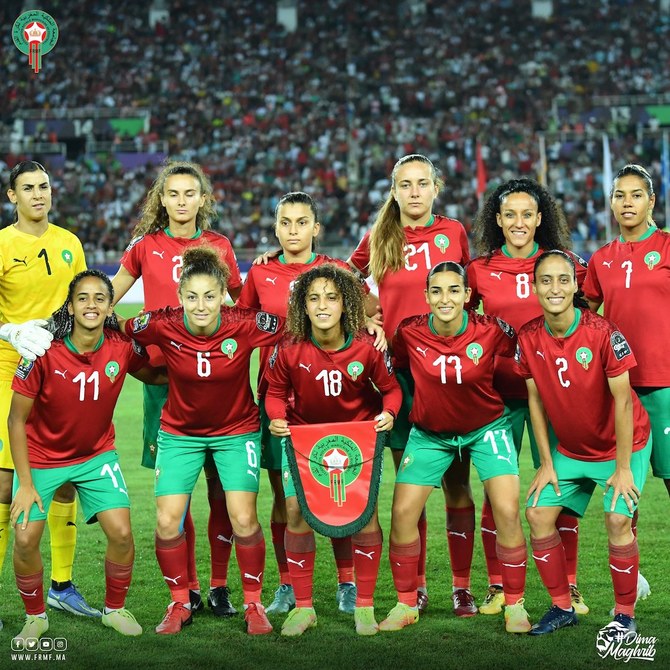

RIYADH: Morocco continued to break new ground on Monday night as they moved into the final of the Women’s Africa Cup of Nations with a dramatic and controversial win over Nigeria in Rabat.
The Atlas Lionesses had already made history by getting this far and qualifying for the 2023 Women’s World Cup, and now only South Africa in Saturday’s final stand between them and national glory.
After 120 minutes of semi-final football ended 1-1 and with Nigeria fielding nine players after receiving two red cards, Morocco won 5-4 on penalties to become the first Arab team to reach the final of the tournament.
Rosella Ayane, who plays her club football in England with Tottenham, scored the winning kick after Ifeoma Onumonu had missed.
Nigeria, continental champions in 11 out of 13 previous tournaments, came into the game as favorites and had the best of the first half. A red card for Halimatu Ayinde just four minutes into the second half after a rash tackle gave Morocco, who last appeared at this tournament in 2000, a numerical as well as home advantage and the North Africans began to pile on the pressure in front of more than 45,000 fans.
Yet it was Nigeria who took the lead just after the hour. After Onumonu’s header had come back off the post, Uchenna Kanu was on hand to open the scoring from close range. It was a short-lived lead as just four minutes later, Ayane broke down the right. Her low cross was palmed away by Chiamaka Nnadozie only for Sanaa Mssoudy to fire the rebound home.
Soon after that, it got worse for Nigeria as Rasheedat Ajibade was red carded as the Atletico Madrid forward brought down Zineb Redouani, the virtual assistant referee overturning the original yellow card.
Morocco had their chances to prevent the game from going to penalties, but the nine women of Nigeria defended resolutely and even hit the woodwork in extra-time through substitute Gift Monday.
The Super Falcons were delighted however to take the game into a shootout. When Khadija Er-Rmichi pulled off an excellent one-handed save from Onumonu then the pendulum swung in the favor of the hosts and there was huge delight when Ayane scored the final kick to take Morocco into the final.
Morocco’s coach Reynald Pedros said: “We played against a team that we knew was strong and then there are some game incidents that are in our favor. We were a bit rushed with the final passes and crosses and lacked a little fluidity but of course we are very happy with the outcome of this semi-final.”
There was plenty of controversy. It was clear that the Nigerian kick-takers not only had to deal with the pressure of a semi-final’s all-or-nothing situation, but lasers from the stands were being shone into their eyes. It was something that goalkeeper Nnadozie also had to deal with. The red cards will be debated too and there was no hiding the disappointment from the Super Falcons.
Nnadozie, who was named player of the match, said: “The whole Moroccan team know that Nigeria is a great team, so to beat us they had to distract us. They did everything they did just to distract us. Since I have been playing football, this is the worst match I have ever played in my life.
“They won but this is not winning for me. The officiating was not really okay. If they were good enough, we were nine players against 11, they would have scored and won. That is to show you how great we are.”
Such discussions about the lasers and officiating will not worry the hosts too much. Not only are they the first Arab team to get this far in the continental tournament but just by reaching the last four, they qualified for the 2023 Women’s World Cup – again the first Arab team to do so.
This could be a turning point for football in Morocco, North Africa, and the Arab world. Lifting the trophy at the weekend would be huge but appearing at the World Cup, to be co-hosted in Australia and New Zealand next summer, is also a major prize. A year of preparation, interest, investment, and excitement should take the women’s game in Morocco to the next level.
The country is already basking in the success of the Atlas Lionesses.
“It’s something incomparable when we all feel the passion of the fans in the stadium and we hear all these people supporting us, they were the 12th, 13th, and 14th man tonight. It was fantastic. We dedicate this victory to them and the spectators who all came very early to the stadium,” Pedros added.
South Africa will be another tough test but with a huge and passionate crowd again expected in Rabat, it will surely be an occasion to remember.
Pedros said: “I think South Africa are a great team and this match will be a great final. Each match is difficult. Since the start of this AFCON, there hasn’t been a team that stands out, there hasn’t been a team that has won by a wide margin. It’s hotly contested, and we saw it again today.
“We hope to have a good final and then try to win it for the country, for everyone, for the girls. But we have to get it out of our minds that it’s a final, we have to say that it’s our last game of the season and we simply have to win it.”
Morocco have already been a major success at the tournament, and Saturday should be a night to remember.


