

Saudi Arabia tells Farnborough air show of plans to become global defense powerhouse

1 / 2
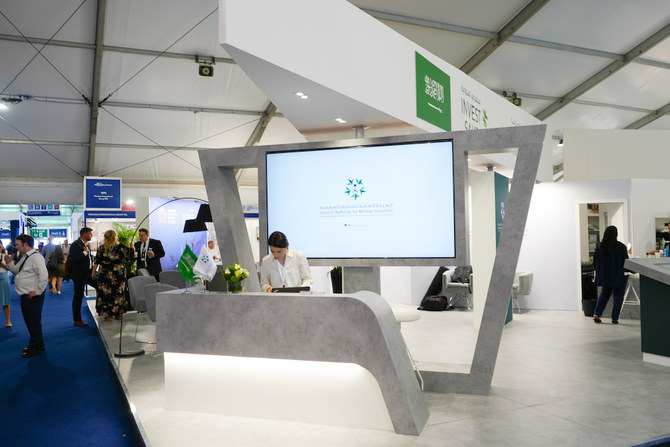
Saudi Arabia’s General Authority for Military Industries inaugurated the Saudi pavilion at Farnborough International Air Show. (Hasenin Fadhel)
2 / 2
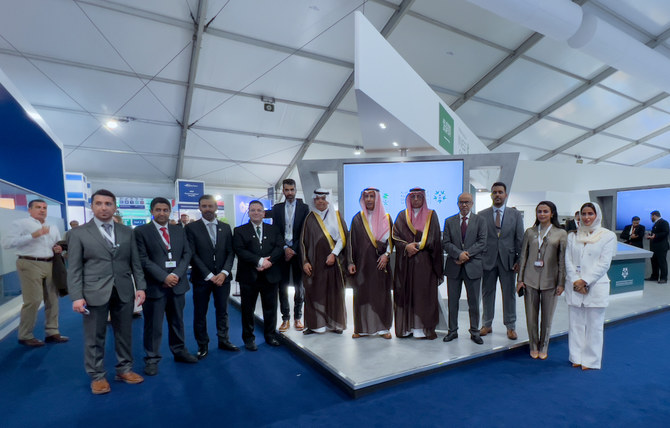
Saudi Arabia’s General Authority for Military Industries inaugurated the Saudi pavilion at Farnborough International Air Show. (Hasenin Fadhel)
Short Url
Updated 20 July 2022
Follow

Saudi Arabia tells Farnborough air show of plans to become global defense powerhouse

  • Saudi Arabia’s key defense stakeholders are attending the Farnborough International Airshow, as the Kingdom seeks to showcase its burgeoning defense industry opportunities
  • 74 opportunities worth billions of dollars for investors, says GAMI governor

FARNBOROUGH: Saudi Arabia plans to develop its nascent defense industry into a global powerhouse with a strategic mix of domestic spending on education, research and development, and significant local and foreign investment.

This plan was outlined on Monday in a statement issued by the General Authority for Military Industries’ Governor Eng. Ahmad Al-Ohali, on the opening day of the Farnborough International Air Show in the UK, which runs until July 22. GAMI’s role is to bring together key players, covering a range of areas from manufacturing to education.

Al-Ohali opened the Kingdom’s pavilion at the show. This is the first Farnborough event since 2018 because the 2020 edition was cancelled. The industry is now recovering from the pandemic that ravaged the sector.

“As one of the world’s 20 biggest economies, the Kingdom is opening itself up to international investment and on an unprecedented scale. This has been our journey since 2017 and under the guidance of Vision 2030. It is an exciting prospect for any original equipment manufacturer or any other investor around the world to become a part of this journey of transformation,” Al-Ohali stated.

“With the localization and technology development plans, supply chain program, our human capital strategy, the World Defense Show, and many other programs, Saudi Arabia will not only expand its footprint in the global defense industry, but also become a hub for innovation in defense,” he added.

“Saudi Arabia today is an investment powerhouse and our reforms over the past several years are proof that we are ready to take all necessary measures to maintain and build on the momentum,” Al-Ohali said.

With Saudi Arabia’s goal of localizing more than 50 percent of its expenditure on defense by 2030, GAMI hopes to develop its nascent industry by collaborating with different stakeholders in the defense and security sectors.

“For example, we have identified our platforms (and) localization plans, developed a robust industrial and services supply chain program, a Military Industry Human Capital program, organized the World Defense Show, and much more. None of this would have been possible if we didn’t have the support of other government stakeholders like the Ministry of Defense and other security ministries, as well as the public and private sector players such as Saudi Arabian Military Industries, and the local and international original equipment manufacturers.”

A key to this expansion has been a supply chain program that would streamline processes in manufacturing and services. “This program has shined a light on the gaps in our local supply chain, which has translated into more than 74 investment opportunities worth billions of dollars for investors all over the world.”

The organization has determined six defense segments that present opportunities for investment, including land for manufacturing; maintenance repair and overhaul fixed wing; electronics; unmanned aerial vehicles; maintenance and repair for the navy; and production of personnel equipment.

Al-Ohali added that one of the key aspects of the program has been the establishment of the Military Industry Marketplace. MIM is a digital gateway into the defense ecosystem for investors and suppliers.

“GAMI does not only determine the investment opportunities in our localization initiatives, but we also make it easier for local and global investors to find the right opportunity and the right strategic partner for them in the Kingdom. Again, these are all key components of our effort to create a healthy, strong, sustainable ecosystem,” Al-Ohali said.

When talking about the Kingdom’s components of the local defense ecosystem, Al-Ohali said it included manufacturing, services, innovation, and education.

“These are all crucial aspects of a well-developed defense sector, but they all have one thing at their absolute core: Talented and skilled human capital. No sector can fully reach its potential without access to local talent, supported by education and training. This is why we have developed a Military Industry Human Capital strategy to make sure our greatest asset, the youth of our nation, is empowered to become the future leaders and innovators of the defense sector.

“Innovation, research and technology in the defense ecosystem is vital for sustainable localization. We are working closely with the newly established General Authority for Defense development to guide the defense technology development.”

Al-Ohali said training of young people was a key component of the strategy. “One such initiative is the National Academy of Military Industries, whereby GAMI is establishing an independent academy to train, upskill, and enable the national personnel that will ultimately help us realize our localization goals.”

Meanwhile, in other developments at the show, the European airplane manufacturer Airbus and several airlines said on Monday they had signed letters of intent to buy carbon removal credits to offset the emissions from air travel.

Airbus was joined by Air Canada, Air France-KLM, EasyJet, International Airlines Group, LATAM Airlines Group, Lufthansa Group and Virgin Atlantic, who have committed to engage in “negotiations on the possible pre-purchase of verified and durable carbon removal credits starting in 2025.”

In further news, General Electric Chief Executive Larry Culp said on Monday a new “GE Aerospace” brand for its aviation business pointed to a “wider strategic aperture” that could eventually lead to the industrial giant entering new businesses.

Asked at the Farnborough Airshow if that meant a greater appetite for acquisitions as the conglomerate prepares to split into three, Culp said any changes would be “first and foremost organic, and then and only then inorganic opportunities.”

Also at the show on Monday, the head of Qatar Airways said an “epidemic” of home working has contributed to staff shortages that are being widely blamed for travel disruption in Europe this summer.

The aviation sector is struggling to secure staff needed to cope with a post-pandemic surge in air travel, prompting London’s Heathrow Airport to impose curbs on capacity to avoid delays, in a move that led to tensions with Dubai’s Emirates.

In opening the show earlier in the day, outgoing Prime Minister Boris Johnson talked about the economy and alluded to his exit from Downing Street. “This government believes in aviation and its power to bring jobs and growth to the entire country.”

“After three years in the cockpit ... I am now handing over the controls seamlessly to someone else. I don’t know who,” he added, sparking laughter from delegates.

(With Agencies)


Saudi Arabia set to lead $500bn wave of GCC debt maturities: Kamco Invest 

Updated 6 sec ago
Follow

Saudi Arabia set to lead $500bn wave of GCC debt maturities: Kamco Invest 

RIYADH: The Gulf Cooperation Council region is expected to see elevated levels of fixed-income maturities over the next five years, driven primarily by Saudi Arabia and the UAE, a new analysis showed. 

In its latest report, Kamco Invest said fixed-income maturities in Saudi Arabia are projected to total $174.5 billion between 2026 and 2030, closely followed by the UAE at $171.8 billion.  

Saudi Arabia’s debt market has recorded robust growth in recent years, attracting strong investor interest in fixed-income instruments amid a global environment of elevated interest rates. 

In October, Kuwait Financial Center — also known as Markaz — said Saudi Arabia dominated the GCC’s primary debt market in the third quarter, raising $20.32 billion through 36 issuances, a 62.7 percent year-on-year increase in value. 

“The bulk of the maturities in Saudi Arabia are for bonds and sukuk issued by the government at $106.4 billion, while in the case of the UAE, the lion’s share of maturities are for instruments issued by corporates at $136.2 billion,” said Kamco Invest. 

Over the next five years, fixed-income maturities in Qatar are expected to reach $85.6 billion, while Kuwait, Bahrain and Oman are each projected to record maturities of around $25 billion. 

Citing Bloomberg data, the report showed that GCC sovereign maturities stand at $244.8 billion over the 2026–2030 period, while corporate maturities are higher at $263.3 billion. 
 
“Both bond and sukuk maturities are expected to remain elevated starting from 2026 until 2030 and then gradually taper for the rest of the tenor. The higher maturities during the next five years reflects deficit financing issuances from GCC governments as well as investment and refinancing related issuances from the corporates,” said Kamco Invest. 

The report added that the majority of maturities are denominated in US dollars, accounting for 64.7 percent, followed by local-currency issuances in Saudi riyals and Qatari riyals at 10.6 percent and 6.3 percent, respectively. 

Owing to the strong credit profiles of GCC governments, most maturities fall within the high investment-grade category. A-rated instruments account for $208.7 billion, while total investment-grade maturities stand at $239.1 billion. 

In terms of instruments, conventional bonds dominate, with maturities of $317.6 billion over the next five years, compared with $190.5 billion for sukuk. Corporate bond maturities, at $173.4 billion, exceed government bond maturities of $144.2 billion. 
 
By sector, banks and other financial services firms account for $210.4 billion in maturities through 2030, representing 79.9 percent of total corporate maturities and 41.4 percent of overall GCC maturities. The energy sector follows with $21.8 billion, or 8.3 percent, of corporate maturities, while utilities and industrials account for $13.6 billion and $5.4 billion, respectively. 

Real estate maturities are concentrated mainly in the UAE and Saudi Arabia, at $11.2 billion and $4.3 billion, respectively, through 2030. 
 
Issuances in 2025 

Aggregate bond and sukuk issuances in the GCC reached $206.6 billion through the third week of December 2025, broadly unchanged from $206.8 billion in the same period a year earlier.

However, issuance patterns shifted markedly. Government issuances declined sharply to $77.9 billion in 2025, from $98.6 billion in 2024, while corporate issuances rose to a record $128.6 billion, up from $108.2 billion. 

In terms of type of issuances, sukuk issuances witnessed a sharp decline during 2025, whereas bond issuances showed a healthy growth. 

“Aggregate GCC bond issuances stood at $125.2 billion in 2025, the highest on record, compared to $106.2 billion during 2024, whereas sukuk issuances declined by 19.1 percent to reach $81.4 billion this year as compared to issuances of $100.6 Bn during 2024,” said Kamco Invest. 

Despite an 18.3 percent decline, Saudi Arabia remained the region’s largest fixed-income issuer, with total issuance of $82.0 billion in 2025, down from $100.3 billion the previous year. 

Issuances from Qatar fell 21.7 percent to $22.1 billion, while the UAE recorded modest growth, with total issuance rising to $64.9 billion from $63.4 billion. Kuwait posted the sharpest increase, with issuance surging to $20.5 billion from $2.6 billion in 2024 following the approval of its debt law. 
 
Green issuances 

Green-instrument issuance in the GCC rose sharply in 2025, though it remained below the record levels seen in 2023. Total green issuance reached $12.5 billion, up from $4.6 billion in 2024 but below $17.3 billion recorded in 2023. 

The UAE led the region with $5.6 billion in green issuance, compared with $3.8 billion a year earlier. Saudi Arabia followed with $5.1 billion, after recording no green issuances in 2024. 

Green sukuk are Shariah-compliant instruments designed to finance environmentally sustainable projects, including renewable energy, clean transportation and climate-resilient infrastructure. 
 
Outlook 

Kamco Invest expects higher issuance levels in 2026, particularly among GCC countries facing fiscal deficits. The UAE and Qatar are also projected to see elevated corporate issuance. 

A potential decline in interest rates could further support issuance activity, especially early in the year, as borrowers seek to lock in lower funding costs. 

“Maturity refinancing is expected to result in approximately $85.4 billion in issuances during the year, while government deficit financing led by lower average oil prices would also contribute to the overall trend during the rest of the year,” the report said.  

Based on IMF forecasts, deficit financing could result in issuance of close to $60 billion in 2026, it added.