

Chandimal powers Sri Lanka's lead past 300 in first Test

Sri Lanka's Dinesh Chandimal bats during the first day of the first test cricket match between Sri Lanka and Pakistan in Galle, Sri Lanka, on July 16, 2022. (AP)
Short Url
Updated 18 July 2022
Follow

Chandimal powers Sri Lanka's lead past 300 in first Test

  • The hosts were 329 for nine when bad light stopped play on day three
  • At close of play, Sri Lanka were leading by 333 in their second innings

GALLE, Sri Lanka: Red hot Dinesh Chandimal struck his second successive half-century to take Sri Lanka's lead past 300 and thwart the Pakistan attack on day three of the opening Test on Monday. 

The hosts were 329 for nine when bad light stopped play for the day in Galle. 

Chandimal, on 86, and Prabath Jayasuriya, on four, were batting at close of play with Sri Lanka leading by 333 in their second innings. 

Mohammad Nawaz claimed his maiden five-wicket haul and combined with fellow spinner Yasir Shah, who took three, to rattle the opposition middle-order in the second session. 

But Chandimal, who struck blazing form with his maiden double century -- 206 not out -- in his team's series-levelling Test win over Australia last week, stood firm in another lower-order show of defiance after the hosts slipped to 235-7. 

"Chandi batted so well in the first innings too. He has done what the team needs," Kusal Mendis, who hit 76, said of the veteran batsman. 

"This is a good total but if we get to that 350 mark, the bowlers will have lot of runs to play with. 

"Tomorrow I think the wicket will get even better for spinners once you get the roller on," he added. 
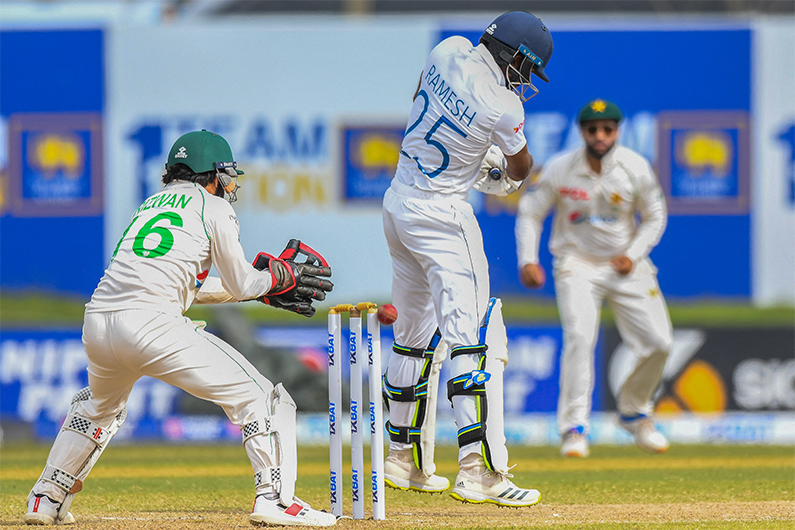


Sri Lanka's Ramesh Mendis (C,R) reacts after being dismissed as Pakistan’s wicketkeeper Mohammad Rizwan (L) watches during the third day of play of the first cricket Test match between Sri Lanka and Pakistan in Galle on July 18, 2022. (AFP)

Chandimal reached his fifty and put on 41 runs with Maheesh Theekshana for the ninth wicket in a repeat performance from the hosts, who had hit back from 133-8 to post 222 in their first innings. 

Earlier Kusal and opener Oshada Fernando scored 64 and put on a key third-wicket stand of 91 to fight back after an early wicket in the morning session. 

Oshada reached his sixth Test fifty in the first session but fell to Yasir on the second ball after lunch. 

Kusal raised his fifty and took on the opposition attack with a few boundaries before Yasir bowled him with an unplayable delivery that pitched outside leg and turned to hit the top of off stump. 

Nawaz, who is making a Test comeback after nearly six years and playing his fourth five-day match, kept chipping away and got key wickets including Angelo Mathews and Niroshan Dickwella. 

"It's every bowler's dream to get a five-for in Test cricket and the same goes for me," Nawaz, who previously played just three Tests in his team's 2016 West Indies tour, told reporters. 

"I just concentrated on transferring my preparation from the nets to execute it in the middle and keep my basics right. We needed to bowl well, especially on this pitch." 

Nawaz, an all-rounder who bats left-handed, hoped the target would not be much more than the current total, adding that would be "achievable" with two or three good partnerships. 

He got nightwatchman Kasun Rajitha on the third ball of the day to set things rolling for Pakistan, but the Sri Lankan batsmen kept coming back on a pitch that is expected to offer more turn to the spinners come day four. 

In a keenly contested match of tail end fights, Pakistan had also hit back to post 218, riding on skipper Babar Azam's 119 as he batted with his own lower order on day two. 


Pakistan highlights Gwadar transshipment role as shipping routes face disruption over regional tensions

Updated 7 sec ago
Follow

Pakistan highlights Gwadar transshipment role as shipping routes face disruption over regional tensions

  • Pakistani ports possess “untapped potential” to attract global shipping lines for transshipment operations, says minister
  • Pakistan eyes leveraging Gwadar as regional transshipment hub as Iran’s closure of Strait of Hormuz disrupts global maritime trade

KARACHI: Pakistan’s Maritime Affairs Minister Junaid Anwar Chaudhry on Thursday highlighted the importance of the port city of Gwadar’s transshipment role as major shipping routes, including the Strait of Hormuz, face disruption due to Iran’s ongoing conflict with the US and Israel in the Gulf. 

The meeting takes place as Iran has effectively closed the Strait of Hormuz, a strategic waterway that lies between it and Oman. It is one of the world’s most critical oil transit routes, with roughly 20 percent of global oil supplies passing through it. Iran has vowed it will attack any ship that enters the strait, causing energy prices to rise sharply on Monday amid disruptions to tanker traffic in the waterway.

Gwadar is a deep-sea port in Pakistan’s southwestern Balochistan province that lies close to the Strait of Hormuz. Pakistani officials have in the past highlighted Gwadar’s geostrategic position as the shortest trade route to the Gulf and Central Asia, stressing that it has the potential to become a regional transshipment hub.

Chaudhry chaired a high-level meeting of government officials to assess emerging logistical challenges facing Pakistan’s trade, particularly in the energy sector, amid tensions in the Gulf. 

“Special focus was placed on fully leveraging the potential of Gwadar Port as a regional transshipment hub and positioning it as an alternative of regional instability,” Pakistan’s maritime affairs ministry said in a statement. 

The minister said Pakistani ports possessed “significant untapped potential” to attract international shipping lines for transshipment operations, noting that it could also ensure long-term sustainability and growth of the country’s maritime sector.

Participants of the meeting discussed measures to strengthen Pakistan’s position as a viable alternative transit and transshipment destination, as key waterways are affected by the disruption. 

The committee also reviewed proposals to amend relevant rules and regulations to facilitate international transshipment operations through on-dock and off-dock terminals.

The chairmen of the Port Qasim Authority, Karachi Port Trust and Gwadar Port Authority attended the meeting, briefing committee members on the current operational readiness of their ports. They spoke about the available capacity for container transshipment, bulk cargo handling and refueling services at Pakistani ports. 

The port in Gwadar is a central part of the China-Pakistan Economic Corridor (CPEC), under which Beijing has funneled tens of billions of dollars into massive transport, energy and infrastructure projects in Pakistan.

Pakistan has long eyed the deep-sea port as a key asset that can help boost its trade with Central Asian states, the Gulf region and ensure the country earns valuable foreign exchange.