

Sri Lanka declares state of emergency ahead of vote for new president

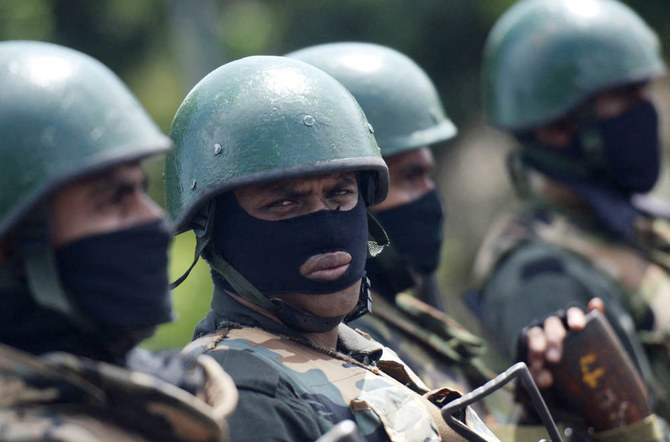
Army cadets stand guard in front of Sri Lankan parliament building in Colombo on July 16, 2022. (AFP)
Short Url
Updated 18 July 2022
Follow

Sri Lanka declares state of emergency ahead of vote for new president

  • Parliament expected to decide new leader on Wednesday
  • Protesters continue to demand acting president’s resignation

COLOMBO: Sri Lanka’s acting President Ranil Wickremesinghe has declared a state of emergency that went into effect on Monday, as the interim government seeks to quell unrest ahead of a vote in parliament later this week to elect a new leader.

The island nation of 22 million people has suffered through shortages of essentials and days-long fuel queues for months, while foreign exchange reserves dwindled close to zero and headline inflation hit 54.6 percent in June.

Wickremesinghe was sworn in as interim president on Friday after his predecessor, Gotabaya Rajapaksa, fled abroad last week after resigning following months-long mass protests over the country’s economic meltdown.

The Sri Lankan Parliament convened on Saturday to begin the process of electing a new leader who will serve the rest of Rajapaksa’s term. Nominations for the election will be heard on July 19, and a vote is expected to take place the next day.

The acting president ordered the state of emergency “in the interest of public security, the protection of public order and the maintenance of supplies and services essential to the life of the community,” an official notice said.

“There were elements within society who were attempting to disrupt the peace in the country,” Wickremesinghe said in a televised statement on Monday. “They would be prohibited from disrupting the country’s progress.”

The government will engage “peaceful protesters who had legitimate concerns” and work with them to find solutions, he added.

Wickremesinghe’s move to impose an emergency comes as protests demanding his resignation continued in different parts of the country. Previous emergency regulations have been used to deploy the military to arrest and detain people, as well as dampen public protests.

“The current declaration of emergency rule is to merely protect (the government) from the people and deny people of their democratic rights,” Dr. Ruvaiz Haniffa, social activist and former president of the Sri Lanka Medical Association, told Arab News.

“Why does it have to use an emergency as a punitive measure against the people it’s supposed to serve unless it is aware that it has not and is not delivering the service the people expect?”

Namal Jayaweera, one of the protest leaders, said that Wickremesinghe was appointed as premier to safeguard the interest of the Rajapaksas, whose family dynasty ruled over Sri Lankan politics for more than 20 years.

Wickremesinghe was named prime minister only in May, after Gotabaya’s elder brother, Mahinda Rajapaksa, stepped down from the position following violent clashes between protesters and supporters of the ruling party in Colombo.

“When he came on as prime minister he said his first priority was to give three meals, get petrol and gas, and power to the people,” Jayaweera told Arab News. “He has failed and could not keep his promises.”

“We will continue the fight until Ranil is also ousted, as we see him as a dealmaker and protector of the Rajapaksa regime.”


94 million need cataract surgery, but access lacking: WHO

A Somali patient undergoes free cataract surgery at Al Nuur eye Hospital in Mogadishu, on February 16, 2015. (AFP)
Updated 11 February 2026
Follow

94 million need cataract surgery, but access lacking: WHO

  • Of the 94 million affected, fewer than 20 percent are blind, while the rest suffer from impaired vision

GENEVA: More than 94 million people suffer from cataracts, but half of them do not have access to the surgery needed to fix it, the World Health Organization said Wednesday.
Cataracts — the clouding of the eye’s lens that causes blurred vision and can lead to blindness — are on the rise as populations get older, with age being the main risk factor.
“Cataract surgery — a simple, 15-minute procedure — is one of the most cost-effective medical procedures, providing immediate and lasting restoration of sight,” the WHO said.
It is one of the most frequently performed surgeries undertaken in high-income countries.
However, “half of the world’s population in need of cataract surgery don’t have access to it,” said Stuart Keel, the UN health agency’s technical lead for eye care.
The situation is worst in the WHO’s Africa region, where three in four people needing cataract surgery remain untreated.
In Kenya, at the current rate, 77 percent of people needing cataract surgery are likely to die with their cataract blindness or vision impairment, said Keel.
Across all regions, women consistently experience lower access to care than men.
Of the 94 million affected, fewer than 20 percent are blind, while the rest suffer from impaired vision.

- 2030 vision -

The WHO said that over the past two decades, global cataract surgery coverage had increased by 15 percent.

In 2021, WHO member states set a target of a 30-percent increase by 2030.
However, current modelling predicts that cataract surgery coverage will rise by only about 8.4 percent this decade.
To close the gap, the WHO urged countries to integrate eye examinations into primary health care and invest in the required surgical equipment.
States should also expand the eye-care workforce, training surgeons in a standardised manner and then distributing them throughout the country, notably outside major cities.
The WHO was on Wednesday launching new guidance for countries on how to provide quality cataract surgery services.
It will also issue guidance to help support workforce development.
Keel said the main issue was capacity and financing.
“We do need money invested to get rid of this backlog, which is nearly 100 million people,” he told a press conference.
While age is the primary risk factor for cataracts, others include prolonged UV-B light exposure, tobacco use, prolonged corticosteroid use and diabetes.
Keel urged people to keep up regular eye checks as they get older, with most problems able to be either prevented or diagnosed and treated.
The cost of the new lens that goes inside the eye can be under $100.
However, out-of-pocket costs can be higher when not covered by health insurance.
“Cataract surgery is one of the most powerful tools we have to restore vision and transform lives,” said Devora Kestel, head of the WHO’s noncommunicable diseases and mental health department.
“When people regain their sight, they regain independence, dignity, and opportunity.”