

Yemen’s Houthis ‘will not extend UN-brokered truce’

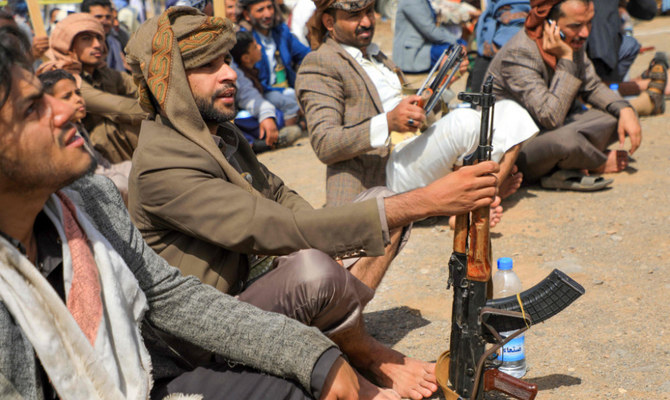
The Iran-backed Houthis said that they would not renew the UN-brokered truce in Yemen. (AFP)
Short Url
Updated 17 July 2022
Follow

Yemen’s Houthis ‘will not extend UN-brokered truce’

  • Cease-fire suffered a major blow after Iran-backed militia refused to open main roads in Taiz

AL-MUKALLA: The Iran-backed Houthis said that they would not renew the UN-brokered truce in Yemen, slamming international calls, mainly from US President Joe Biden, to the movement to adhere to the truce and open roads in the besieged city of Taiz.

The movement’s Supreme Political Council blasted the outcomes of Biden’s visit to the region that called them to strengthen the truce, claiming that the calls “affect the sovereignty, security and stability of Yemen,” and pledged not to extend the truce.

“The SPC deplored the talk about understandings about extending the truce, stressing that the truce, which the side of the aggression did not abide by the implementation of its terms, represented a shocking and disappointing experience that cannot be repeated in the future,” the movement said in a statement carried by their official media. 

The joint Saudi and American statement that came out on Saturday after the US president’s meeting with Saudi officials called on the Houthis to implement all of the truce’s terms, including ending their siege of Taiz, Yemen’s third largest city, stressing that the truce has achieved “the longest period of peace in Yemen in six years.”

Other American officials such as US Secretary of State Antony Blinken also asked the Houthis to respect the truce and open roads in Taiz and the other provinces.

In addition to saying they were not going to extend the truce, the Houthis responded to the calls by threatening to launch deadly attacks across Yemen, mainly in the central province of Marib, to break what they call “the blockade” and seize control of oil, gas and electricity facilities in Marib.

“To Biden, our country will not be left under siege and occupation. Our oil and gas resources will not be left in the hands of thieves and corrupt people,” Hussein Al-Ezzi, a Houthi leader, said on Twitter. 

The UN-brokered truce came into effect on April 2 and was renewed for another two months in June.

The truce has led to a significant reduction in violence and allowed the resumption of commercial flights from Sanaa airport and fuel ships to Hodeidah port.

The truce suffered a major blow after the Houthis refused to open main roads in Taiz and alternately suggested opening a small and old road into the city, a proposal that was rejected by the Yemeni government.

Yemen army generals believe that sporadic attacks by the Houthis and their repositioning and mobilization of forces and military equipment outside key cities such as Marib and Taiz show that they are preparing for new military operations when the truce expires.

Yemen’s army has said that eight soldiers were killed and nine others wounded in Houthi attacks, accusing the Houthis of committing 188 violations during the past three days in Hodeidah, Taiz, Marib and Hajjah.

Yemen’s Foreign Minister Ahmed Awadh bin Mubarak said that he discussed with the US Yemen envoy Tim Lenderking on Sunday achieving peace in Yemen and ending the Houthi siege on the city of Taiz.

“I reiterated the centrality of the besieged #Taiz issue. I explained that Taiz can’t be left behind and the #Houthis must end their atrocities against the populated city,” the Yemeni minister tweeted.

Tunisia’s famed blue-and-white village threatened after record rains

Updated 57 min 37 sec ago
Follow

Tunisia’s famed blue-and-white village threatened after record rains

  • The one-time home of French philosopher Michel Foucault and writer Andre Gide, the village is protected under Tunisian preservation law, pending a UNESCO decision on its bid for World Heritage status

SIDI BOU SAID, Tunisia: Perched on a hill overlooking Carthage, Tunisia’s famed blue-and-white village of Sidi Bou Said now faces the threat of landslides, after record rainfall tore through parts of its slopes.
Last week, Tunisia saw its heaviest downpour in more than 70 years. The storm killed at least five people, with others still missing.
Narrow streets of this village north of Tunis — famed for its pink bougainvillea and studded wooden doors — were cut off by fallen trees, rocks and thick clay. Even more worryingly for residents, parts of the hillside have broken loose.
“The situation is delicate” and “requires urgent intervention,” Mounir Riabi, the regional director of civil defense in Tunis, recently told AFP.
“Some homes are threatened by imminent danger,” he said.
Authorities have banned heavy vehicles from driving into the village and ordered some businesses and institutions to close, such as the Ennejma Ezzahra museum.

- Scared -

Fifty-year-old Maya, who did not give her full name, said she was forced to leave her century-old family villa after the storm.
“Everything happened very fast,” she recalled. “I was with my mother and, suddenly, extremely violent torrents poured down.”
“I saw a mass of mud rushing toward the house, then the electricity cut off. I was really scared.”
Her Moorish-style villa sustained significant damage.
One worker on site, Said Ben Farhat, said waterlogged earth sliding from the hillside destroyed part of a kitchen wall.
“Another rainstorm and it will be a catastrophe,” he said.
Shop owners said the ban on heavy vehicles was another blow to their businesses, as they usually rely on tourist buses to bring in traffic.
When President Kais Saied visited the village on Wednesday, vendors were heard shouting: “We want to work.”
One trader, Mohamed Fedi, told AFP afterwards there were “no more customers.”
“We have closed shop,” he said, adding that the shops provide a livelihood to some 200 families.

- Highly unstable -

Beyond its famous architecture, the village also bears historical and spiritual significance.
The village was named after a 12th-century Sufi saint, Abu Said Al-Baji, who had established a religious center there. His shrine still sits atop the hill.
The one-time home of French philosopher Michel Foucault and writer Andre Gide, the village is protected under Tunisian preservation law, pending a UNESCO decision on its bid for World Heritage status.
Experts say solutions to help preserve Sidi Bou Said could include restricting new development, building more retaining walls and improving drainage to prevent runoff from accumulating.
Chokri Yaich, a geologist speaking to Tunisian radio Mosaique FM, said climate change has made protecting the hill increasingly urgent, warning of more storms like last week’s.
The hill’s clay-rich soil loses up to two thirds of its cohesion when saturated with water, making it highly unstable, Yaich explained.
He also pointed to marine erosion and the growing weight of urbanization, saying that construction had increased by about 40 percent over the past three decades.
For now, authorities have yet to announce a protection plan, leaving home and shop owners anxious, as the weather remains unpredictable.