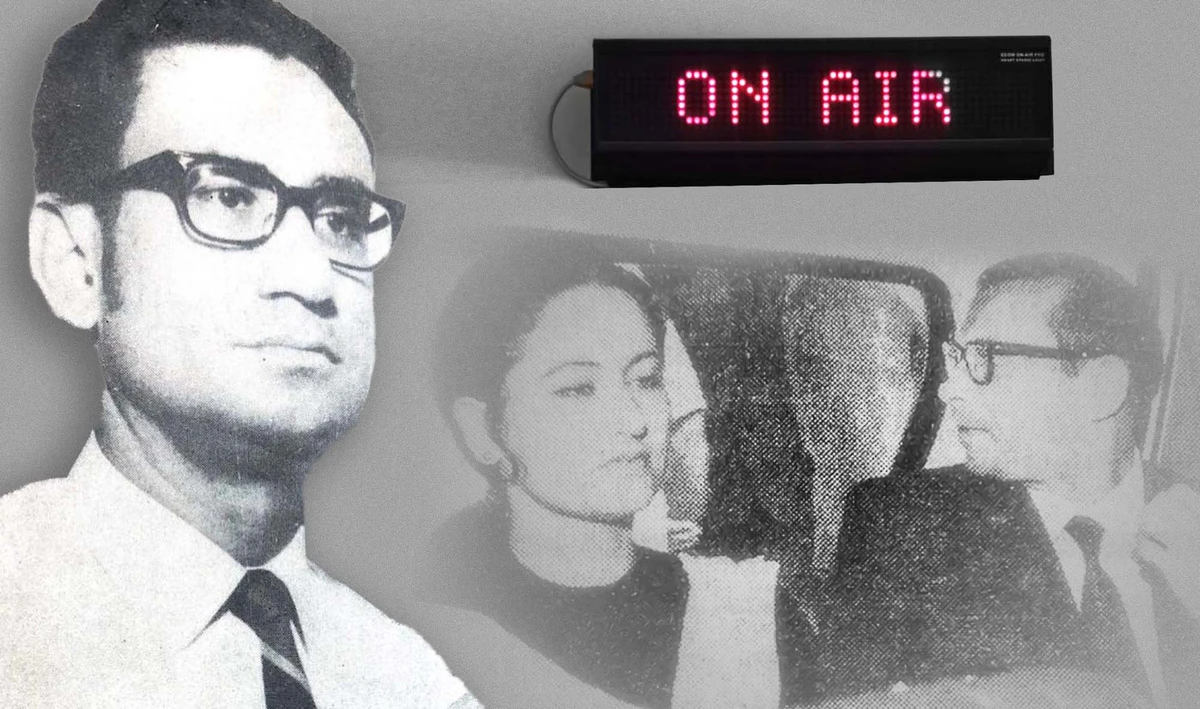
- Mustafa Zaidi’s death in 1970 made international headlines as ‘Pakistan’s first jet set murder’
- Journalists Saba Imtiaz and Tooba Masood started investigating the unsolved case three years ago
KARACHI: In a first for Pakistan, two journalists are hosting a true-crime podcast in which they are trying to re-examine the mystery of the death of well-known poet Mustafa Zaidi, which for over 50 years has remained unsolved.
The poet, a civil servant, was found dead on Oct. 13, 1970, at his residence in Karachi. He was 40. His death made international headlines, even more so as his lover and the subject of several poems, Shahnaz Gul, was found unconscious beside him.

The Associated Press at the time referred to the case as “Pakistan’s first jet set murder.” Many theories have emerged about Zaidi’s untimely death, with some citing suicide, and some poisoning. But no one knows for sure and in the absence of evidence, the main suspect, Gul, was acquitted due to lack of evidence.

Three years ago, journalists Saba Imtiaz and Tooba Masood started investigating the case.
“We approached this very much like journalists approach investigation. In this case, it is quite hard because everything happened 50 plus years ago,” Imtiaz told Arab News. “Because it happened long ago, a lot of the people we wanted to talk to are dead. The biggest challenge was trying to find enough witnesses and people.”
To share their findings, the journalists decided to create “Notes on a Scandal.”
“We felt, the best way to tell our story is through a podcast,” Masood said, adding that they were sure it would appeal to different age groups. “My ex-students, colleagues, people of parents’ age are all listening to it. Some even recall they were there at that time.”
And the podcast has found an audience not only in Pakistan, but also abroad.
“There is a huge Pakistani diaspora which is interested in all of the things that are in the podcast,” Imtiaz said. “There is a huge chunk of young people interested in Urdu poetry and particularly in Mustafa Zaidi. There is a huge amount of interest in him as a poet and as a civil servant. He just himself has a big audience as well who come with a lot of specific expectations of what they want from a Mustafa Zaidi show.”
The first season of “Notes on a Scandal” consists of eight episodes and was launched on Google, Apple and Spotify in December last year. It takes listeners through the case, introduces key characters, their relationships, and traces the events leading to Zaidi’s death.

As Imtiaz and Masood are preparing to release its second season in the next few weeks, they promise to examine the trial of Gul, and to focus on how the Pakistani media covered it at the time.
“There is also a forensic investigation to this, how Shehnaz Gul becomes the central figure for all of this,” Imtiaz said.
The investigation and podcast have already attracted much attention in the media world.
“The approach is interesting, it is very conversational which is what a podcast should be, actually. There is a lot of poetry reading which I love,” Amber Rahim Shamsi, journalist and TV anchor, told Arab News. “We need more podcasts like Tooba and Saba’s that really reflect society and politics in whatever era those crimes happen. We need more interesting stories from Pakistan’s history and past and present told in this manner.”
For author Kamran Asdar Ali, who has been investigating the case as well, what Imtiaz and Masood did was “amazing.”
“The kind of research they have done brings alive a particular moment,” he said. “The way they sort of assembled the different episodes brought a movement in Pakistan — cultural history, social history, intellectual history — and different personalities and what Karachi was like.”
Ahmer Naqvi, culture writer and content creator, found the podcast “well researched snapshots into a moment of Pakistani history.”
“Two really good journalists who have taken both a topic that is very fascinating but also an era that really captures the imagination of a certain segment of Pakistani society,” he said. “And in doing so perhaps also feels to see it more honestly and properly and I think that’s something that was really great in this podcast.”
The material Imtiaz and Masood have been gathering for their research is planned to eventually become a book. Under the working title “Society Girl: A Tale of Sex, Lies and Scandal in Pakistan,” parts of it have already been published in the winter 2022 issue of The American Scholar quarterly literary magazine of the Phi Beta Kappa Society.