

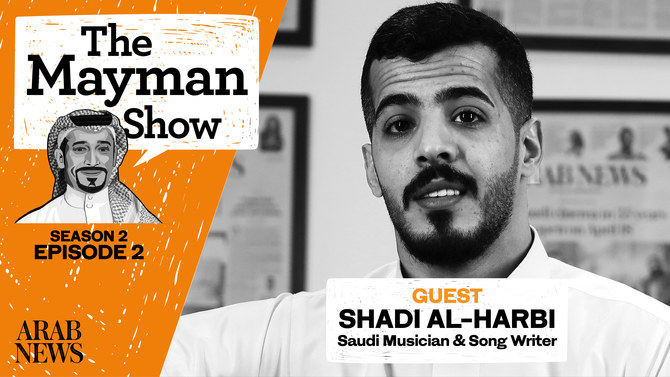

RIYADH: Saudi Arabian songwriter and musician Shadi Al-Harbi thinks the Kingdom’s Vision 2030 has enabled artists and creatives to achieve their dreams.
Al-Harbi told the “Mayman Show” the last couple of years had been beneficial to him, and that other rising stars in Saudi Arabia would also agree.
“The way that (the entertainment) industry is moving currently, it’s enabling us to promote ourselves as artists in so many ways that we just couldn’t (in the) last decade,” he said.
The musician added that beforehand, nobody would look at you as an artist or give you an opportunity to be on stage unless you were already an established singer.
“These days, I mean, every weekend a singer pops out of nowhere; I don’t think on planet Earth there is (another) government that supports the talented people in its country — only in Saudi Arabia you will find this,” he said.
“I’ve looked all around the world; not a country does this. No government does this. They get involved here — in Saudi Arabia — they get involved with the talented people. They help them,” he continued. “They support and they give them the venue and platform to basically get exposure. So my point is, if you’re a singer, artist, a talented person, no matter what you do: If you don’t make it these years, I mean, I don’t know when (you will).”
The Saudi artist from Al-Khabra in Al-Qassim loves exploring other cultures and learning how to hone his skills on various musical instruments. He is particularly fond of Japanese and Chinese influences.
Commenting on Japanese music, Al-Harbi said: “It’s ninja stuff, that’s why I love Hirajoshi, green tea, this kind of stuff.”
He added that Chinese musicians use the same scale as the Sudanese do in their music.
“It’s an opportunity to learn something new. I would never reject that. It’s soothing, it’s relaxing music and, I don’t know man, I love it,” he said.
Al-Harbi, who has dabbled with Jazz, Blues, Country, and Rock (he is a huge fan of AC/DC’s song “Whole Lotta Rosie”) is currently working on Turkish/Saudi fusion music. “It’s like, we mix the Turkish music into Saudi music. We’re using musical instruments, Turkish musical instruments and playing Saudi music on it. Also, we’re using the Saudi (instruments), like (the) oud. I (have) got a percussionist who is playing along with me, so he’s making the Saudi beat using Turkish instruments.”
Al-Harbi’s music has transcended cultures, and he has followers from all over the world including in the US and the UAE, where he has performed live.
The musician took the initiative when he was younger, and learned how to play musical instruments on his own without a teacher. “I started playing oud, yeah and that was self-taught. All of them, oud, guitar, piano, and sazi — some people call it bozuk in Turkish,” he said.
Watch all episodes of the Mayman Show here: www.arabnews.com/maymanshow


