Pakistan starts flight operations for return of over 83,000 Hajj pilgrims

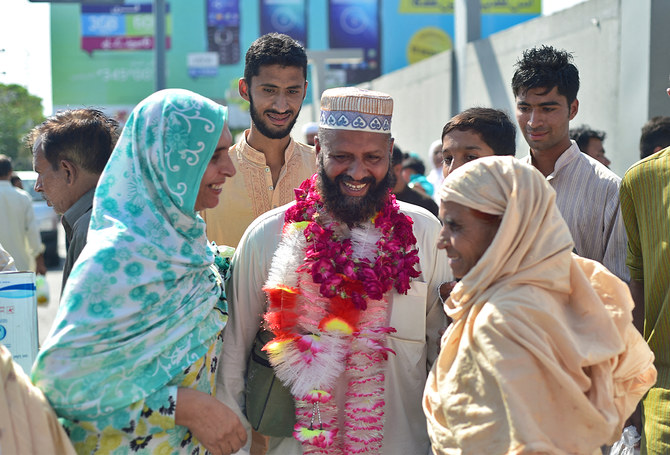
A Pakistani Hajj pilgrim meets relatives outside the airport upon his return home in Islamabad, Pakistan, on October 3, 2015. (AFP/File)
Short Url
Updated 14 July 2022
Follow

Pakistan starts flight operations for return of over 83,000 Hajj pilgrims

  • Pakistan’s national airline to operate over 154 flights till August 13
  • Up to one million pilgrims performed Hajj this year 

ISLAMABAD: Pakistan will begin its post-Hajj flight operations to bring back over 83,000 pilgrims from Saudi Arabia from today, Thursday, confirmed the spokesperson of the country’s national airline. 

Up to one million pilgrims from all parts of the world performed the annual Islamic pilgrimage, Hajj, after Saudi Arabia lifted coronavirus restrictions for the first time in two years. 

Pilgrims were required to be vaccinated and under 65 years of age. 

The kingdom allotted Pakistan a quota of 83,132 pilgrims this year out of which 34,453 availed the government’s Hajj scheme while over 48,000 performed Hajj through private operators. 

“The Pakistan International Airlines (PIA) post-Hajj flight operation starts on July 14,” Abdullah Hafeez Khan, spokesperson of Pakistan’s national airline PIA, told Arab News. “PIA will bring back over 28,000 pilgrims to Pakistan in more than 154 post-Hajj flights,” he added. 

Of these 28,000 pilgrims, Khan said 17,200 had availed the government’s Hajj scheme while 10,800 had gone on the pilgrimage through private operators. He said PIA’s post-Hajj flight operation will conclude on August 13. 

Pilgrims who performed the Hajj through the government scheme would be facilitated with their boarding cards and baggage before arriving at the airport, Khan said. 

“We have started a city check-in facility for the first time in both Makkah and Madinah. Their [pilgrims] boarding cards and luggage check-in will be done at their residence in groups with the help of the Hajj mission officials,” he said. 

Khan said the facility would save a lot of time for pilgrims, who previously had to arrive at the airport 12 hours before their flights departed. 

Pilgrims who went to the kingdom on the government’s Hajj scheme will arrive in Pakistan from Friday, confirmed Muhammad Umar Butt, a spokesperson of Pakistan’s religious affairs ministry. 

 “The process of the return of pilgrims under the government scheme will start from July 15 with the two Airblue flights that will carry a total of 414 pilgrims from Jeddah to Multan and Lahore,” he told Arab News. 

 He said that 134 flights of PIA, Airblue, Serene Air, and Saudi Airlines will take part in the post-Hajj flights operation for pilgrims who went to the kingdom on the government’s scheme. 

 The departure of pilgrims from Makkah to Madinah will begin on July 17, he said, while the first Hajj flight from Madinah to Pakistan will start on July 25. 

 “A total of 17,000 pilgrims will come back from Madinah while another 17,000 will return from Makkah,” Butt added. 


Pakistan urges equal application of international law, flags Indus treaty at UN debate

Updated 4 sec ago
Follow

Pakistan urges equal application of international law, flags Indus treaty at UN debate

  • Pakistani envoy says silence over violations of international law are fueling conflicts from South Asia to Gaza
  • He urges the UN secretary-general to use the Charter’s preventive tools more proactively to help avert conflicts

ISLAMABAD: Pakistan’s UN ambassador on Monday called for equal application of international law in resolving global conflicts, warning that India’s decision to hold the 1960 Indus Waters Treaty in abeyance and the unresolved dispute over Kashmir continued to threaten stability in South Asia.

Speaking at an open debate of the UN Security Council on “Leadership for Peace,” Ambassador Asim Iftikhar Ahmad said selective enforcement of international law and silence in the face of violations were fueling conflicts worldwide, undermining confidence in multilateral institutions.

His remarks come months after a brief but intense military escalation between India and Pakistan in May, following a gun attack on tourists in Indian-administered Kashmir. India blamed the attack on Pakistan, a charge Islamabad denied while calling for a transparent international probe.

The attack triggered a military standoff between the two South Asian nuclear neighbors and prompted New Delhi to suspend the World Bank-brokered Indus Waters Treaty, a move Pakistan says has no basis in international law and has described as “an act of war.”

“India’s unilateral suspension of the Indus Waters Treaty — a rare and enduring example of successful diplomacy — is yet another blatant breach of international obligations that undermines regional stability and endangers the lives and livelihoods of millions,” Ahmad told the council.

He said Jammu and Kashmir remained one of the oldest unresolved disputes on the Security Council’s agenda and required a just settlement in line with UN resolutions and the wishes of the Kashmiri people, a position India has long rejected.

Ahmad broadened his remarks to global conflicts, citing Gaza, Ukraine, Sudan and other crises, and said peace could not be sustained through “selective application of international law” or by sidelining the United Nations when violations occur.

The Pakistani envoy also referred to the Pact for the Future, a political declaration adopted by UN member states this year aimed at strengthening multilateral cooperation, accelerating progress toward the 2030 development goals and reforming global governance institutions.

While welcoming the pact, Ahmad warned that words alone would not deliver peace, pointing to widening development financing gaps, rising debt distress and climate shocks that he said were reversing development gains across much of the Global South.

He called for a stronger and more proactive role for the UN Secretary-General, including earlier use of preventive tools under the UN Charter, and urged the Security Council to demonstrate credibility through consistency, conflict prevention and greater respect for international court rulings.

“No nation can secure peace alone,” Ahmad said. “It is a collective endeavor, requiring leadership, cooperation and genuine multilateralism.”