


RIYADH: Saudi Arabia and France share an ancient diplomatic relationship dating back to 1839, with the opening of the first French diplomatic post in the Arabian Peninsula.
The ties thrived over time, eventually encompassing all aspects of bilateral cooperation on trade, cultural, educational and political agreements.
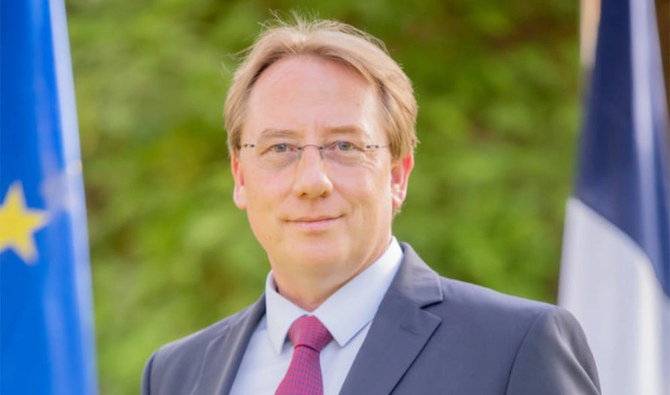
Celebrating Bastille Day, Arab News en Francais met with French Ambassador to Saudi Arabia Ludovic Pouille to discuss the Global Strategic Partnership between the Kingdom and France as well as the ambassador’s aspirations in the country.
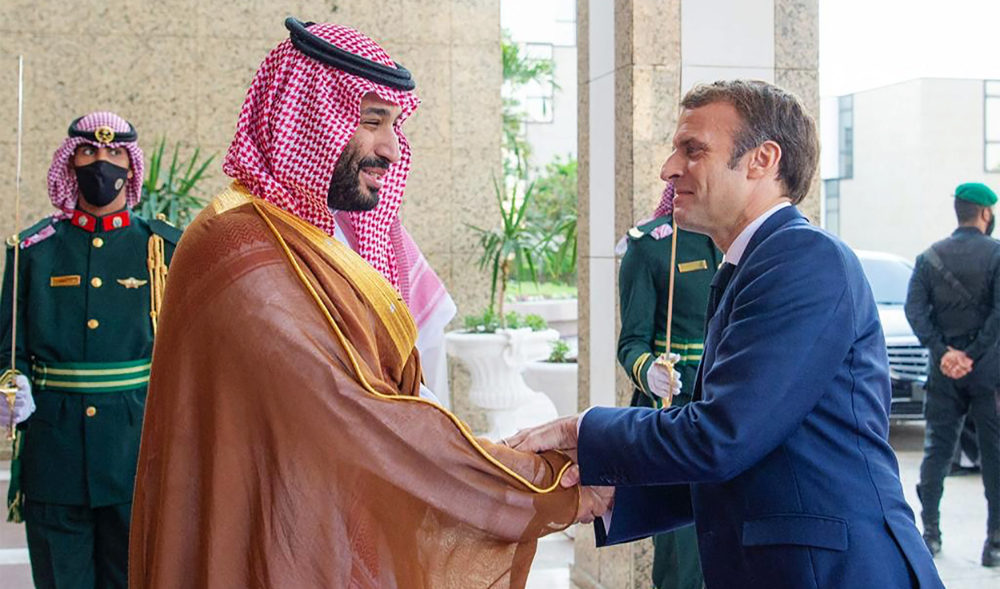
Saudi Crown Prince Mohammed bin Salman receives French President Emmanuel Macron in Jeddah on Dec. 4, 2021. Saudi Arabia and France share a historic relationship dating back to 1839. (AFP)
Regarding cultural cooperation between the two states, the ambassador told Arab News: “Since the intergovernmental agreement signed during Crown Prince Mohammed bin Salman’s visit to Paris in 2018, the project of AlUla has been a remarkable medium of cooperation between the two countries in all fields, most notably tourism, culture and heritage.”
The aforementioned visit took Franco-Saudi relations to another level, during which an emblematic bilateral agreement for the development of interconnected urban centers and cultural and tourism institutions in the AlUla region and around the Mada’in Saleh Nabataean archaeological site was born.
We wish to promote the excellence and know-how of our institutions to the Saudis, especially with regard to the production of events, the presentation of artists and their works, the training and the opening of art schools.
Ludovic Pouille, French Ambassador to Saudi Arabia
“Archaeology is a historical key player in this cooperation. In 2002, the very first Franco-Saudi archaeological excavation, led by the French archaeologist Laila Nehme, was launched in Mada’in Saleh. This year we celebrate the 20th anniversary of this cooperation, which has expanded with no less than 16 Franco-Saudi archaeological missions in the Kingdom,” said Pouille, adding that this partnership will continue to progress with the upcoming construction of Villa Hegra, a cultural complex dedicated to contemporary art in AlUla.
The ambassador said he was proud to have participated in the opening of a branch of the Alliance Française in AlUla in November 2021, and believes it will bring together the Saudi and French speaking communities.
Cultural and artistic cooperation, already deep rooted, is constantly developing and blooming. June 2022 has witnessed the first edition of the music festival in Diriyah, organized by the Embassy of France in Saudi Arabia.
“Similarly, Mohammed Abdo’s concert in Paris on July 22nd will be an opportunity to introduce the traditional Saudi songs to the French public” he said, adding that these events promote the rapprochement of peoples and intercultural dialogue because they create bridges between cultures.
“France is the forerunner in several sectors, such as cinema, music, culinary arts, video games and the performing arts,” Pouille said. “We wish to promote the excellence and know-how of our institutions to the Saudis, especially with regard to the production of events, the presentation of artists and their works, the training and the opening of art schools. We have a lot to do together.”
Despite the lion’s share of cultural programs, the growth in Franco-Saudi relations is not limited to that. Sports cooperation between France and Saudi Arabia is developing rapidly.
The French ambassador does not hide his avid support for Al-Hilal Saudi Football Club. He told Arab News that several agreements have been signed in recent years by the Saudi Ministry of Sports and various French entities, especially with the French Football Federation, the National Institute of Sport and Performance and the French Handball Federation.
Several football training centers for Saudi youth are being developed in the Kingdom, in collaboration with the FFF, but that is not all. “French players specializing in the organization of sports competitions have excelled in recent years on the Saudi scene,” Pouille said.
“The first thing that comes to my mind is the Rally Dakar, organized since 2020 in Saudi Arabia by Amaury Sports Organization, which is a flagship event of our sports cooperation. ASO has also launched other major events with Saudi authorities, such as the first tour of Arabia in cycling in 2020, the Baja Rally in the Eastern Province, the AlUla eco-trail and the Riyadh Marathon. As a sports nation and organizer of international events such as the Paris Olympics in 2024, France has a lot of experience to convey.”
At an economic level, Saudi Arabia and France have always had a privileged relationship but it was boosted after the visit of President Emmanuel Macron in 2017 to the Kingdom.
“French investments in Saudi Arabia reached around $3 billion in 2020, mainly in the energy sector, while Saudi invested about $600 million in France, mainly in hotels and real estate,” said Pouille.
The French ambassador noted that, on the trade front, merchandise trade between France and Saudi Arabia amounted to $6 billion in 2021, up by 25 percent year-on-year, reflecting the strength of bilateral trade relations. In the ranking of Saudi Arabia’s supplier countries, France ranks eighth and retains a market share of about 3.4 percent of total Saudi imports.
When asked where he sees this cooperation in five years, Pouille said that he is very optimistic.
“Saudi Arabia has launched a series of giga-projects: NEOM, AlUla, Red Sea Project, Qiddiya, AMALA, Diriyah, and many development projects in the capital and the rest of the country in areas covering tourism and entertainment, arts and culture, renewable energy, new technologies and innovation,” he said.
“Thanks to partnerships with Saudi companies, especially those concluded during the business forum on the sidelines of President Emmanuel Macron’s visit, French companies are already present in these sectors, which will certainly be very promising in the years to come. The sky will be our limit.”
There is an active and dynamic French community living in Saudi Arabia, many of whom are executives working in large French or foreign groups in the energy, defense, transport and tourism sectors. As per the ambassador, as of July 2022, there are 5,600 registered French people living in the Kingdom — 2,500 in Riyadh and 600 in the Eastern Province (Dammam, Alkhobar, and Jubail), as well as 2,500 in Jeddah, Madinah and Makkah.
“I am indeed pleased to see more and more compatriots choosing to come to Saudi Arabia thanks to the many economic and cultural projects being developed as part of Vision 2030,” said Pouille.
He added that the French community in Saudi Arabia enjoys an excellent quality of life, with access to good services, especially digital, as well as an increasingly varied array of leisure activities in a secure environment.
For Pouille, the presence of three prominent French international schools in Riyadh, Jeddah and Alkhobar, alongside a network of five Alliance Francaises in the country, reinforce the attractiveness of the Kingdom for French and French-speaking families.
“Access to high-level medical infrastructure is a plus and the French community has particularly appreciated the rigorous management of the pandemic by the Saudi authorities,” he said.
At the end of the interview, the ambassador seized the opportunity to wish readers a happy National Day saying: “On this July 14, our National Day, I hope that, in the years to come, the French will visit Arabia in greater numbers and that more and more tourists and Saudi investors will visit France.”


