

New US-Israel agreement to prevent Iranian nuclear bomb
New US-Israel agreement to prevent Iranian nuclear bomb/node/2121231/middle-east
New US-Israel agreement to prevent Iranian nuclear bomb
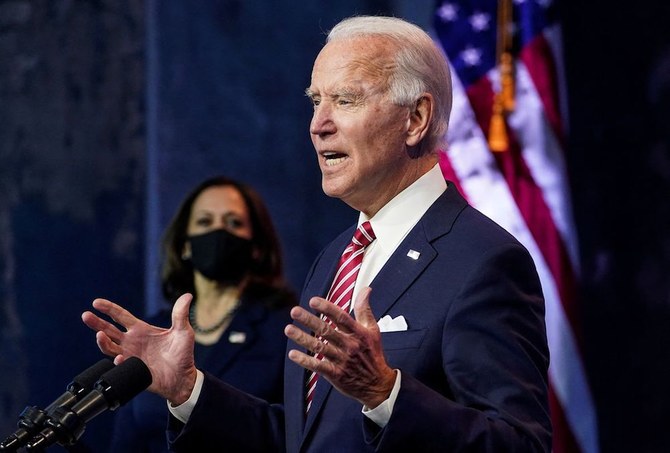
US President Joe Biden will sign an agreement with Israel this week pledging that both countries will combat Iran’s nuclear weapon ambitions. (Reuters)
New US-Israel agreement to prevent Iranian nuclear bomb
Strategic declaration will be centerpiece of US president’s visit to Israel
Two countries will ‘use all elements of national power’ to rein in Tehran
Updated 12 July 2022
Arab News
JEDDAH: US President Joe Biden will sign an agreement with Israel this week pledging that both countries will use “all elements of national power” to ensure that Iran never obtains a nuclear weapon, Israeli officials said on Tuesday.
The declaration of a joint stance against Iran’s nuclear program and regional aggression will be the centerpiece of Biden’s visit to Israel this week, after which he will travel to Saudi Arabia.
Iran is at the top of Israel’s agenda for meetings with US representatives at all levels, including Prime Minister Yair Lapid’s meeting with Biden, one official said. “Iran is continuing to violate its obligations and continues to deceive the international community.”
The official said Iran was “playing for time” in talks aimed at reviving the collapsed 2015 deal to curb its nuclear program. “As long as Iran believes time is on its side, it will not give in or make any concessions. Time has run out and it is crucial to exert pressure on Iran.”
Collaboration with the Biden administration on the Iran front was “very strong,” and Israel was grateful for it, the official said, and work on a joint strategy would be taken “to the next level” during Biden’s visit.
The new joint declaration would be “a living testimony to the unique quality, depth and scope of the US-Israel relationship,” an Israeli diplomatic source said on Tuesday. “It expresses the warmth and profound commitment to the relationship on both sides, specifically to Israel’s security, prosperity and wellbeing.”
Before traveling to Jeddah Biden is expected to meet Palestinian President Mahmoud Abbas in Bethlehem, and visit Augusta Victoria, a Palestinian hospital in east Jerusalem, where he will announce that the US is restoring aid to Palestinian hospitals in the city.
The Biden administration refused to allow Israeli officials to accompany the president in occupied EastJerusalem, indicating that they do not recognize that part of the city as Israeli.
Druze: the great survivors
How the world's most secretive faithhas endured for a thousand years
Trump: US carrying out ‘major combat operations’ in Iran
An Israeli defense official said the operation had been planned for months in coordination with Washington
Updated 5 min 41 sec ago
Agencies
WASHINGTON/DUBAI/CAIRO: US President Donald Trump said on Saturday that the United States had begun “major combat operations” in Iran, warning that there may be US casualties.
The strikes, which Trump said were aimed at destroying Iranian missiles and annihilating its navy, follow repeated US-Israeli warnings that they would strike Iran again if it pressed ahead with its nuclear and ballistic missile programs.
“I do not make this statement lightly. The Iranian regime seeks to kill,” Trump said in a video shared on Truth Social.
“The lives of courageous American heroes may be lost and we may have casualties that often happens in war, but we’re doing this, not for now. We’re doing this for the future, and it is a noble mission.”
Trump told the members of the Islamic Revolutionary Guard, Iran’s armed forces, to lay down their weapons, promising that they would be granted immunity.
The other option, according to Trump, is “certain death.”
Washington and Tehran held a series of talks in recent weeks about Iran’s nuclear ambition. The most recent one was held on Thursday with no deal.
“Iran refused, just as it has for decades and decades. They rejected every opportunity to renounce their nuclear ambitions, and we can’t take it anymore,” Trump said.Israel launched a pre-emptive attack against Iran on Saturday, and a United States attack is underway, plunging the Middle East into a renewed military confrontation and further dimming hopes for a diplomatic solution to Tehran’s nuclear dispute with the West.
The latest updates:
• Israeli military reports missiles have been launched from Iran toward Israel, authorities call on people to head to shelters
• Iranian President Masoud Pezeshkian is “safe and sound”, state media reported.
• The Jerusalem municipality ordered schools and workplaces to close on Saturday after Israel launched strikes on arch-foe Iran
• US embassies in Qatar, Bahrain issue shelter-in-place orders for personnel
• Tasnim reports Iran is preparing for strong response to Israel
• Israeli media: We are awaiting confirmation of the assassination of a number of prominent Iranian leaders
• Iranian television has declared a state of alert in all hospitals across the country
• Israeli media said that Israel was targeting rocket launch sites to prevent Iran from responding
• The head of Iran’s National Security Committee said that Israel has embarked on a path whose outcome is not in its hands
• Explosions heard in the cities of Qom, Karaj and Kermanshah
• Explosions heard in Isfahan, central Iran
• Israeli Army Radio said air force launches second wave of strikes on Iran
The scope of the air and sea operations was not immediately clear. Iran was preparing a crushing retaliation, an Iranian official said.
An apparent strike in Iran’s capital Saturday happened near the offices of Khamenei. State television acknowledged an explosion in the area of the offices.
Israeli media reported attempts to assassinate Iranian President Masoud Pezeshkian during the attacks, and have not ruled out Khamenei being targeted.
Several missiles have struck University Street and the Jomhouri area in Tehran, while explosion likely occurred in the northern Seyyed Khandan area of Tehran, state media reported. Thick smoke was also rising from the vicinity of Pasteur Street in downtown Tehran, ISNA said.
The attack, coming after Israel and Iran engaged in a 12-day air war in June, follows repeated US-Israeli warnings that they would strike again if Iran pressed ahead with its nuclear and ballistic missile programs.
“The State of Israel launched a pre-emptive attack against Iran to remove threats to the State of Israel,” Defense Minister Israel Katz said.
People watch as smoke rises on the skyline after an explosion in Tehran on Feb. 28, 2026. (AP)
An Israeli defense official said the operation had been planned for months in coordination with Washington, and that the launch date was decided weeks ago.
The US military declined to immediately comment on the attack.
Explosions were heard in Tehran on Saturday, Iranian media reported, and sirens sounded across Israel around 08:15 local time in what the military said was a proactive alert to prepare the public for the possibility of an incoming missile strike.
The Israeli military announced the closure of schools and workplaces, with exceptions for essential sectors, and a ban on public airspace.
Israel closed its airspace to civilian flights, and the airports authority asked the public not to go to any of the country’s airports.
The country’s airspace will reopen and flights to and from Israel to resume ‘as soon as the security situation allows,’ the airport authority said.
Iran’s airspace has been closed, Tasnim news agency reported.
People run for cover following an explosion in Tehran on Feb. 28, 2026. (WANA via Reuters)
The US and Iran renewed negotiations in February in a bid to resolve the decades-long dispute through diplomacy and avert the threat of a military confrontation that could destabilize the region.
Israel, however, insisted that any US deal with Iran must include the dismantling of Tehran’s nuclear infrastructure, not just stopping the enrichment process, and lobbied Washington to include restrictions on Iran’s missile program in the talks.
Iran said it was prepared to discuss curbs on its nuclear program in exchange for lifting sanctions but ruled out linking the issue to missiles.
Tehran also said it would defend itself against any attack.
It warned neighboring countries hosting US troops that it would retaliate against American bases if Washington struck Iran.
In June, the US joined an Israeli military campaign against Iranian nuclear installations, in the most direct American military action ever against the Islamic Republic.
Tehran retaliated then by launching missiles toward the US Al Udeid air base in Qatar, the largest in the Middle East.
Western powers have warned that Iran’s ballistic missile project threatens regional stability and could deliver nuclear weapons if developed. Tehran denies seeking atomic bombs.