

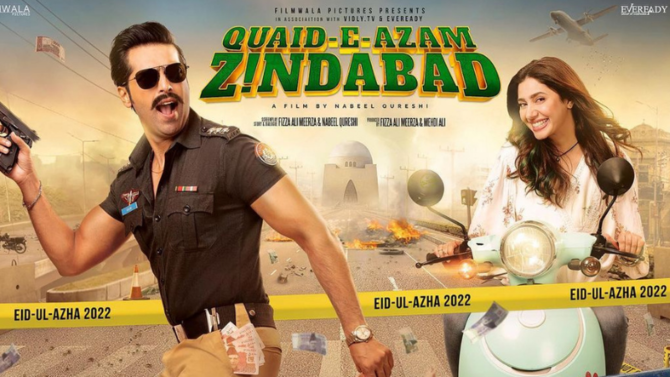

KARACHI: Nabeel Qureshi’s highly anticipated ‘Quaid-e-Azam Zindabad,’ starring Pakistani megastars Mahira Khan and Fahad Mustafa, hit cinema screens across the country on the Eid holiday, with the cast saying this was a feature with many firsts: a cop film, and a musical masala movie with an important message.
The movie, which encountered delays due the COVID-19 pandemic, brings Khan and Mustafa together on the silver screen for the first time and has generated a lot of anticipation and excitement among film fans and cinema-goers.
The action-packed movie simultaneously released on Sunday in 14 countries, including the United Arab Emirates, England and the United States.
“I genuinely think this is an entertaining film. It’s a relevant film. I have not seen a cop film in Pakistan before, I have not seen such action before,” Khan told Arab News in an interview ahead of the launch. “It’s a full on, what we say in Urdu, masala film, and it also has a very important message.”
The movie has “a lot of firsts” and features characters one will remember for a long time, Mustafa, a film and television actor and producer best known for hosting the popular game show Jeeto Pakistan, said.
“It’s the first cop film. Nobody [in Pakistan] has done that before or maybe lately nobody has done it,” the lead actor told Arab News. “We are only trying to create characters people can relate to for a very long time.”
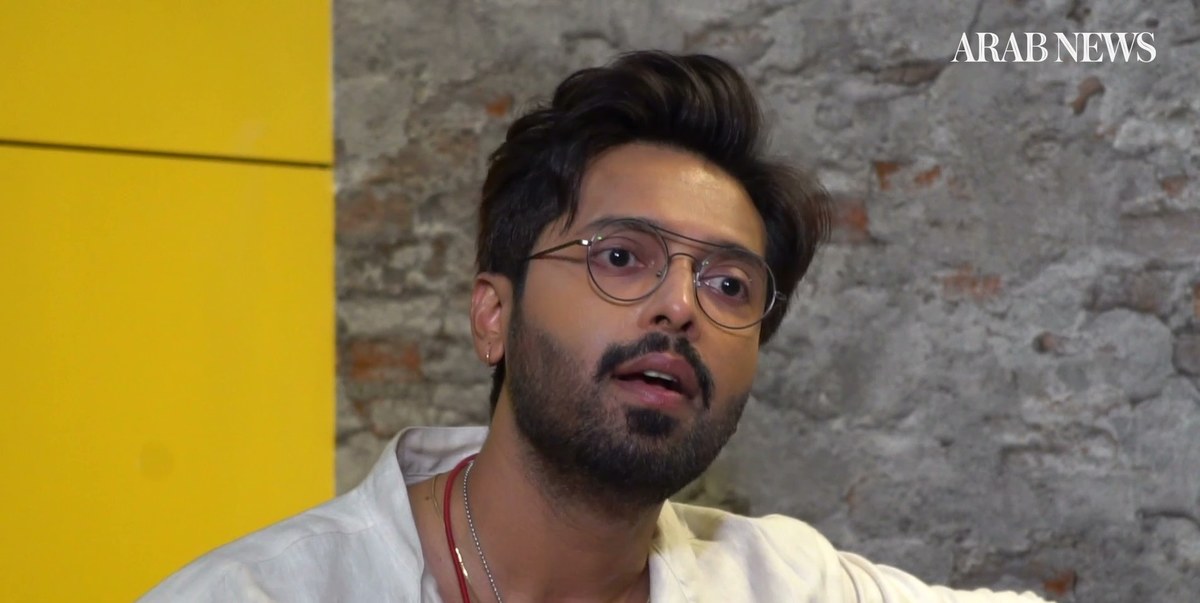
Pakistani artist Fahad Mustafa speaks about his movie Quaid-e-Azam Zindabad in exclusive interview with Arab News in Karachi. (AN Photo)
Speaking about her character, Khan said she stood for a “message,” whether it related to the harassment of women or human and animal rights.
“She is a girl who doesn’t think about social norms, societal norms, she does what she wants to do and she has a very strong moral compass,” Khan said. “She believes this is right and this is wrong.”
“And she also believes in giving second chances,” she said, chuckling as she glanced at Mustafa.

Pakistani artist Mahira Khan speaks about her movie Quaid-e-Azam Zindabad in exclusive interview with Arab News in Karachi. (AN Photo)
The actor was confident his fans would love the film.
“This is the film that can actually bring people out of their house and make them watch that cinematic experience,” Mustafa said. “So, I think this is the last hope. I really hope that they come out and we’d be able to do more films then.”
The two actors had some interesting anecdotes to share, with Mustafa recalling a tough shoot with a lion on the set.
“I had no clue I was scared of lions,” he said. “The lion was real and it was right there, and in the end, it is a lion, so what do you do?”
“It was a little scary and fun but I don’t really want to remember that day, you know, it was not a fun shoot.”
Khan recalled a scene where she was carrying a puppy on a bike. As the camera came close, the dog just turned its face and started kissing the lens.
“We had these little moments,” a smiling Khan added.
‘Quaid-e-Azam Zindabad’ is not the only Pakistani movie releasing on Eid, and will face tough competition from the much-awaited Humayun Saeed and Mehwish Hayat-starrer ‘London Nahi Jaunga.’
Mustafa said he believed both films needed each other.
“It is not time to compete but collectively … as a unified group, we should be working together,” the actor said.
“So much is riding on both the films” doing well, Khan added. “The box office will dictate how investors, distributors, filmmakers will all feel about cinema because at the end of the day, it is a business.”
“Go watch London Nahi Jaunga,” both actors then said in unison.

Pakistani artists Fahad Mustafa (L) and Mahira Khan speak about their movie Quaid-e-Azam Zindabad in exclusive interview with Arab News in Karachi. (AN Photo)
At the end of the day, the two stars said they were relieved to be returning to the big screen.
“This is the real thing; this is what an actor lives for,” Mustafa said.
Khan added:
“Nothing like a film, nothing like cinema … Oh, we wanna do this forever … cinema has that magic.”


