

Urban flooding hits Pakistan’s largest city as deadly monsoon rains lash South Asia

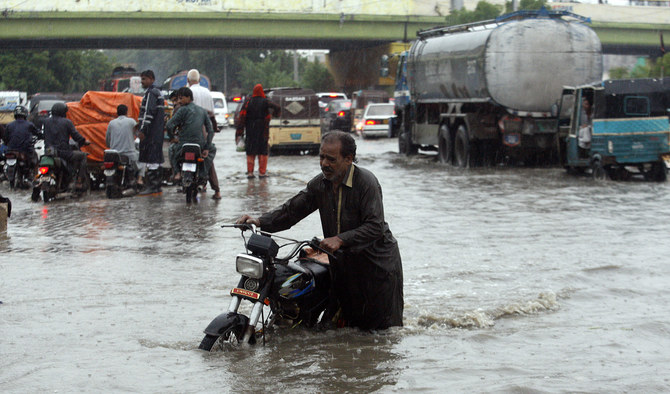
A Pakistani man push his bike through a flooded road after a heavy rainfall in Karachi, Pakistan, on July 8, 2022. (AP)
Short Url
Updated 25 September 2022
Follow

Urban flooding hits Pakistan’s largest city as deadly monsoon rains lash South Asia

  • Monsoon rains have already killed 116 people in Pakistan
  • Karachi Administrator Murtaza Wahab says city's drains working at 'packed capacity'

KARACHI: The main roads of Pakistan’s largest city, Karachi, were under water on Saturday, with many parts of the metropolis hit by power outages, as heavy monsoon rains continued to lash the region. 

The rains, which began with the onset of monsoon season in South Asia in mid-June, have already killed 116 people in Pakistan, with nearly half the deaths taking place in the country’s south and southwest.


People wade through a flooded road in a business district after a heavy rainfall in Karachi, Pakistan, on July 9, 2022. (AP)

Karachi, the capital of the southern Sindh province and Pakistan’s financial and economic hub, suffers from urban flooding each year, with people dying from drowning and electrocution, as the city’s clogged drains fail to empty water from the streets.

While local media channels showed rescue services using lifeboats to evacuate women and children, netizens said there has been little assistance from the local administration, as they shared video footage from impassable streets in the main parts of the city. 


“All roads are flooded,” Wasif Shakil, a Karachi-based journalist, told Arab News. “There’s no government in the city, we are living on our own here in Karachi.”

Karachi Administrator Murtaza Wahab, who was sharing live updates on his Twitter account, said pumping stations have been used to remove the water, as drains were working at “packed capacity.” In some areas the pumps could not work as electricity had been cut off — an issue that he said was being resolved with the use of power generators.

The Pakistan Meteorological Department (PMD) has warned of more isolated falls and thunderstorms during the upcoming Eid Al-Adha holidays as monsoon currents continue to penetrate the region.


Pakistan to begin first phase of Hajj 2026 trainings from today

Updated 31 December 2025
Follow

Pakistan to begin first phase of Hajj 2026 trainings from today

  • Training programs to be held in phases across Pakistan till February, says religion ministry
  • Saudi Arabia allocated Pakistan a total quota of 179,210 pilgrims for Hajj 2026

ISLAMABAD: Pakistan’s religious affairs ministry has said that it will begin the first phase of mandatory Hajj 2026 training for pilgrims intending to perform the pilgrimage from today, Thursday.

The one-day Hajj training programs will be held in phases across the country at the tehsil level until February. The ministry directed intending pilgrims to bring their original identity cards and the computerized receipt of their Hajj application to attend the training sessions.

“Pilgrims should attend the one-day training program according to their scheduled date,” Pakistan’s Ministry of Religious Affairs (MoRA) said in a statement.

The ministry said training schedules are being shared through the government’s Pak Hajj 2026 mobile application as well as via SMS. It added that details of the schedule are also available on its website.

According to the ministry, training programs will be held in Abbottabad on Jan. 2; Ghotki, Thatta and Kotli on Jan. 3; and Tando Muhammad Khan and Khairpur on Jan. 4.

Hajj training sessions will be held in Rawalakot, Badin and Naushahro Feroze on Jan. 5, while pilgrims in Fateh Jang, Dadu and Tharparkar will receive the training on Jan. 6.

The ministry said training programs will be conducted in Umerkot and Larkana on Jan. 7, followed by sessions in Mirpurkhas, Shahdadkot and Mansehra on Jan. 8.

Pakistan’s religious affairs ministry has previously said these trainings will be conducted by experienced trainers and scholars using multimedia.

It said the training has been made mandatory to ensure that intending pilgrims are fully aware of Hajj rituals and administrative procedures.

Saudi Arabia has allocated Pakistan a quota of 179,210 pilgrims for Hajj 2026, of which around 118,000 seats have been reserved under the government scheme, while the remainder will be allocated to private tour operators.

Under Pakistan’s Hajj scheme, the estimated cost of the government package ranges from Rs1,150,000 to Rs1,250,000 ($4,049.93 to $4,236), subject to final agreements with service providers.