

Japan ex-PM Abe dies after being shot while making a speech

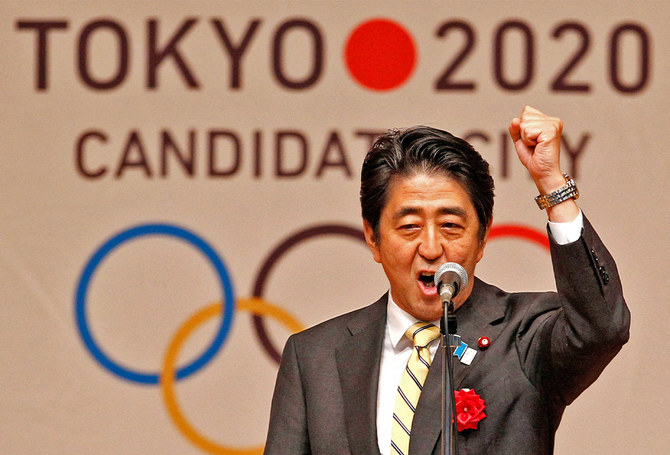
Japan's Prime Minister Shinzo Abe gestures as he speaks during Tokyo 2020 kick off rally in Tokyo August 23, 2013. (REUTERS/File)
Short Url
Updated 08 July 2022
Follow

Japan ex-PM Abe dies after being shot while making a speech

  • It was the first assassination of a sitting or former Japanese premier since 1930s
  • Abe served two terms as prime minister, stepping down in 2020 citing ill health

NARA, Japan: Former Prime Minister Shinzo Abe, Japan's longest-serving leader, died on Friday after being shot while campaigning for a parliamentary election, public broadcaster NHK said.

A man opened fire on Abe, 67, from behind with an apparently homemade gun as he spoke at a drab traffic island in the western city of Nara, Japanese media showed earlier.

It was the first assassination of a sitting or former Japanese premier since the days of prewar militarism in the 1930s.

Speaking before Abe's death was announced, Prime Minister Fumio Kishida condemned the shooting in the "strongest terms" while Japanese people and world leaders expressed shock at the violence in a country in which political violence is rare and guns are tightly controlled.

"This attack is an act of brutality that happened during the elections - the very foundation of our democracy - and is absolutely unforgivable," said Kishida, struggling to keep his emotions in check.

A fire department official had said Abe appeared to be in a state of cardiac arrest when airlifted to hospital.

Police said a 41-year-old man suspected of carrying out the shooting had been arrested. NHK quoted the suspect, identified as Tetsuya Yamagami, as telling police he was dissatisfied with Abe and wanted to kill him.

Abe was making a campaign speech outside a train station when two shots rang out at about 11:30 a.m. (0230 GMT). Security officials were then seen tackling a man in a grey T-shirt and beige trousers.

"There was a loud bang and then smoke," businessman Makoto Ichikawa, who was at the scene, told Reuters, adding that the gun was the size of a television camera.

"The first shot, no one knew what was going on, but after the second shot, what looked like special police tackled him."


TRANSFUSIONS
Earlier, Kyodo news service published a photograph of Abe lying face-up on the street by a guardrail, blood on his white shirt. People were crowded around him, one administering heart massage.

Nara emergency services said he had been wounded on the right side of his neck and left clavicle. His brother, Defence Minister Nobuo Kishi, had said Abe was getting blood transfusions.

NHK showed live footage of Abe's wife, Akie, on her way by train to the hospital where he was being treated.

Airo Hino, political science professor at Waseda University, said such a shooting was unprecedented in Japan. "There has never been anything like this," he said.

Senior Japanese politicians are accompanied by armed security agents but often get close to the public, especially during political campaigns when they make roadside speeches and shake hands with passersby.

In 2007, the mayor of Nagasaki was shot and killed by a yakuza gangster. The head of the Japan Socialist Party was assassinated during a speech in 1960 by a right-wing youth with a samurai short sword. A few other prominent postwar politicians were attacked but not injured.

Police said the suspected shooter was a resident of Nara. Media said he had served in Japan's military for three years until 2005. Defence Minister Kishi declined to comment on that.

Abe served two terms as prime minister, stepping down in 2020 citing ill health. But he has remained a dominant presence over the ruling Liberal Democratic Party (LDP), controlling one of its major factions.

Kishida, Abe's protege, had been hoping to use the election to emerge from Abe's shadow and define his premiership, analysts have said. Kishida suspended his election campaign after the shooting. All main political parties condemned the attack. 


Congo-Brazzaville president set to extend decades-long rule

Updated 2 sec ago
Follow

Congo-Brazzaville president set to extend decades-long rule

BRAZZAVILLE: At the age of 82 and after more than 40 years in power, Denis Sassou Nguesso is the clear favorite to win Sunday’s presidential election in Congo-Brazzaville.
With the opposition divided, sidelined and largely absent, observers say voter turnout could slump to a record low in the oil-rich but impoverished central African country.
Sassou Nguesso ranks as one of Africa’s longest-serving leaders, along with Equatorial Guinea’s Teodoro Obiang Nguema and Cameroonian President Paul Biya.
“Honestly, I don’t see the point of voting on March 15. Whether I vote or not, we’ll have the same winner,” said Cyril Massamba, who lives in the capital Brazzaville.
Sassou Nguesso, a career military officer, first led Congo under a one-party system from 1979 to 1992 before losing the first multi-party elections to former prime minister Pascal Lissouba, whom Sassou Nguesso then overthrew in a civil war in 1997.
He has maintained a firm grip over the former French colony, which gained independence in 1960 and has traditionally maintained close ties with both France and Russia.
Six candidates are bidding to unseat him but few have the resources to compete with the ruling Congolese Labour Party (PCT).
The party’s red Soviet-style flags and giant Sassou Nguesso portraits have filled city streets since the campaign began.
Lacking broad support, opposition candidates have been unable to rally behind a single challenger.
The two main opposition parties have chosen not to stand, one of them arguing that conditions for a free and transparent election have not been met, and urging supporters to vote “according to their conscience.”
“Denis Sassou Nguesso controls the entire electoral process,” said Clement Mierassa, an opposition figure, former minister and previous presidential candidate.
He argued that all those running against the president were just placeholders.
Two prominent candidates who challenged Sassou Nguesso in the disputed 2016 election remain in prison, serving 20-year sentences for “endangering state security.”

- Turnout fears, unemployment -

“I’ll go to a polling station the day my own child is a candidate,” joked shopkeeper Monique Ouollo.
Sassou Nguesso has urged his supporters to turn out and vote in Sunday’s first round, telling a rally in Pointe?Noire: “No abstention!” No date has yet been given for a second round of voting.
But many young people in the port city voiced frustration over chronic unemployment and the lack of economic prospects in a country rich in oil and gas.
Despite GDP growth of 2.9 percent in 2025, about half the population of six million lives below the poverty line, according to the World Bank.
Congo-Brazzaville depends heavily on hydrocarbons, which account for more than three-quarters of export earnings.
Authorities say proven oil reserves will last another 25 years at current production rates and aim to reach 500,000 barrels a day by 2030.
Gas production reached three million tons of LNG last year.
Although it has 10 million hectares of arable land, only about four percent is farmed, mostly for low-yield subsistence crops.
The country imports much of its food, leaving households exposed to swings in global prices, shipping costs and exchange rates.
Officials hope Congo’s location — between the Congo Basin and the Atlantic Ocean — will help turn it into a regional trading hub, tapping existing rail and road networks to boost links with neighbors.

- Diplomatic balancing act -

At Sassou Nguesso’s first campaign rally last month, foreign paramilitaries were spotted on rooftops nearby, including a sniper.
Their presence fueled speculation about Russian mercenaries providing security, mirroring arrangements in the Central African Republic.
A ruling party official confirmed to AFP that the men were Russian personnel, without detailing their mission.
Seen as a relatively stable hub in a volatile region, Congo-Brazzaville retains close ties with Paris, its largest development aid donor, and is home to around a hundred French companies.
But Russia is also a longstanding partner: Congo was allied with the Soviet bloc from 1968 to the early 1990s.
Though Sassou Nguesso maintains tight control over the security apparatus, some of his allies acknowledge that fears of a power grab remain.
The president told AFP in an interview in early March that he does not intend to “remain in power forever.”