

Verdict due in corruption trial of former world football officials Blatter and Platini

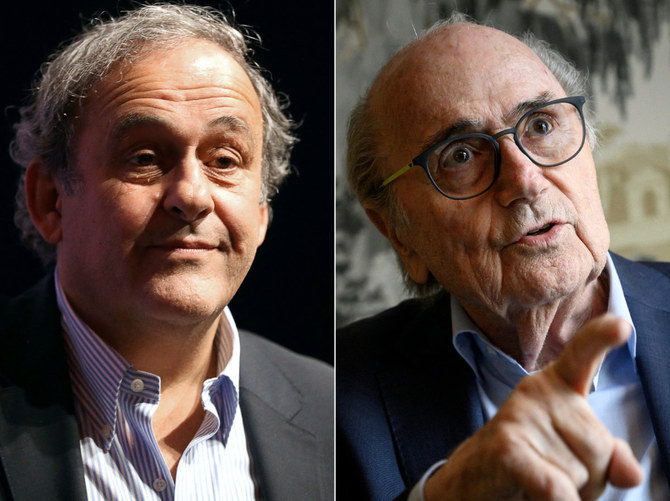
Michel Platini, left, and Sepp Blatter. (AFP file photos)
Short Url
Updated 08 July 2022
Follow

Verdict due in corruption trial of former world football officials Blatter and Platini

  • The case meant Blatter ended his reign as FIFA president in disgrace and it wrecked Platini’s hopes of succeeding him after he was banned from football when the affair came to light

BELLINZONA, Switzerland: Swiss judges are set to rule on Friday in the corruption trial of ex-FIFA president Sepp Blatter and France’s former football hero Michel Platini, once among soccer’s most powerful figures.

Prosecutors accuse Blatter, a Swiss who led global soccer body FIFA for 17 years, and Platini, a former France national team captain and manager, of unlawfully arranging for FIFA to pay the Frenchman 2 million Swiss francs ($2.06 million) in 2011.

Both deny the allegations.

Prosecutors have asked the court to impose suspended 20-month prison sentences on both men, and to compel them to repay Zurich-based FIFA 2.23 million Swiss francs.

The verdict is due around 0800 GMT.

The case meant Blatter ended his reign as FIFA president in disgrace and it wrecked Platini’s hopes of succeeding him after he was banned from football when the affair came to light.

Blatter, 86, had said the 2-million franc payment followed a “gentlemen’s agreement” between the pair when he asked Platini to be his technical adviser in 1998.

Platini, 67, worked as a consultant between 1998 and 2002 with an annual salary of 300,000 Swiss francs — the most FIFA could afford because of money troubles the organization had at the time, Blatter has told the court.

The rest of Platini’s 1 million per year salary was to be settled at a later date, Blatter said.

Motives for the payment are unclear, although the two men met in 2010 and discussed the upcoming elections for the FIFA presidency in 2011.

When Blatter approved the payment, he was campaigning for re-election against Mohamed bin Hammam of Qatar. Platini, then president of European soccer association UEFA, was seen as having sway with European members who could influence the vote.

Prosecutors have said that the oral agreement between the two men for Platini to be paid 2 million francs later for his consultancy work never existed, and described it as an “invention.”

The payment emerged following a huge investigation launched by the US Department of Justice into bribery, fraud and money-laundering at FIFA in 2015, which triggered Blatter’s resignation.

Both officials were banned in 2015 from soccer for eight years over the payment, although their bans were later reduced. 

Platini, who also lost his job as UEFA president following the ban, said the affair was a deliberate attempt to thwart his attempt to become FIFA president in 2015.

Platini’s former general secretary at UEFA, Gianni Infantino, entered the FIFA race and won the election in 2016. 


Jordan make history as they reach Arab Cup final for first time with narrow victory over Saudi Arabia

Updated 15 December 2025
Follow

Jordan make history as they reach Arab Cup final for first time with narrow victory over Saudi Arabia

  • Green Falcons left to rue squandered chances as they miss out on what would have been their first final appearance in the competition since 2002
  • Semi-final victory comes during a stellar year for Jordan in which they also qualified for the World Cup for the first time ever

DOHA: A header by Nizar Al-Rashdan gave Jordan a 1-0 victory in a tense match against Saudi Arabia on Monday and sent them to their first Arab Cup final.

Deprived of the services of Yazan Al-Naimat, who suffered a devastating knee injury in their quarter-final against Iraq, Jordan delivered a brave performance, greatly limiting the Saudi attacking threat across the 90 minutes.

The semi-final at Al-Bayt Stadium in Qatar attracted the highest attendance of the tournament so far, a vibrant crowd of 62,825. Both sides began cautiously, with Jordan lining up in a robust 5-4-1 formation that sought to restrict Salem Al-Dawsari and Saleh Abou Al-Shamat in the final third.

The game opened up a little after the break, as a tactical change from Jordan helped them gain greater control on the counterattack. Mohammed Abu Zrayq in particular proved influential down the right flank as he stretched the Saudi defense and gave the Nashama more attacking momentum.

The decisive moment, however, came from the opposite side. Mahmoud Al-Mardi delivered a dipping cross from the left, catching the Green Falcons’ defense off guard, and Al-Rashdan rose to head home the only goal of the match in the 66th minute.

Saudi Arabia responded with a series of substitutions, including the introduction of Al-Qadsiah midfielder Musab Al-Juwayr. The former Al-Hilal player helped link play between Al-Dawsari and Feras Al-Brikan down the left channel as the Saudis pressed for the equalizer.

Al-Brikan and then Saleh Al-Shehri both went close but Yazeed Abulaila stood firm in goal, producing a crucial save just minutes after Jordan took the lead.

The match ended on a particularly sour note for Saudi Arabia when last man Waleed Al-Ahmed was shown a straight red card in the closing moments after bringing down an opponent to halt a counterattack, as Jordan saw out their historic victory.

They now face Morocco, who earlier in the day defeated the UAE 3-0, in the final on Thursday.