

United Arab Emirates cuts red tape to attract digital businesses

An Emirati woman is pictured inside the 'Museum of The Future' on 23 February 2022, one day after its opening in the Gulf emirate of Dubai. (AFP/FILE)
Short Url
Updated 06 July 2022
Follow

United Arab Emirates cuts red tape to attract digital businesses

  • UAE aims to make it easier for digital companies to incorporate
  • Sets a target for 300 digital companies to incorporate within a year

DUBAI: The United Arab Emirates is cutting red tape to make it easier and quicker for digital companies to incorporate, the latest economic policy announcement as the government seeks to further diversify the economy away from oil revenues.

Trade minister Thani Al Zeyoudi, flanked by executives from many state-linked entities, on Wednesday announced the changes that include better access to the financial and banking system.

“We want to show digitally enabled companies from Europe, Asia, the Americas, that the UAE is the world’s best place to live, work, invest and scale,” the minister told reporters, setting a target for 300 digital companies to incorporate within a year.

Those setting up in the UAE, home to financial center Dubai and oil-rich Abu Dhabi, would have visas issued sooner and be offered attractive commercial and residential leases, he said.

As other governments step up national efforts to increase renewable energy sources and move away from fossil fuels, the UAE is rolling out a series of initiatives to double the economy to $816 billion by 2030.

“We want to show that we are here to help; from commercial licenses and work visas, to opening bank accounts, finding office space and the perfect place to live,” Al Zeyoudi said.
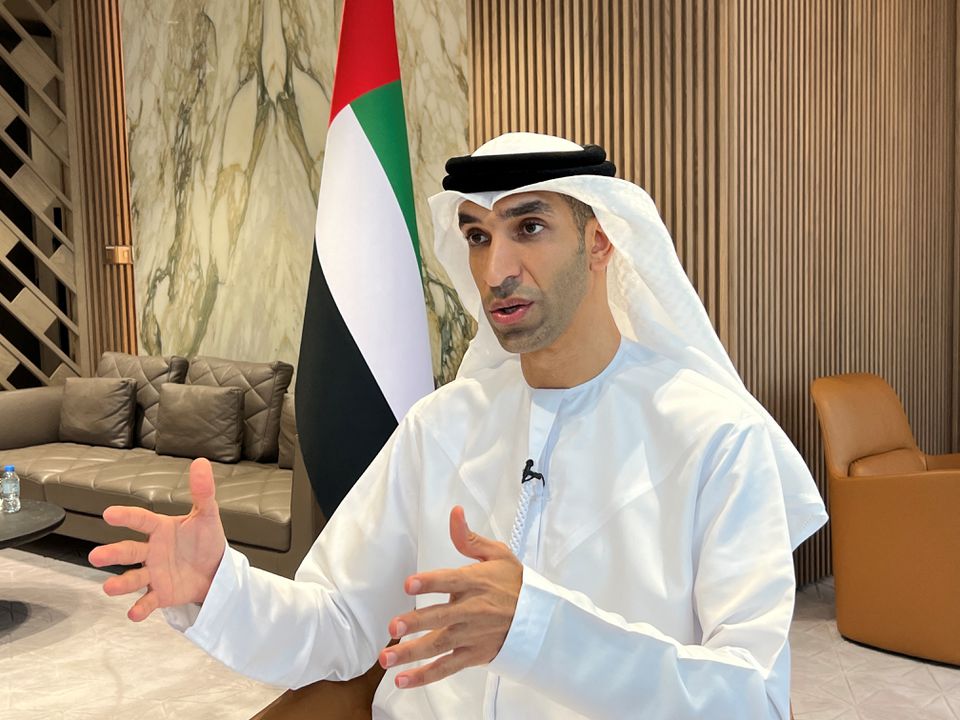


United Arab Emirates Minister of State for Foreign Trade Thani Al Zeyoudi gestures during an interview with Reuters in Dubai, United Arab Emirates, June 30, 2022. (REUTERS)

Some company executives complain about the bureaucracy involved in setting up a business, including in hiring international staff in a country where citizens are a minority.

Still, the UAE’s Dubai has established itself as the region’s premier business hub and is already home to many multinational corporations and international businesses.

But regional competition has intensified as Saudi Arabia takes steps to re-mold itself as a leading financial and tourism center under the leadership of de facto ruler Crown Prince Mohammed bin Salman.

“We’re moving from a regional hub to a global hub,” Al Zeyoudi said. “We’re competing with the big, big boys now.”


Iran open to compromises to reach nuclear deal with US, minister tells BBC

Updated 15 sec ago
Follow

Iran open to compromises to reach nuclear deal with US, minister tells BBC

  • A US delegation, including envoys Steve Witkoff and Jared Kushner, will meet with the ⁠Iranians on Tuesday morning
LONDON: Iran is ready to consider compromises to reach a nuclear deal with the United States ​if Washington is willing to discuss lifting sanctions, Iran’s Deputy Foreign Minister Majid Takht-Ravanchi told the BBC in an interview published on Sunday.
Iran has said it is prepared to discuss curbs on its nuclear program in return for the lifting of sanctions, but has repeatedly ruled out linking the issue to other questions including ‌missiles.
Takht-Ravanchi confirmed ‌that a second round of ​nuclear talks ‌would ⁠take place ​on ⁠Tuesday in Geneva, after Tehran and Washington resumed discussions in Oman earlier this month.
“(Initial talks went) more or less in a positive direction, but it is too early to judge,” Takht-Ravanchi told the BBC.
A US delegation, including envoys Steve Witkoff and Jared Kushner, will meet with the ⁠Iranians on Tuesday morning, a source ‌had told Reuters on Friday, ‌with Omani representatives mediating the US-Iran contacts.
Iran’s ​atomic chief said on ‌Monday the country could agree to dilute its most ‌highly enriched uranium in exchange for all financial sanctions being lifted. Takht-Ravanchi used this example in the BBC interview to highlight Iran’s flexibility.
The senior diplomat reiterated Tehran’s stance that ‌it would not accept zero uranium enrichment, which had been a key impediment to reaching ⁠a deal ⁠last year, with the US viewing enrichment inside Iran as a pathway to nuclear weapons.
Iran denies seeking such nuclear weapons.
During his first term in office, Trump pulled the US out of a 2015 Iran nuclear agreement, known as the Joint Comprehensive Plan of Action, the signature foreign policy achievement of former Democratic President Barack Obama.
The deal eased sanctions on Iran in exchange for Tehran limiting its nuclear program to ​prevent it from being ​able to make an atomic bomb.