

British Council workers stranded in Afghanistan at ‘high risk’

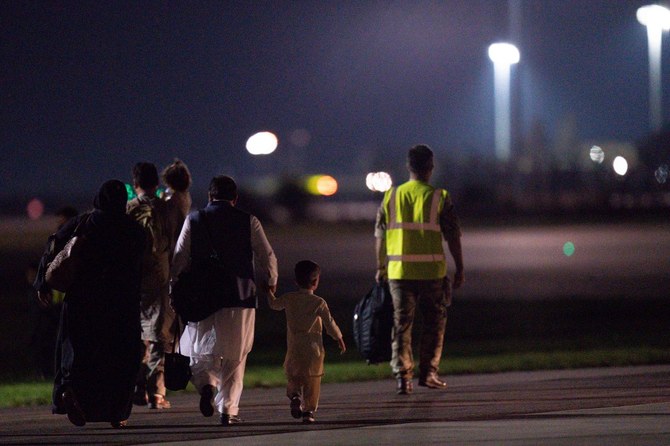
Passengers evacuated from Afghanistan are escorted across the tarmac after disembarking a British military transport aircraft. (File/AFP)
Short Url
Updated 04 July 2022
Follow

British Council workers stranded in Afghanistan at ‘high risk’

  • Over 180 teachers for the educational outfit suddenly given permission to come to Britain but still lack clear travel route

LONDON: Over 180 teachers at the British Council risk being stranded in Afghanistan after being given permission by the UK government to apply to come to Britain but still lacking a clear route for traveling to the country, The Guardian reported.

Former colleagues and MPs campaigned for the recovery of the contractors, horrified that they had been left behind as full-time British Council staff were extracted amid fears that they would face punishment from the Taliban for teaching values that do not align with the new Kabul administration.

Of the teachers stuck in Afghanistan, 85 have been classified as being at “very high risk,” while another 90 workers have been listed at “high risk.” Many have reportedly gone into hiding fearing the Taliban’s crackdown.

Joe Seaton, a former British Council employee who worked alongside many of the teachers in Afghanistan, told the Guardian that no evacuation plan has been drawn up for the contractors despite 11 months passing since the fall of the city to the Taliban.

Having originally not been afforded the right to be recovered to Britain, the UK government suddenly announced last month that British Council contractors will now be allowed to apply to come to the UK with their families. A decision was expected in August.

Seaton said: “We are finally making some progress, but there does not yet seem to be any clear arrangements on how to get them out. This is a key question. How long will it take to get them out? Every day is another day in grave danger, and so far, all government efforts at processing former British Council staff have been very slow and clunky. The government needs to massively speed up on processing the individual cases.”

He added that the British Council did not have a full list of contractors who worked with them, which he had provided to the organization: “I have given the British Council lists of the contractors on several occasions as they did not have the information.”

Seaton, who speaks to the contractors stuck in Afghanistan on a near-daily basis via WhatsApp, told The Guardian that, following the government’s decision, they were “optimistic, but worried this might be another false dawn.”

The Home Office decision in June ruled that British Council contractors, staff at GardaWorld and former Chevening Scholars could come to Britain with their families so long as the total number of refugees applying in this category to the Foreign Office did not exceed 1,500. Problems with housing have mired the government’s attempts to process Afghan refugees, with the average Afghan family significantly larger than the space afforded by a typical British house.

They have been told to make applications online, but the Home Office Minister for Afghan Resettlement conceded that this would be difficult in many parts of the country.

The British Council said: “We have a full and comprehensive list of our former colleagues and have shared that list with relevant government departments.

We know our former colleagues are living in increasingly desperate circumstances, as the situation in the country continues to deteriorate.

The Afghanistan relocation schemes are run by the UK government. We have been pushing for progress with senior contacts within the UK government to ensure the earliest consideration of our former colleagues’ relocation applications.”


UN’s top court opens Myanmar Rohingya genocide case

Updated 14 min 8 sec ago
Follow

UN’s top court opens Myanmar Rohingya genocide case

  • The Gambia filed a case against Myanmar at the UN’s top court in 2019
  • Verdict expected to impact Israel’s genocide case over war on Gaza

DHAKA: The International Court of Justice on Monday opened a landmark case accusing Myanmar of genocide against its mostly Muslim Rohingya minority.

The Gambia filed a case against Myanmar at the UN’s top court in 2019, two years after a military offensive forced hundreds of thousands of Rohingya from their homes into neighboring Bangladesh.

The hearings will last three weeks and conclude on Jan. 29.

“The ICJ must secure justice for the persecuted Rohingya. This process should not take much longer, as we all know that justice delayed is justice denied,” said Asma Begum, who has been living in the Kutupalong refugee camp in Bangladesh’s Cox’s Bazar district since 2017.

A mostly Muslim ethnic minority, the Rohingya have lived for centuries in Myanmar’s western Rakhine state but were stripped of their citizenship in the 1980s and have faced systemic persecution ever since.

In 2017 alone, some 750,000 of them fled military atrocities and crossed to Bangladesh, in what the UN has called a textbook case of ethnic cleansing by Myanmar.

Today, about 1.3 million Rohingya shelter in 33 camps in Cox’s Bazar, turning the coastal district into the world’s largest refugee settlement.

“We experienced horrific acts such as arson, killings and rape in 2017, and fled to Bangladesh,” Begum told Arab News.

“I believe the ICJ verdict will pave the way for our repatriation to our homeland. The world should not forget us.”

A UN fact-finding mission has concluded that the Myanmar 2017 offensive included “genocidal acts” — an accusation rejected by Myanmar, which said it was a “clearance operation” against militants.

Now, there is hope for justice and a new future for those who have been displaced for years.

“We also have the right to live with dignity. I want to return to my homeland and live the rest of my life in my ancestral land. My children will reconnect with their roots and be able to build their own future,” said Syed Ahmed, who fled Myanmar in 2017 and has since been raising his four children in the Kutupalong camp.

“Despite the delay, I am optimistic that the perpetrators will be held accountable through the ICJ verdict. It will set a strong precedent for the world.”

The Myanmar trial is the first genocide case in more than a decade to be taken up by the ICJ. The outcome will also impact the genocide case that Israel is facing over its war on Gaza.

“The momentum of this case at the ICJ will send a strong message to all those (places) around the world where crimes against humanity have been committed,” Nur Khan, a Bangladeshi lawyer and human rights activist, told Arab News.

“The ICJ will play a significant role in ensuring justice regarding accusations of genocide in other parts of the world, such as the genocide and crimes against humanity committed by Israel against the people of Gaza.”
