

British Council workers stranded in Afghanistan at ‘high risk’

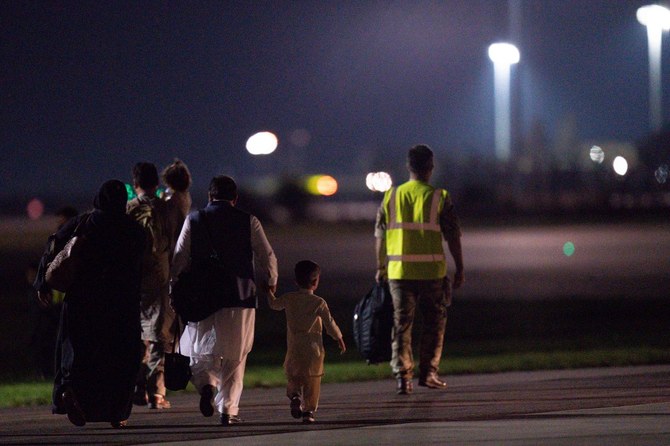
Passengers evacuated from Afghanistan are escorted across the tarmac after disembarking a British military transport aircraft. (File/AFP)
Short Url
Updated 04 July 2022
Follow

British Council workers stranded in Afghanistan at ‘high risk’

  • Over 180 teachers for the educational outfit suddenly given permission to come to Britain but still lack clear travel route

LONDON: Over 180 teachers at the British Council risk being stranded in Afghanistan after being given permission by the UK government to apply to come to Britain but still lacking a clear route for traveling to the country, The Guardian reported.

Former colleagues and MPs campaigned for the recovery of the contractors, horrified that they had been left behind as full-time British Council staff were extracted amid fears that they would face punishment from the Taliban for teaching values that do not align with the new Kabul administration.

Of the teachers stuck in Afghanistan, 85 have been classified as being at “very high risk,” while another 90 workers have been listed at “high risk.” Many have reportedly gone into hiding fearing the Taliban’s crackdown.

Joe Seaton, a former British Council employee who worked alongside many of the teachers in Afghanistan, told the Guardian that no evacuation plan has been drawn up for the contractors despite 11 months passing since the fall of the city to the Taliban.

Having originally not been afforded the right to be recovered to Britain, the UK government suddenly announced last month that British Council contractors will now be allowed to apply to come to the UK with their families. A decision was expected in August.

Seaton said: “We are finally making some progress, but there does not yet seem to be any clear arrangements on how to get them out. This is a key question. How long will it take to get them out? Every day is another day in grave danger, and so far, all government efforts at processing former British Council staff have been very slow and clunky. The government needs to massively speed up on processing the individual cases.”

He added that the British Council did not have a full list of contractors who worked with them, which he had provided to the organization: “I have given the British Council lists of the contractors on several occasions as they did not have the information.”

Seaton, who speaks to the contractors stuck in Afghanistan on a near-daily basis via WhatsApp, told The Guardian that, following the government’s decision, they were “optimistic, but worried this might be another false dawn.”

The Home Office decision in June ruled that British Council contractors, staff at GardaWorld and former Chevening Scholars could come to Britain with their families so long as the total number of refugees applying in this category to the Foreign Office did not exceed 1,500. Problems with housing have mired the government’s attempts to process Afghan refugees, with the average Afghan family significantly larger than the space afforded by a typical British house.

They have been told to make applications online, but the Home Office Minister for Afghan Resettlement conceded that this would be difficult in many parts of the country.

The British Council said: “We have a full and comprehensive list of our former colleagues and have shared that list with relevant government departments.

We know our former colleagues are living in increasingly desperate circumstances, as the situation in the country continues to deteriorate.

The Afghanistan relocation schemes are run by the UK government. We have been pushing for progress with senior contacts within the UK government to ensure the earliest consideration of our former colleagues’ relocation applications.”


Trump urges Iranian Kurds to attack Iran as war widens

Updated 06 March 2026
Follow

Trump urges Iranian Kurds to attack Iran as war widens

  • Azerbaijan preparing unspecified retaliatory measures on Thursday
  • The seven-day war has now seen Iran target Israel, the Gulf states, Cyprus, Turkiye and Azerbaijan, and spread to the Indian Ocean off Sri Lanka

DUBAI/WASHINGTON: US President Donald Trump encouraged Iranian Kurdish forces in Iraq to launch attacks against Iran as the Middle East conflict widened, with Azerbaijan warning it would retaliate for being targeted by Iranian missiles.
Israel on Friday said it had ​started a “broad-scale” wave of attacks against infrastructure targets in Tehran, as Gulf cities came under renewed bombardment by Iran.
The seven-day war has now seen Iran target Israel, the Gulf states, Cyprus, Turkiye and Azerbaijan, and spread to the Indian Ocean off Sri Lanka where a US submarine sank an Iranian naval ship.
On the possibility of the Iranian Kurdish forces entering Iran, Trump told Reuters on Thursday: “I think it’s wonderful that they want to do that, I’d be all for it.”
Two Iranian drone attacks targeted an Iranian opposition camp in Iraqi Kurdistan on Thursday, security sources said.
Iranian Kurdish militias have consulted with the United States in recent days about whether, and how, to attack Iran’s security forces in the western part of the country, according to three sources with knowledge of the matter.
The Iranian Kurdish coalition of groups based on the Iran-Iraq border in ‌the semi-autonomous region ‌of Iraqi Kurdistan has been training to mount such an attack in hopes of weakening the country’s ​military, ‌as ⁠the United ​States ⁠and Israel pound Iranian targets with bombs and missiles. Trump, speaking with Reuters in a telephone interview, also said the United States must have a role in deciding who will be the next leader of Iran after airstrikes killed Supreme Leader Ayatollah Ali Khamenei last week.
“We’re going to have to choose that person along with Iran. We’re going to have to choose that person,” he said.
US Defense Secretary Pete Hegseth said on Thursday that the US was not expanding its military objectives in Iran, despite what Trump said about choosing the country’s next leader.
“There’s no expansion in our objectives. We know exactly what we’re trying to achieve,” he said. The attack on Iran is a major political gamble for the Republican president, with opinion polls showing little support and ⁠Americans concerned about the rise in gasoline prices caused by disruption to energy supplies. Trump dismissed that ‌concern. Shares on Wall Street fell on Thursday, weighed by surging oil prices, as the ‌economic impact of the campaign intensified, with countries around the world cut off from a ​fifth of global supplies of oil and liquefied natural gas and ‌air transport still facing chaos and global logistics increasingly snarled.

Azerbaijan prepares to retaliate
Azerbaijan was preparing unspecified retaliatory measures on Thursday after it said ‌four Iranian drones crossed its border and injured four people in the Nakhchivan exclave.
“We will not tolerate this unprovoked act of terror and aggression against Azerbaijan,” President Ilham Aliyev told a meeting of his Security Council.
Iran, which has a significant Azeri minority, denied it targeted its neighbor.
Lebanon’s Iran-backed Hezbollah militia warned Israeli residents to evacuate towns within 5 km (3 miles) of the border between the countries in a message posted on its Telegram channel in Hebrew early on Friday.
“Your military’s ‌aggression against Lebanese sovereignty and safe citizens, the destruction of civilian infrastructure and the expulsion campaign it is carrying out will not go unchallenged,” Hezbollah said.

Us munitions full
Hegseth and Admiral Brad Cooper, who leads ⁠US forces in the Middle East, ⁠said during a briefing about operations that the US has enough munitions to continue its bombardment indefinitely.
“Iran is hoping that we cannot sustain this, which is a really bad miscalculation,” Hegseth told reporters at Central Command headquarters in Florida. “Our munitions are full up and our will is ironclad.”
The Pentagon earlier this week said the military campaign, known as Operation Epic Fury, is focused on destroying Iran’s offensive missiles, missile production and navy, while not allowing Tehran to have a nuclear weapon.
Cooper said the US had now hit at least 30 Iranian ships, including a large drone carrier that he said was the size of a World War Two aircraft carrier.
He added that B-2 bombers had in the past few hours dropped dozens of 2,000 penetrator bombs targeting deeply buried ballistic missile launchers, and that bombings were also targeting Iran’s missile production facilities.
Iran’s ballistic missile attacks had decreased by 90 percent since the first day of the war, while drone attacks had decreased by 83 percent in that time frame, he said. In Iran, at least 1,230 people have been killed, according to the Iranian Red Crescent Society, including 175 schoolgirls and staff killed at a primary ​school in Minab in the country’s south on the first day ​of the war. Another 77 have been killed in Lebanon, its Health Ministry says. Thousands fled southern Beirut on Thursday after Israel warned residents to leave.