

Pakistan’s Hajj operations going smoothly, says religious affairs minister

A Pakistani hajj volunteer speaks to pilgrims at Makkah, Saudi Arabia on June 16, 2022. (Courtesy: Pakistani Hajj mission at Jeddah, Saudi Arabia)
Short Url
Updated 03 July 2022
Follow

Pakistan’s Hajj operations going smoothly, says religious affairs minister

  • Mufti Abdul Shakoor confirms Saudi Arabia has increased Pakistan’s Hajj quota to 83,132
  • Pakistani Hajj mission has established two hospitals and 7 dispensaries for pilgrims

ISLAMABAD: Federal Minister for Religious Affairs Mufti Abdul Shakoor said on Sunday Pakistan’s Hajj operations were running smoothly as a majority of pilgrims had already arrived in Saudi Arabia.


Pakistan’s religious affairs minister Mufti Abdul Shakoor (2L) takes briefing from the officials of Pakistani Hajj mission in Makkah, Saudi Arabia, on July 3, 2022. (Photo courtesy: Ministry of Religious Affairs)

Pakistan was initially allocated a quota of 81,132 pilgrims this year, out of which more 34,000 were supposed to utilize the government scheme while the rest had to be facilitated by private operators.
However, the Saudi authorities later increased Pakistan’s quota by 2,000, the minister confirmed, taking it to 83,132 pilgrims.
“The Saudi government has provided best facilities to Pakistani pilgrims,” he told Arab News over the phone from Makkah. “With [the kingdom’s] cooperation, we have completed all arrangements and our Hajj operation is going on smoothly without any problem.”



Pakistan’s religious affairs minister Mufti Abdul Shakoor is inspecting food preparations for pilgrims in Makkah, Saudi Arabia, on July 1, 2022. (Courtesy: Ministry of Religious Affairs)

Shakoor said the arrangements provided to pilgrims included pick and drop service from airport, provision of good residential facilities in both Makkah and Madinah, hygienic food, transport and medical facilities.
“The Hajj medical mission has established one main hospital and five dispensaries in Makkah along with one main hospital and two dispensaries in Madinah,” he continued. “78,322 pilgrims have already arrived [in Saudi Arabia], including 34,322 under the government scheme, and the arrival of private scheme pilgrims will complete on July 4.”
The minister applauded the Saudi government for providing the Makkah Route facility to Pakistani pilgrims on a bigger scale this year, making it possible for the religious affairs ministry to operate “Hajj flights of Peshawar Faisalabad and Sialkot from the Islamabad airport.”
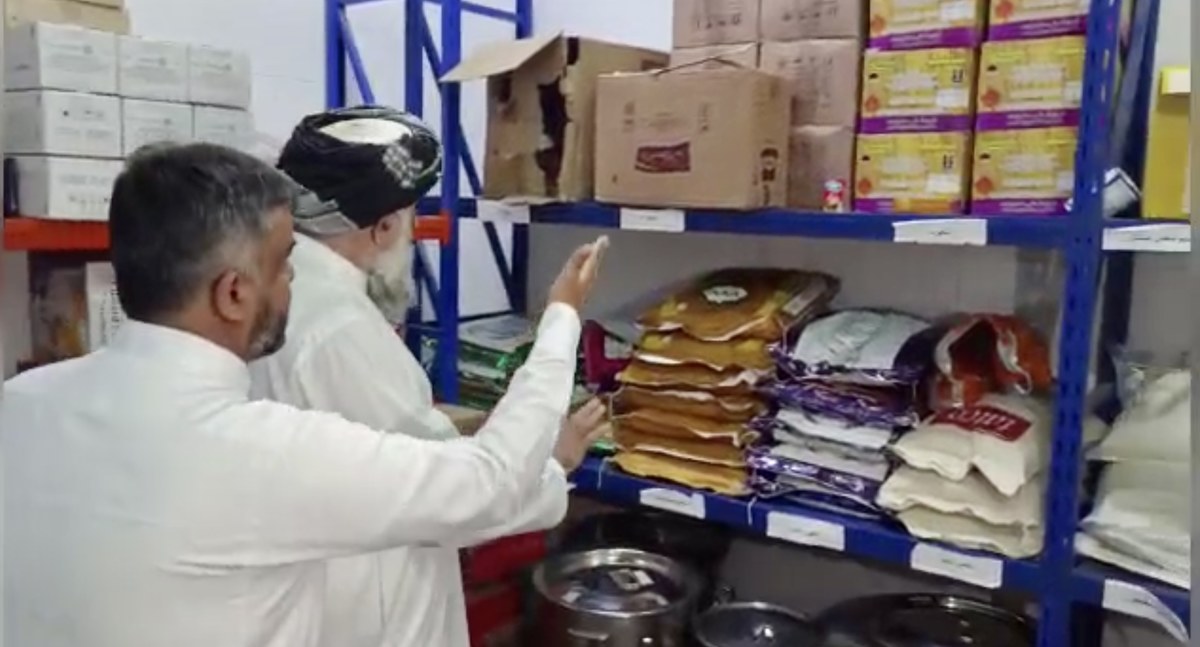


Pakistan’s religious affairs minister Mufti Abdul Shakoor is inspecting food preparations for pilgrims in Makkah, Saudi Arabia, on July 1, 2022. (Courtesy: Ministry of Religious Affairs)

“To help pilgrims perform Hajj without any trouble, the Saudi government has improved the services at Mina, Arafat and Muzdalifah,” he said, adding the authorities had also established a toll-free helpline and there were guides in both Makkah and Madinah to help pilgrims and resolve their problems.
Shakoor said the Saudi authorities had also provided home check-in facility on return flights that would make them collect luggage from the residential facilities of pilgrims for flights from Makkah and Madinah.
Asked about Hajj expenses, he said the government had managed to significantly bring them down despite the depreciation of the Pakistani currency and other financial challenges.
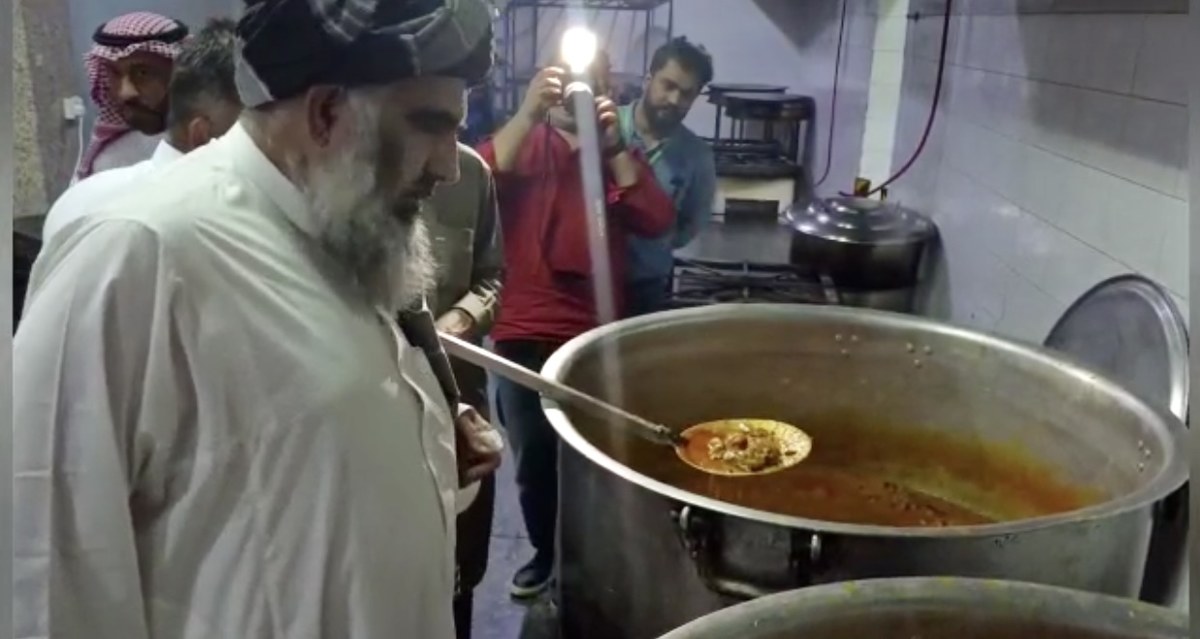


Pakistan’s religious affairs minister Mufti Abdul Shakoor is inspecting food preparations for pilgrims in Makkah, Saudi Arabia, on July 1, 2022. (Courtesy: Ministry of Religious Affairs)

“We have brought down Hajj expenses by eliminating the role of the middle man and got residences directly from Saudi companies at much lower rates,” he said.
The minister added the government had tried to further cut down the expenses by providing one way trip to pilgrims in such a way that those who landed in Madinah would return to Pakistan after performing the pilgrimage from Makkah and those who arrived in Jeddah would return from Madinah.



Sindh assembly passes resolution rejecting move to separate Karachi

Updated 6 sec ago
Follow

Sindh assembly passes resolution rejecting move to separate Karachi

  • Chief Minister Shah cites constitutional safeguards against altering provincial boundaries
  • Calls to separate Karachi intensified amid governance concerns after a mall fire last month

ISLAMABAD: The provincial assembly of Pakistan’s southern Sindh province on Saturday passed a resolution rejecting any move to separate Karachi, declaring its territorial integrity “non-negotiable” amid political calls to carve the city out as a separate administrative unit.

The resolution comes after fresh demands by the Muttahida Qaumi Movement (MQM) and other voices to grant Karachi provincial or federal status following governance challenges highlighted by the deadly Gul Plaza fire earlier this year that killed 80 people.

Karachi, Pakistan’s largest and most densely populated city, is the country’s main commercial hub and contributes a significant share to the national economy.

Chief Minister Syed Murad Ali Shah tabled the resolution in the assembly, condemning what he described as “divisive statements” about breaking up Sindh or detaching Karachi.

“The province that played a foundational role in the creation of Pakistan cannot allow the fragmentation of its own historic homeland,” Shah told lawmakers, adding that any attempt to divide Sindh or separate Karachi was contrary to the constitution and democratic norms.

Citing Article 239 of Pakistan’s 1973 Constitution, which requires the consent of not less than two-thirds of a provincial assembly to alter provincial boundaries, Shah said any such move could not proceed without the assembly’s approval.

“If any such move is attempted, it is this Assembly — by a two-thirds majority — that will decide,” he said.

The resolution reaffirmed that Karachi would “forever remain” an integral part of Sindh and directed the provincial government to forward the motion to the president, prime minister and parliamentary leadership for record.

Shah said the resolution was not aimed at anyone but referred to the shifting stance of MQM in the debate while warning that opposing the resolution would amount to supporting the division of Sindh.

The party has been a major political force in Karachi with a significant vote bank in the city and has frequently criticized Shah’s provincial administration over its governance of Pakistan’s largest metropolis.

Taha Ahmed Khan, a senior MQM leader, acknowledged that his party had “presented its demand openly on television channels with clear and logical arguments” to separate Karachi from Sindh.

“It is a purely constitutional debate,” he told Arab News by phone. “We are aware that the Pakistan Peoples Party, which rules the province, holds a two-thirds majority and that a new province cannot be created at this stage. But that does not mean new provinces can never be formed.”

Calls to alter Karachi’s status have periodically surfaced amid longstanding complaints over governance, infrastructure and administrative control in the megacity, though no formal proposal to redraw provincial boundaries has been introduced at the federal level.