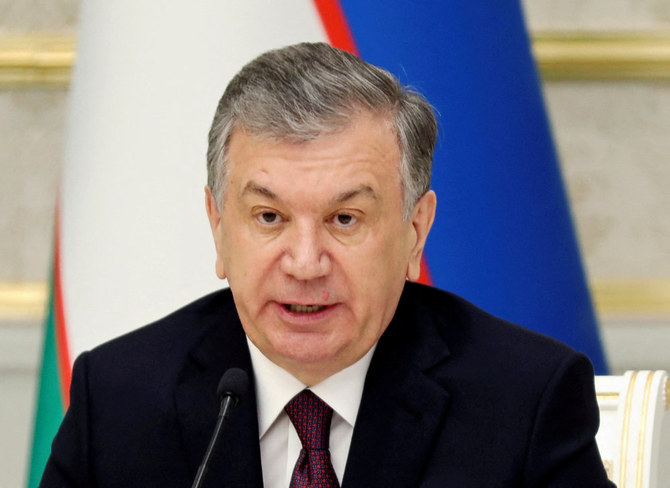
ALMATY: Uzbek President Shavkat Mirziyoyev on Saturday dropped plans to curtail the autonomy of the country’s Karakalpakstan province following a rare public protest in the northwestern region, his office said.
Friday’s rally was called to protest constitutional reform plans that would have changed the status of Karakalpakstan, an autonomous republic home to the Karakalpak people — an ethnic minority group with its own language, Uzbek authorities said.
Police dispersed the protesters after some of them tried to storm local government buildings in the region’s capital, Nukus, following a march and a rally at the city’s central market, local and government officials said.
Mirziyoyev later issued a decree proclaiming a state of emergency in Karakalpakstan for a month “in order to ensure the security of citizens, defend their rights and freedoms and restore the rule of law and order” in the region.
Under the current Uzbek constitution, Karakalpakstan is described as a sovereign republic within Uzbekistan that has the right to secede by holding a referendum.
The new version of the constitution — on which Uzbekistan plans to hold a referendum in the coming months — would no longer mention Karakalpakstan’s sovereignty or right for secession.
But in a swift reaction to the protest, Mirziyoyev said on Saturday during a visit to Karakalpakstan that the changes regarding its status must be dropped from the proposed reform, his office said in a statement.
Karakalpakstan’s government said in a statement earlier on Saturday that police had detained the leaders of Friday’s protest, and several other protesters who had put up resistance.
The changes concerning Karakalpakstan were part of a broader constitutional reform proposed by Mirziyoyev, which also includes strengthening civil rights and extending the presidential term to seven years from five.
If the reform is endorsed in the planned referendum, it would reset Mirziyoyev’s term count and allow him to run for two more terms.

Uzbekistan scraps plans to curb Karakalpak autonomy after protest
Short Url
https://arab.news/46hvz
Uzbekistan scraps plans to curb Karakalpak autonomy after protest
- If the reform is endorsed in the planned referendum, it would reset Mirziyoyev’s term count and allow him to run for two more terms
A South Korean court sentences Yoon to 5 years in prison on charges related to martial law decree
SEOUL: A South Korean court sentenced former President Yoon Suk Yeol to five years in prison Friday on some charges related to his imposition of martial law.
The verdict is the first against Yoon in the eight criminal trials over the decree he issued in late 2024 and other allegations.
The most significant charge against him alleges that he led a rebellion in connection with his martial law enforcement and it carries a potential death penalty.
The Seoul Central District Court in the case decided Friday sentenced him for other charges like his defiance of authorities’ attempts to detain him.
Yoon hasn’t immediately publicly responded to the ruling. But when an independent counsel earlier demanded a 10-year prison term for Yoon over those charges, Yoon’s defense team accused them of being politically driven and lacking legal grounds to demand such “an excessive” sentence.
Yoon has been impeached, arrested and dismissed as president after his short-lived imposition of martial law in December 2024 triggered huge public protests calling for his ouster.
Yoon maintains he didn’t intend to place the country under military rule for an extended period, saying his decree was only meant to inform the people about the danger of the liberal-controlled parliament which obstructed his agenda. But investigators have viewed Yoon’s decree as an attempt to bolster and prolong his rule, charging him with rebellion, abuse of power and other criminal offenses.
The verdict is the first against Yoon in the eight criminal trials over the decree he issued in late 2024 and other allegations.
The most significant charge against him alleges that he led a rebellion in connection with his martial law enforcement and it carries a potential death penalty.
The Seoul Central District Court in the case decided Friday sentenced him for other charges like his defiance of authorities’ attempts to detain him.
Yoon hasn’t immediately publicly responded to the ruling. But when an independent counsel earlier demanded a 10-year prison term for Yoon over those charges, Yoon’s defense team accused them of being politically driven and lacking legal grounds to demand such “an excessive” sentence.
Yoon has been impeached, arrested and dismissed as president after his short-lived imposition of martial law in December 2024 triggered huge public protests calling for his ouster.
Yoon maintains he didn’t intend to place the country under military rule for an extended period, saying his decree was only meant to inform the people about the danger of the liberal-controlled parliament which obstructed his agenda. But investigators have viewed Yoon’s decree as an attempt to bolster and prolong his rule, charging him with rebellion, abuse of power and other criminal offenses.
© 2026 SAUDI RESEARCH & PUBLISHING COMPANY, All Rights Reserved And subject to Terms of Use Agreement.