

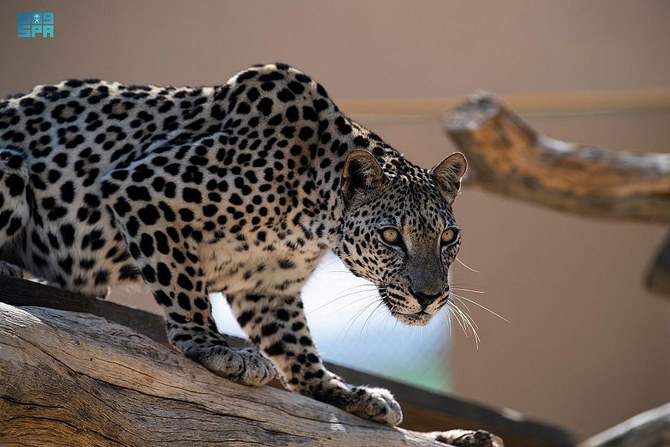
Saudi Arabia’s efforts to protect Arabian Leopard documented by Princess Reema Bint Bandar

Saudi Arabia’s efforts to protect the Arabian Leopard is one of the most prominent global models, said Princess Reema bint Bandar, the Kingdom’s ambassador to the United States while launching a new book entitled, “The Arabian Leopard”. (SPA)
Short Url
Updated 03 July 2022
Follow

Saudi Arabia’s efforts to protect Arabian Leopard documented by Princess Reema Bint Bandar

  • Her book ‘The Arabian Leopard’ documents national efforts through the strategy of the Royal Commission for AlUla to preserve the endangered animal
  • The book contains over 100 works of art and photos

LONDON: Saudi Arabia’s efforts to protect the Arabian Leopard is one of the most prominent global models, said Princess Reema bint Bandar, the Kingdom’s ambassador to the United States.
Princess Reema’s remarks came in the presence of Prince Khalid bin Bandar, the Saudi ambassador to the UK, while launching a new book entitled, “The Arabian Leopard”, Saudi Press Agency reported on Friday.
The book documents national efforts through the strategy of the Royal Commission for AlUla to preserve the Arabian Leopard and protect it from extinction, within the objectives of the Kingdom’s Vision 2030.
Assouline Publishing House in London hosted the book launching ceremony, during which the ambassador emphasized the Kingdom’s efforts to protect the leopard and return it to its natural habitats.

Prepared and written by a number of experts in the fields of environment and nature conservation, the book contains over 100 works of art and photos. It also contains various reports on the history of the Arabian tiger, which has existed for more than 500,000 years in the Arabian Peninsula.
The International Union for Conservation of Nature classifies the Arabian Leopard as among the most endangered animals, with only 200 alive today, due to overhunting and other reasons within the animal’s subsistence system.

The RCU’s strategy to preserve the animal includes a variety of initiatives, including expanding the breeding program by opening a dedicated center in the Sharaan Nature Reserve, and establishing the Global Fund for the Arabian Leopard, for which the authority has allocated $25 million.

In line with the Saudi Green Initiative, RCU aims to convert 80 percent of AlUla’s area into nature reserves, including wild plants and animals, as initiatives to protect the Arabian leopard have also included the resettlement of wild species such as mountain ibex and gazelles.

Rewilding Arabia
Return of the leopard is at the heart of plans to conserve and regenerate Saudi Arabia’s landscapes and wildlife

Enter


keywords

Saudi Food and Drug Authority pioneering digital health safety

Updated 4 sec ago
Follow

Saudi Food and Drug Authority pioneering digital health safety

  • Digital foundation enabled the development of centralized dashboards that provide real-time analysis of adverse events
  • Major improvement has been the use of Robotic Process Automation (RPA) to ensure medication safety works smoothly

TOKYO: Saudi Arabia is establishing itself as a regional leader in digital health regulation by integrating advanced technologies into the Saudi Food and Drug Authority’s (SFDA) pharmacovigilance and cosmetic safety oversight.

In line with Vision 2030’s digital goals, these projects are creating new standards for using data to protect public health, according to the SFDA.

A report by the Oxford Business Group says the transformation began with modernising the National Pharmacovigilance Centre’s adverse reaction reporting system. Moving from paper-based submissions to the fully digital “Saudi Vigilance” platform marked a significant step forward.

The introduction of smart reporting forms with structured data fields and behavioural nudges grounded in psychological principles significantly improved reporting quality and completion rates.

This digital foundation enabled the development of centralised dashboards that provide real-time analysis of adverse events, enabling early identification of safety signals and under-reporting trends.

A major improvement has been the use of Robotic Process Automation (RPA) to ensure medication safety works smoothly. By letting computers handle repetitive tasks like sorting reports and checking data, the SFDA has become more efficient.

The new RPA system for identifying safety signals has also sped things up. These technology solutions have made work easier and happier employees by eliminating boring manual tasks.

The SFDA’s digital changes also help prevent risks by using new online learning tools. The aRMMs e-learning system, with training videos about high-risk medicines, has changed how health care workers learn. Adding digital safety steps directly into hospital computer systems has also made a big difference. This new approach puts safety alerts and learning materials directly into doctors’ daily work, ensuring important information reaches them when they need it.

Digital innovation has also helped prevent medication errors. Moving from the old Phonetic and Orthographic Computer Analysis system to the new Saudi Name Registration (SNR) platform has made it easier to spot potentially confusing drug names. With better computer programs that check both Arabic and English names, plus real-time alerts and automatic updates, the SNR system is a big step forward in ensuring the safety of medicines before they reach the market.

Looking ahead, the SFDA plans to use these digital changes to make cosmetic products safer as well.

Planned projects using artificial intelligence include computer systems that spot rule-breaking, automated ingredient checks, and tools that read customer feedback to identify early warning signs.

This digital strategy puts Saudi Arabia ahead in new ways of making rules. By using artificial intelligence, automation, and data analysis in its work, the SFDA is improving how it tracks medicine safety and preparing for further progress in keeping products safe for consumers.

All these efforts support Vision 2030’s goal of building a knowledge-based economy and keeping Saudi citizens as safe as possible.