Saudi Red Crescent Authority and The Helicopter Co. launch air ambulance service

1 / 2
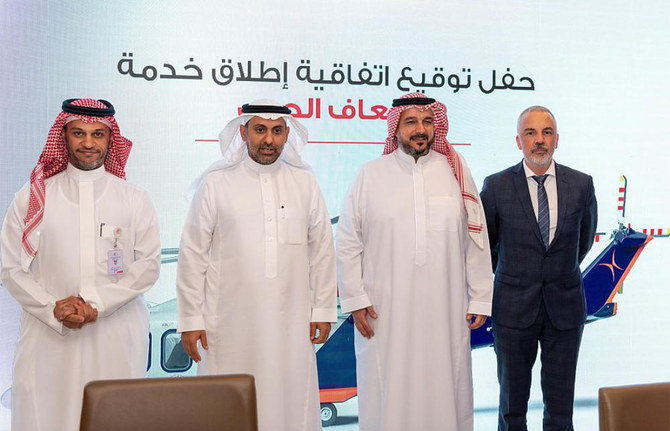
The agreement was signed by President of the Saudi Red Crescent Authority Jalal Al-Owaisi and CEO of The Helicopter Co. Capt. Arnaud Martinez. (SPA)
2 / 2
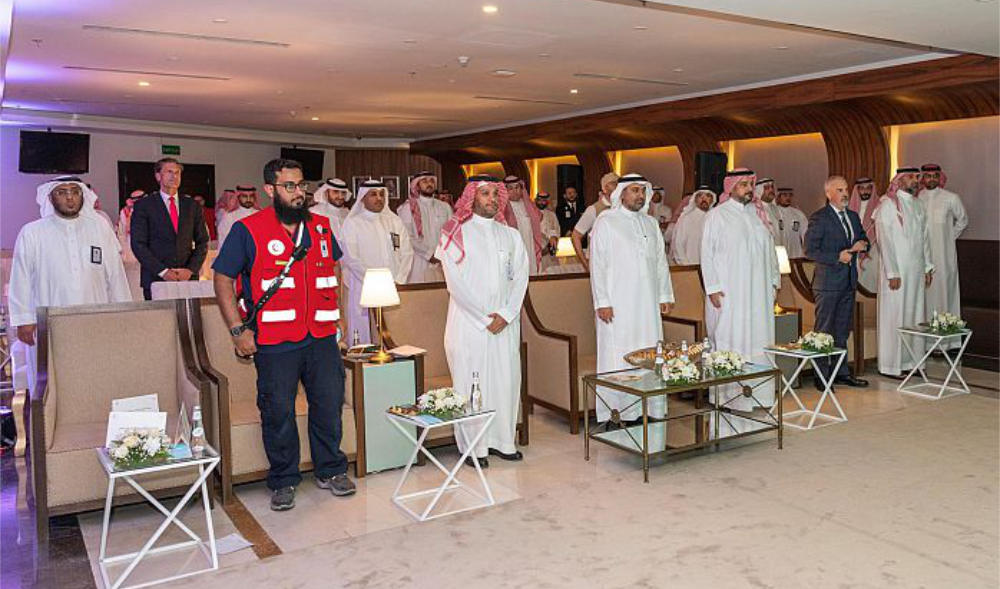
The agreement was signed by President of the Saudi Red Crescent Authority Jalal Al-Owaisi and CEO of The Helicopter Co. Capt. Arnaud Martinez. (SPA)
Short Url
Updated 02 July 2022
Follow

Saudi Red Crescent Authority and The Helicopter Co. launch air ambulance service

  • The service will be implemented in Riyadh first then gradually cover the rest of the Kingdom’s regions in several phases

RIYADH: The Saudi Red Crescent Authority and The Helicopter Co. have signed an agreement to launch an air ambulance service in the Kingdom.

The signing, which aims to raise the quality and efficiency of ambulance services to save lives, was attended by Health Minister Fahd Al-Jalajel, who is also chairman of the board of directors of the Saudi Red Crescent Authority.

The agreement was signed by President of the Saudi Red Crescent Authority Jalal Al-Owaisi and CEO of The Helicopter Co. Capt. Arnaud Martinez.

The agreement stems from the authority’s belief in the importance of an air ambulance, which can respond quickly to save lives in emergencies and exceptional circumstances — such as locations that are difficult to reach otherwise — in which speed of communication is crucial to providing medical care.

The agreement stipulates the provision of air ambulance helicopters around the clock to transport highway accident casualties and transfer critical cases between hospitals.

The service will be implemented in Riyadh first then gradually cover the rest of the Kingdom’s regions in several phases.

Air ambulance helicopters will also be provided to respond to critical cases at holy sites and will be among the services provided by the authority to pilgrims and visitors during the Hajj season.

Raed Ismail, chairman of the board of directors at The Helicopter Co., said that this agreement is the result of relentless efforts and cooperation with the Saudi Red Crescent Authority and represents an important step in keeping pace with modern health systems that contribute to saving lives.

The Helicopter Co. was established in 2019 by the Public Investment Fund as the first local operator of commercial helicopters. Today, the company owns 17 helicopters that provide air ambulance services and are also available for tourism and business trips. It recently signed an agreement to purchase 42 new helicopters.

The air ambulance service falls within the objectives of the Kingdom’s Vision 2030, as it will contribute to facilitating access to emergency medical care and reduce the percentage of deaths and injuries resulting from traffic accidents.



Nearly 60 percent of employers have difficulty finding skilled workers, World Bank official says

Updated 5 sec ago
Follow

Nearly 60 percent of employers have difficulty finding skilled workers, World Bank official says

  • Luis Benveniste: We find that people lack opportunities to upskill or reskill in a rapidly changing labor market
  • Benveniste: There won’t be a jobs revolution without a skills revolution

RIYADH: Skill shortages remain a major constraint on business growth, with nearly 60 percent of employers reporting difficulty finding workers with relevant skills and capabilities, a World Bank official told Arab News.

On the sidelines of the Global Labor Market Conference in Riyadh on Tuesday, Luis Benveniste, senior adviser and acting global director for education and skills at the World Bank, said: “We find that people lack opportunities to upskill or reskill in a rapidly changing labor market, because of automation, because of digital transformation, because of climate change, jobs are changing, and so people are not able to acquire the skills that are relevant.”

He said that an estimated 70 percent of children in low and middle income countries are unable to read an age-appropriate paragraph with comprehension by the age of 10, making it harder to develop job-relevant skills later in life.

“In the absence of those foundational skills, it’s much harder to get those job-relevant skills that will enable them to open up to a fruitful, thriving career,” Benveniste said, adding that the gap often becomes more pronounced as young people enter the labor market.

He said addressing the challenge begins with expanding access to high-quality early childhood education, including proper nutrition and learning stimulation, and supporting teachers to use evidence-based teaching methods to strengthen literacy and numeracy.

He also pointed out the importance of closer coordination between governments, educators, and employers to better align training with labor market demand.

This includes engaging the private sector in curriculum development, improving labor market data systems, and expanding opportunities for apprenticeships and on-the-job training.

“More and more we see results-based financing approaches so that skilling institutions get rewarded not just for training people, but for ensuring that people who have been trained find jobs and hold those jobs six to 12 months after finalizing their training programs,” he said.

Benveniste highlighted the role of short-cycle training and micro-credentials, which allow workers to step in and out of the labor market to build flexible, stackable qualifications over time, helping them move up the job ladder.

He said that improved access to scholarships and training loans is also needed to ensure low-income learners are not excluded.

Tackling unemployment, particularly among youth and women, will require sustained collaboration between the public and private sectors, he said, adding that neither can respond to the scale of labor market change alone.

“There won’t be a jobs revolution without a skills revolution,” Benveniste said, emphasizing the need to invest in priority growth sectors such as manufacturing, agribusiness, and healthcare to ensure workers gain the capabilities required for the jobs of the future.

Speaking to Arab News, Samer Al-Kharashi, director of the UN Tourism Regional Office for the Middle East, said tourism has become a key tool for rural development and job creation, noting that a large share of the world’s poorest populations live in rural areas and are more likely to be in informal or vulnerable employment.

“Eighty-four percent of the world’s poor live in rural areas, (and) those people are twice as likely to be in informal or vulnerable employment.

“If you compare that 80 percent of them versus 44 percent in urban areas, that means that there is very important area that needs the focus of the mutual work from governments, international organizations and private sectors.”

Al-Kharashi said expanding tourism in rural regions can help create jobs, empower women and youth and support small and medium enterprises, but that it requires capacity-building, training, infrastructure and entrepreneurship support, alongside the adoption of digital and sustainable tools, including artificial intelligence.

He said the Kingdom’s tourism sector offers strong potential for Saudi entrepreneurs and SMEs, noting that local knowledge, culture, and technology skills are key assets for attracting visitors seeking authentic experiences.

“One of every 10 jobs is in tourism,” Al-Kharashi said, adding that the sector has moved from a recovery phase into a period of sustained expansion and growth, creating new opportunities in different segments of the industry.

“We can see that in numbers, tourism to national numbers have been raised in 2025 to 1.52 billion, with an increase of 4 percent from last year. So the sector is booming very strong. A lot of opportunities (are) coming. We can see that in depth.” 

He said the tourism industry is largely driven by the private sector, with governments and national organizations playing a regulatory and enabling role to ensure that development preserves the environment and supports the empowerment of women and youth.