

Saudi Red Crescent Authority and The Helicopter Co. launch air ambulance service

1 / 2
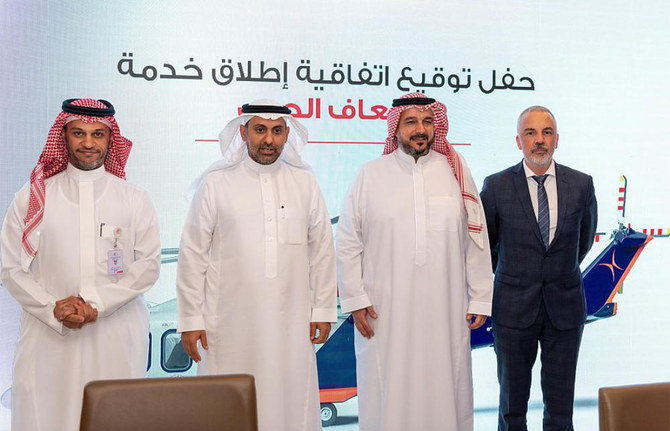
The agreement was signed by President of the Saudi Red Crescent Authority Jalal Al-Owaisi and CEO of The Helicopter Co. Capt. Arnaud Martinez. (SPA)
2 / 2
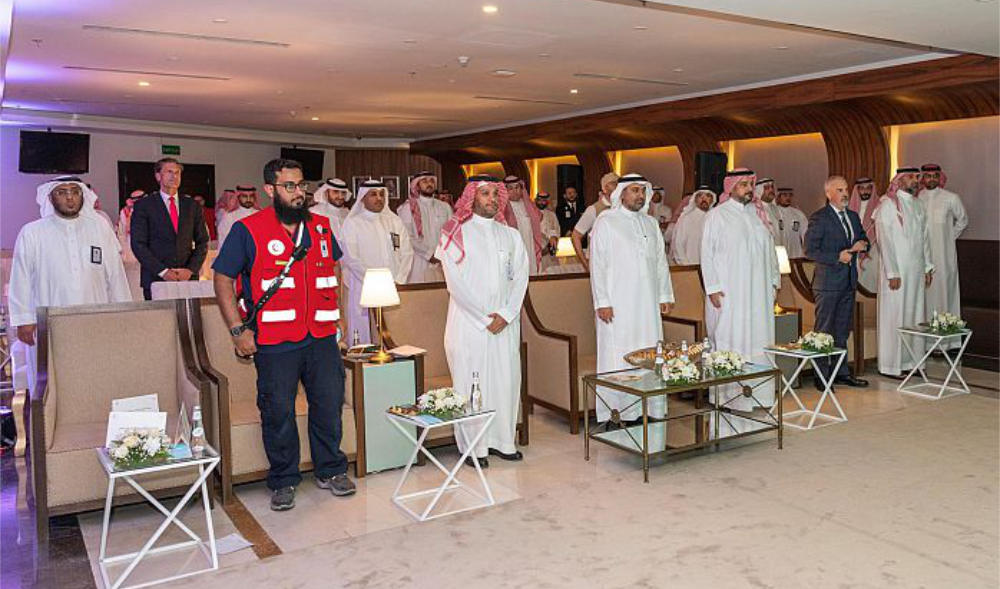
The agreement was signed by President of the Saudi Red Crescent Authority Jalal Al-Owaisi and CEO of The Helicopter Co. Capt. Arnaud Martinez. (SPA)
Short Url
Updated 02 July 2022
Follow

Saudi Red Crescent Authority and The Helicopter Co. launch air ambulance service

  • The service will be implemented in Riyadh first then gradually cover the rest of the Kingdom’s regions in several phases

RIYADH: The Saudi Red Crescent Authority and The Helicopter Co. have signed an agreement to launch an air ambulance service in the Kingdom.

The signing, which aims to raise the quality and efficiency of ambulance services to save lives, was attended by Health Minister Fahd Al-Jalajel, who is also chairman of the board of directors of the Saudi Red Crescent Authority.

The agreement was signed by President of the Saudi Red Crescent Authority Jalal Al-Owaisi and CEO of The Helicopter Co. Capt. Arnaud Martinez.

The agreement stems from the authority’s belief in the importance of an air ambulance, which can respond quickly to save lives in emergencies and exceptional circumstances — such as locations that are difficult to reach otherwise — in which speed of communication is crucial to providing medical care.

The agreement stipulates the provision of air ambulance helicopters around the clock to transport highway accident casualties and transfer critical cases between hospitals.

The service will be implemented in Riyadh first then gradually cover the rest of the Kingdom’s regions in several phases.

Air ambulance helicopters will also be provided to respond to critical cases at holy sites and will be among the services provided by the authority to pilgrims and visitors during the Hajj season.

Raed Ismail, chairman of the board of directors at The Helicopter Co., said that this agreement is the result of relentless efforts and cooperation with the Saudi Red Crescent Authority and represents an important step in keeping pace with modern health systems that contribute to saving lives.

The Helicopter Co. was established in 2019 by the Public Investment Fund as the first local operator of commercial helicopters. Today, the company owns 17 helicopters that provide air ambulance services and are also available for tourism and business trips. It recently signed an agreement to purchase 42 new helicopters.

The air ambulance service falls within the objectives of the Kingdom’s Vision 2030, as it will contribute to facilitating access to emergency medical care and reduce the percentage of deaths and injuries resulting from traffic accidents.


Saudi tourism minister urges governments to ease travel barriers amid global tensions

Updated 22 January 2026
Follow

Saudi tourism minister urges governments to ease travel barriers amid global tensions

  • Tourism Minister Ahmed Al-Khateeb said visa restrictions and connectivity were major hurdles disrupting global movement, urging more frequent flights to smaller destinations
  • Panel examined key challenges facing the $10 trillion global travel industry, including rising geopolitical tensions, climate volatility, artificial intelligence and growing cyber risks

DUBAI: Saudi Arabia’s tourism minister, Ahmed Al-Khateeb, has said travel should be made more accessible and flexible as it fosters dialogue and peace at a time when geopolitical tensions are prompting governments to impose stricter visa restrictions.

He was speaking during a panel discussion at the World Economic Forum’s annual meeting in Davos, which examined the key challenges facing the $10 trillion global travel industry. These include rising geopolitical tensions, climate volatility, artificial intelligence and growing cyber risks.

“Tourism brings peace at a time where everybody wants to hear about peace. It connects people, encourages dialogue, creates economies, and serves smaller economies like Africa, Latin America, the Pacific and the Caribbean countries,” said Al-Khateeb.

His remarks come as the US has tightened visa and immigration policies, affecting nationals from dozens of countries, and as anti-tourism protests have surfaced in parts of Europe amid mounting concerns over overtourism in major destinations.

He highlighted Saudi Arabia’s achievements in tourism, saying the sector has created 250,000 jobs in the last five years and boosted female participation to 47 percent, exceeding the global average of 45 percent. He highlighted the Kingdom’s focus on building new airports and expanding existing ones, as well as boosting the hotel sector to cater for 150 million travelers by 2030.

The sector’s contribution to the economy has grown from about 3 percent in 2020 to 5 percent today, with plans to raise that figure to between 8 and 10 percent by 2030.

With travel and tourism accounting for around 10 percent of global GDP, Al-Khateeb said that raising the sector’s contribution in Saudi Arabia would strengthen the Kingdom’s economy, make it more resilient and sustainable, and “allow us to share our beautiful culture with the world.”

He said visa restrictions and connectivity were major hurdles disrupting global movement, urging more frequent flights to smaller destinations to diversify traveler experiences and expand economies beyond major hubs.

With panelists citing last year’s anti-tourism protests in Spain and Mexico, Al-Khateeb said overtourism, already a challenge in some cities, will worsen as the UN projects an increase in the number of global travelers from 1.5 billion to 2 billion by 2050. He therefore urged governments to promote smaller cities and spread tourism beyond traditional hotspots to boost economic growth and create more jobs.

Panel at the World Economic Forum examined key trends and challenges shaping the $10 trillion global travel industry. (Screengrab)

Expressing similar sentiments, Martin Eurnekian, CEO of Corporacion America International, linked economic growth to travel and said travel deregulation in the past had boosted European economies.

“Our history shows when growth was accelerated and these were the cases where the (travel) industry was set free,” said Eurnekian, adding geopolitical tensions and economic regulations were exacting a heavy cost on the industry.

“This is an industry based on freedom and globalization and if we lose sight of that we can really hurt the industry,” he added.

Cara Morton, CEO of global businesses and operations and a member of the executive committee at Zurich Insurance Group, said “disruption is now the norm,” citing an in-house assessment that found 80 percent of 4,000 business travelers experienced some form of disruption during their journeys.

She highlighted the role of artificial intelligence in steering people to new, less crowded destinations: “Obviously that will require governments to then make sure that those places have got the right infrastructure, but we will be able to see wealth distributed more equally. So the key is how we use AI in this area.”

Al-Khateeb said that while AI can enhance traveler experience, it should not replace human interaction.

“We will use tech when it isn’t necessary … such as using AI (for passengers to) move fast and finish their biometrics, but when you go to destination, you want to be served by humans not machines.”

He highlighted global travel trends, including the growing role of airports as destinations in their own right, driven by retail and food and beverage offerings, as well as the rapid rise of wellness tourism.

“Travel interacts with a wide range of sectors from aviation and airports to mobility, transportation, hotels, retail, and entertainment,” said Al-Khateeb.