

Reopening of girls’ high schools raised at Afghan Taliban’s first national gathering since takeover

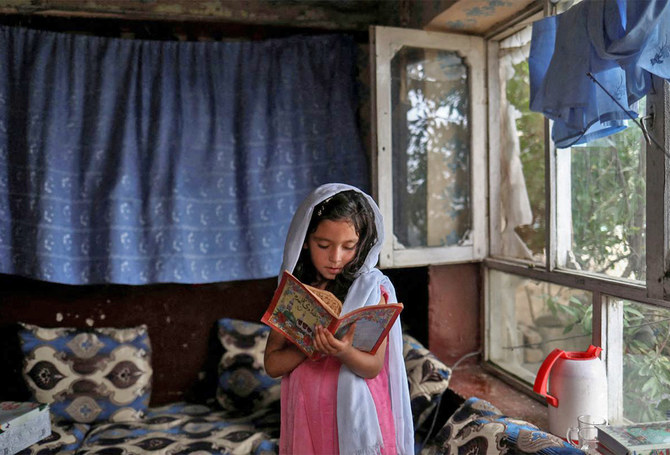
An Afghan girl reads a book inside her home in Kabul, Afghanistan, on June 13, 2022. (REUTERS/File)
Short Url
Updated 30 June 2022
Follow

Reopening of girls’ high schools raised at Afghan Taliban’s first national gathering since takeover

  • Taliban organized gathering of 3,000 male religious and ethnic leaders from across Afghanistan
  • It was the first such gathering to take place since Taliban took over Afghanistan last August

KABUL: At least one participant at a gathering organized by the Taliban of 3,000 male religious and ethnic leaders from across Afghanistan called on Thursday for high schools for girls to reopen.

It was the first such gathering to take place since the Taliban took over the country in August.

The Taliban in March backtracked on their announcement that high schools would open for girls, saying they would remain closed until a plan was drawn up in accordance with Islamic law for them to reopen. read more

The u-turn left students in tears and drew condemnation from humanitarian agencies, rights groups and diplomats.

“They will learn and will be a good guide for their children in society,” said Sayed Nassrullah Waizi, from central Bamiyan province, in calling for the schools to open.

It was not clear how much support this sentiment would receive or how a decision on the issue might be reached.

International governments, particularly Washington, have said the Taliban needs to change its course on women’s rights to roll back the enforcement of sanctions that have severely hampered the banking sector.

Afghanistan is in a deep economic crisis as billions in central bank reserves have been frozen and international sanctions enforced on the banking sector after the Taliban took control.

The country’s acting prime minister said in a speech at the gathering in the capital Kabul that it was aimed at addressing challenges and strengthening the administration.

“The Islamic Emirate of Afghanistan is trying to solve all problems ... this government has been reached after a lot of sacrifice, we should work together to strengthen it,” Mohammad Hasan Akhund said.

Some local media reported sounds of continuous gunfire near the gathering. A Taliban administration spokesman said there was no issue, that security was very high and the sounds of gunfire was due to a mistake by security guards.

The gathering appeared similar to a “loya jirga,” a traditional form of decision making in Afghanistan that some leaders, including former republic President Ashraf Ghani have used.

Civil society groups have criticized the lack of female participation. The Taliban acting deputy prime minister said women’s involvement was taking place as their male family members would attend. read more

Foreign states have called for an inclusive Afghan government. Key ministerial roles are held by Taliban members in an acting basis and the group has ruled out elections.


Deadly militant offensive sweeps northern and eastern Burkina Faso

Updated 6 sec ago
Follow

Deadly militant offensive sweeps northern and eastern Burkina Faso

  • Burkina Faso, ruled by a military junta since September 2022, has faced more than 10 years of raids by groups linked to Al-Qaeda and the Daesh
ABIDJAN: Al-Qaeda-affiliated JNIM has in recent days claimed to have inflicted heavy losses in Burkina Faso as a surge in deadly militant attacks sweeps across the Sahelian state.
Burkina Faso, ruled by a military junta since September 2022, has faced more than 10 years of raids by groups linked to Al-Qaeda and the Daesh, including the Group for the Support of Islam and Muslims (JNIM).
A February UN Security Council report noted that the “pace of JNIM attacks” had slowed in September as fighters were diverted to Mali to back an attempted fuel blockade.
“The group’s efforts in Mali have been the primary focus since early September last year,” said Heni Nsaibia, analyst at conflict monitor ACLED.
But attacks never fully stopped, and JNIM has launched a string of large-scale assaults in northern and eastern Burkina Faso since mid-February, killing dozens, including civilians.
“Since February 14, JNIM has claimed responsibility for 10 attacks across different regions of Burkina Faso,” said Hasret Kargin, an Africa studies researcher at intelligence firm Mintel World.
Deadly assaults
The deadliest incidents targeted Titao’s military base on February 15 in the northwest, where the group says it killed dozens of soldiers.
A separate ambush on the same day left around 50 forestry officers dead in Tandjari in the east.
Around 10 civilians were also killed in Titao, including seven Ghanaian traders.
“This latest round demonstrated a high degree of coordination, given the number of large-scale attacks that occurred between 12 and 22 February,” Nsaibia said.
“Over 130 people” — Burkinabe soldiers, civilian auxiliaries and JNIM fighters — “were killed in this series of battles.”
Kargin noted that JNIM has issued no formal statement explaining the recent uptick after several months of reduced activity.
But militant groups often strike “right before and during” the Muslim holy month of Ramadan, he said, adding current dry-season conditions had helped them on the ground.
‘Smuggling zones’
Recent attacks have gripped the country’s north and east, areas seen as financial hubs for Al-Qaeda’s Sahel branch.
“These are zones with numerous gold sites and key routes that fuel the group’s smuggling activities,” a Burkinabe security analyst said, requesting anonymity.
The north “acts as a bridge” to JNIM’s “main central command” in Mali, Kargin said, while he east — home to a vast nature reserve straddling Niger, Benin and Burkina Faso — allows the group to push into neighboring countries.
The forests, he added, both shield fighters from airstrikes and generate income through illegal timber sales and control of artisanal gold mining.
The Tandjari attack near regional capital Fada N’Gourma highlights JNIM’s growing freedom of movement after having “gained a lot of ground in recent years,” Nsaibia said.
“The question is not the frequency of attacks — they never stopped — but how these groups are able to inflict such heavy losses” when the army claims to be better equipped and better organized, said a Burkinabe political scientist.
The army, which rarely comments on attacks, said in mid-February it now controls 74 percent of national territory, with some “600 villages retaken.”
According to the UN report, JNIM recently appointed a senior leader in eastern Burkina Faso tasked with expanding into Benin, Ivory Coast, Ghana, Niger and Togo.