

As life-saving drugs disappear in Pakistan, pharma industry seeks tax break, price revision

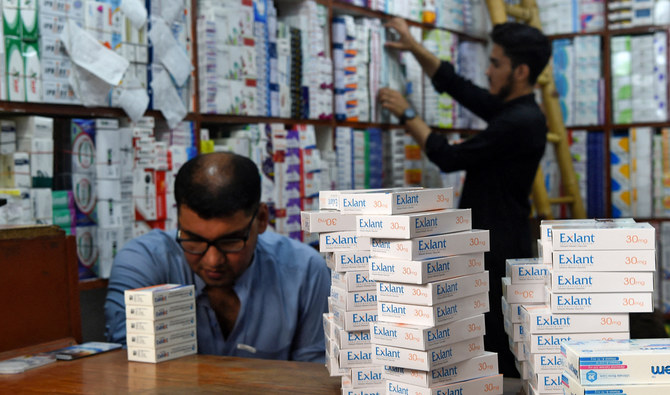
Pharmacists arrange medicines at a pharmacy shop in Peshawar on September 1, 2021. (AFP/ File)
Short Url
Updated 30 June 2022
Follow

As life-saving drugs disappear in Pakistan, pharma industry seeks tax break, price revision

  • Industry reps say new sales tax on medicines will annually deprive them of Rs70 billion
  • Number of life-saving drugs unavailable in the market can go up to 200 within weeks

ISLAMABAD: Pakistan’s pharmaceutical industry has urged the government to abolish a newly imposed one percent sales tax and jack up prices of all medicines to overcome the shortage of over fifty life-saving drugs in the local market.

The new sales tax was included in Pakistan’s latest budget, approved by parliament this week. The government has been struggling to levy maximum direct and indirect taxes on different products and businesses to shore up its fragile economy and meet the conditions of the International Monetary Fund to revive a stalled $6 billion loan program.

“We strongly urge the government to withdraw one percent sales tax on medicines to keep the industry viable and overcome shortage of life-saving drugs in the market,” Qazi Mansoor Dilawar, chairman of Pakistan Pharmaceutical Manufacturers’ Association, told Arab News.

He said the supply of over fifty essential medicines had been disrupted in the market since manufacturers were importing the raw material to produce only those medicines that were profitable to them.

“Our input cost has escalated manifold in the last two years with the appreciation of dollar, increase in freight charges and international raw material, but the government is not willing to increase the prices of medicine,” he said.

The annual total pharmaceutical market in Pakistan is estimated to be around Rs700 billion. Pakistan imports much of the medicinal raw material from China and industrial experts say freight charges have increased around eight times since the onset of the COVID-19 pandemic.

In January, the country’s ousted premier Imran Khan’s administration imposed a 17 percent sales tax on the import of raw material, promising that the amount would be refunded to pharmaceutical companies after the consumption of their stock.

Prime Minister Shehbaz Sharif’s government has now withdrawn the 17 percent tax on the import of raw material, but levied one percent sales tax on all medicines.

“This one percent sales tax on medicines means the industry will be collectively paying Rs70 billion in tax this year,” Dilawar said.

Unlike other businesses, the pharma industry cannot increase medicines prices on its own since only the federal government is authorized to revise the rates of lifesaving drugs.

“We have a capping of every medicine and cannot increase their price on our own,” the association chief said, adding if the government failed to withdraw the sales tax and increase medicines prices, there would be a shortage of another two hundred drugs in the market within a couple of weeks.

The government has promised to look into the demands of pharmaceutical companies and address their concerns to ensure smooth supply of medicines in the market.

“We are well aware of the pharma industry’s demands and are trying to address them,” Sajid Hussain Shah, a spokesperson for the health ministry, told Arab News.

However, he warned that the ministry would initiate action in case medicines were hoarded to create an artificial shortage in the market.

“We are closely monitoring the medicine supply,” he said, “and won’t spare anyone who is found guilty of creating artificial shortage of medicines.”


Pakistani, Bangladeshi officials discuss trade, investment and aviation as ties thaw

Updated 28 December 2025
Follow

Pakistani, Bangladeshi officials discuss trade, investment and aviation as ties thaw

  • Pakistan and Bangladesh were once one nation, but they split in 1971 as a result of a bloody civil war
  • Ties between Pakistan, Bangladesh have warmed up since last year and both nations have resumed sea trade

ISLAMABAD: Pakistan's High Commissioner to Bangladesh Imran Haider on Sunday met Chief Adviser Muhammad Yunus in Dhaka, the latter's office said on, with the two figures discussing trade, investment and aviation.

Pakistan and Bangladesh were once one nation, but they split in 1971 as a result of a bloody civil war, which saw the part previously referred to as East Pakistan seceding to form the independent nation of Bangladesh.

Ties between Pakistan and Bangladesh have warmed up since former prime minister Sheikh Hasina’s ouster as a result of a student-led uprising in August 2024. Relations remain frosty between Dhaka and New Delhi over India’s decision to grant asylum to Hasina.

Pakistan has attempted to forge closer ties with Bangladesh in recent months and both South Asian nations last year began sea trade, followed by efforts to expand government-to-government commerce.

"During the meeting, both sides discussed ways to expand cooperation in trade, investment, and aviation as well as scaling up cultural, educational and medical exchanges to further strengthen bilateral relations between the two South Asian nations," Yunus's office said in a statement on X.

In 2023-24 Pakistan exported goods worth $661 million to Bangladesh, while its imports were only $57 million, according to the Trade Development Authority of Pakistan. In Aug. this year, the Pakistani and Bangladeshi commerce ministries signed a memorandum of understanding to establish a Joint Working Group on Trade, aiming to raise their bilateral trade volume to $1 billion in the financial year that began in July.

The Pakistani high commissioner noted that bilateral trade has recorded a 20 percent growth compared to last year, with business communities from both countries actively exploring new investment opportunities, according to the statement.

He highlighted a significant increase in cultural exchanges, adding that Bangladeshi students have shown strong interest in higher education opportunities in Pakistan, particularly in medical sciences, nanotechnology, and artificial intelligence. Haider also said that Dhaka-Karachi direct flights are expected to start in January.

"Chief Adviser Professor Muhammad Yunus welcomed the growing interactions between the two countries and emphasized the importance of increased visits as well as cultural, educational and people-to-people exchanges among SAARC (South Asian Association for Regional Cooperation) member states," the statement read.

"Professor Yunus also underscored the need to further boost Bangladesh–Pakistan trade and expressed hope that during Mr. Haider’s tenure, both countries would explore new avenues for investment and joint venture businesses."