

As life-saving drugs disappear in Pakistan, pharma industry seeks tax break, price revision

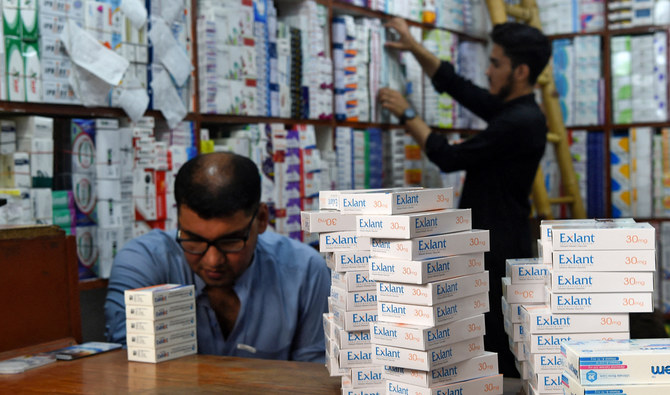
Pharmacists arrange medicines at a pharmacy shop in Peshawar on September 1, 2021. (AFP/ File)
Short Url
Updated 30 June 2022
Follow

As life-saving drugs disappear in Pakistan, pharma industry seeks tax break, price revision

  • Industry reps say new sales tax on medicines will annually deprive them of Rs70 billion
  • Number of life-saving drugs unavailable in the market can go up to 200 within weeks

ISLAMABAD: Pakistan’s pharmaceutical industry has urged the government to abolish a newly imposed one percent sales tax and jack up prices of all medicines to overcome the shortage of over fifty life-saving drugs in the local market.

The new sales tax was included in Pakistan’s latest budget, approved by parliament this week. The government has been struggling to levy maximum direct and indirect taxes on different products and businesses to shore up its fragile economy and meet the conditions of the International Monetary Fund to revive a stalled $6 billion loan program.

“We strongly urge the government to withdraw one percent sales tax on medicines to keep the industry viable and overcome shortage of life-saving drugs in the market,” Qazi Mansoor Dilawar, chairman of Pakistan Pharmaceutical Manufacturers’ Association, told Arab News.

He said the supply of over fifty essential medicines had been disrupted in the market since manufacturers were importing the raw material to produce only those medicines that were profitable to them.

“Our input cost has escalated manifold in the last two years with the appreciation of dollar, increase in freight charges and international raw material, but the government is not willing to increase the prices of medicine,” he said.

The annual total pharmaceutical market in Pakistan is estimated to be around Rs700 billion. Pakistan imports much of the medicinal raw material from China and industrial experts say freight charges have increased around eight times since the onset of the COVID-19 pandemic.

In January, the country’s ousted premier Imran Khan’s administration imposed a 17 percent sales tax on the import of raw material, promising that the amount would be refunded to pharmaceutical companies after the consumption of their stock.

Prime Minister Shehbaz Sharif’s government has now withdrawn the 17 percent tax on the import of raw material, but levied one percent sales tax on all medicines.

“This one percent sales tax on medicines means the industry will be collectively paying Rs70 billion in tax this year,” Dilawar said.

Unlike other businesses, the pharma industry cannot increase medicines prices on its own since only the federal government is authorized to revise the rates of lifesaving drugs.

“We have a capping of every medicine and cannot increase their price on our own,” the association chief said, adding if the government failed to withdraw the sales tax and increase medicines prices, there would be a shortage of another two hundred drugs in the market within a couple of weeks.

The government has promised to look into the demands of pharmaceutical companies and address their concerns to ensure smooth supply of medicines in the market.

“We are well aware of the pharma industry’s demands and are trying to address them,” Sajid Hussain Shah, a spokesperson for the health ministry, told Arab News.

However, he warned that the ministry would initiate action in case medicines were hoarded to create an artificial shortage in the market.

“We are closely monitoring the medicine supply,” he said, “and won’t spare anyone who is found guilty of creating artificial shortage of medicines.”


Pakistan, UK sign £35 million Green Compact to strengthen climate resilience

Updated 21 December 2025
Follow

Pakistan, UK sign £35 million Green Compact to strengthen climate resilience

  • Pakistan ranks among nations most vulnerable to climate change and has seen erratic changes in its weather patterns
  • UK will help Pakistan mobilize climate finance, strengthen regulatory frameworks and develop bankable climate projects

ISLAMABAD: Pakistan and the United Kingdom (UK) have formalized a comprehensive climate partnership with the launch of a Green Compact that aims to enhance climate resilience, accelerate clean energy transition and scale up nature-based solutions, including mangrove conservation, Pakistani state media reported on Sunday.

The agreement, signed in Islamabad by Federal Minister for Climate Change and Environmental Coordination Dr. Musadik Malik and UK Minister for International Development Jennifer Chapman, unlocks £35 million in targeted support for green development and long-term climate action, according to Radio Pakistan broadcaster.

Pakistan ranks among nations most vulnerable to climate change and has seen erratic changes in its weather patterns that have led to frequent heatwaves, untimely rains, storms, cyclones, floods and droughts in recent years. In 2022, monsoon floods killed over 1,700 people, displaced another 33 million and caused over $30 billion losses, while another 1,037 people were killed in floods this year.

Mohammad Saleem Shaikh, a spokesperson for Pakistan’s Ministry of Climate Change, described the compact as a “decisive move toward action-oriented climate cooperation,” noting that its implementation over the next decade will be critical for Pakistan which regularly faces floods, heatwaves and water stress.

“The Compact is structured around five core pillars: climate finance and investment, clean energy transition, nature-based solutions, innovation and youth empowerment, and adaptation and resilience,” the report read.

“Under the agreement, the UK will work with Pakistan to mobilize public and private climate finance, strengthen regulatory frameworks for green investment, and develop bankable climate projects.”

Clean energy forms a central component of Pakistan’s transition, with Islamabad planning to expand solar and wind generation to reduce fossil fuel dependence, improve energy security and stabilize power costs, according to Shaikh.

“Renewable energy is now economically competitive, making the transition both environmentally and financially viable,” he was quoted as saying.

“Nature-based solutions, particularly large-scale mangrove restoration, will protect coastal communities from storm surges and erosion while enhancing biodiversity and carbon sequestration.”

Under the Compact, technical support, mentoring and access to investors will be provided to climate-smart startups and young innovators, reflecting Pakistan’s recognition of youth-led initiatives as central to future climate solutions.

On the occasion, Chapman, on her first official visit to Pakistan, underscored the urgency of climate action, highlighting the UK’s support for renewable energy, mangrove and ecosystem restoration, early-warning systems, climate budgeting and international investment flows into Pakistan.

Shaikh described the Green Compact as “a strategic turning point” in Pakistan–UK relations on climate change, saying its effective implementation is essential for Pakistan to meet its national climate targets.