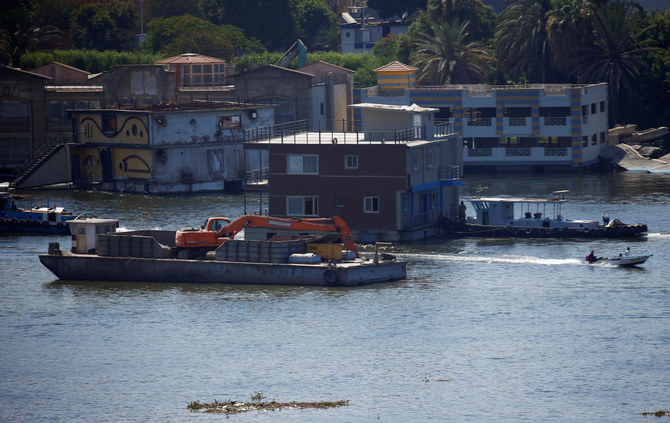
CAIRO: Owners of the Nile’s famous houseboats in the heart of Egypt’s capital are having their homes demolished and towed away as authorities impound what they say are unlicensed dwellings.
The boats, many of them elegant two-story structures with verandas, have been moored for decades along the tree-lined banks of the Nile between the island of Zamalek and Giza, just west of central Cairo.
They have featured in films and literature, such as Nobel laureate Naguib Mahfouz’s novel Adrift on the Nile.
Last week, owners of about 30 houseboats were served with notices saying that their boats would be impounded. Egypt’s water and irrigation ministry said on Tuesday that 15 had been removed, with the rest to be dealt with over the next few days.
The ministry posted pictures of the boats being smashed by diggers on barges and being towed away by tugs.
The water and irrigation ministry could not be reached for comment.
Ikhlas Helmy, 87, whose houseboat was still standing on Wednesday, said she had invested her savings in it and could not bear to leave.
“I was born in a houseboat, this is my entire life,” she said. “My husband loved the Nile like me. He died before he could refurbish the houseboat, so I did it.”
Authorities say the removals follow warnings to owners, presenting them as part of efforts to maintain the river and prioritize commerce and tourism.
In comments to local media Ayman Anwar, an official responsible for the protection of the Nile, compared the houseboats to polluting old cars.
Owners say they had been challenging sharp increases in mooring fees, but had continued to pay other fees for use of the river bank and navigation rights.
They and their supporters on social media say the removal of the boats is the latest in a series of assaults on places of beauty or historic interest in the capital.
Officials have not said what development might be planned after the boats are gone.
On the eastern bank of the same stretch of the river, Egypt’s military has led the construction of a concrete walkway dotted with shops and cafes.
Elsewhere in Cairo, residential blocks, trees and parts of old cemeteries have been uprooted to make way for a network of new roads and bridges.
Ahmed el-Hosseiny, whose houseboat was towed away on Tuesday, described emptying it after being served with an eviction notice.
“We started to collect our possessions, our stories, our history, our hearts, our memories, and our feelings and place them into boxes,” he said.

Owners distraught as historic Nile houseboats are removed
https://arab.news/mkew7
Owners distraught as historic Nile houseboats are removed
- Many of the elegant two-story houseboats have been moored for decades
Arts festival’s decision to exclude Palestinian author spurs boycott
- A Macquarie University academic who researches Islamophobia and Palestine, Abdel-Fattah responded saying it was “a blatant and shameless act of anti-Palestinian racism and censorship,” with her lawyers issuing a letter to the festival
SYDENY: A top Australian arts festival has seen the withdrawal of dozens of writers in a backlash against its decision to bar an Australian Palestinian author after the Bondi Beach mass shooting, as moves to curb antisemitism spur free speech concerns.
The shooting which killed 15 people at a Jewish Hanukkah celebration at Sydney’s Bondi Beach on Dec. 14 sparked nationwide calls to tackle antisemitism. Police say the alleged gunmen were inspired by Daesh.
The Adelaide Festival board said last Thursday it would disinvite Randa Abdel-Fattah from February’s Writers Week in the state of South Australia because “it would not be culturally sensitive to continue to program her at this unprecedented time so soon after Bondi.”
FASTFACTS
• Abdel-Fattah responded, saying it was ‘a blatant and shameless act of anti-Palestinian racism and censorship.’
• Around 50 authors have since withdrawn from the festival in protest, leaving it in doubt, local media reported.
A Macquarie University academic who researches Islamophobia and Palestine, Abdel-Fattah responded saying it was “a blatant and shameless act of anti-Palestinian racism and censorship,” with her lawyers issuing a letter to the festival.
Around 50 authors have since withdrawn from the festival in protest, leaving it in doubt, local media reported.
Among the boycotting authors, Kathy Lette wrote on social media the decision to bar Abdel-Fattah “sends a divisive and plainly discriminatory message that platforming Australian Palestinians is ‘culturally insensitive.'”
The Adelaide Festival said in a statement on Monday that three board members and the chairperson had resigned. The festival’s executive director, Julian Hobba, said the arts body was “navigating a complex moment.”
a complex and unprecedented moment” after the “significant community response” to the board decision.
In the days after the Bondi Beach attack, Jewish community groups and the Israeli government criticized Prime Minister Anthony Albanese for failing to act on a rise in antisemitic attacks and criticized protest marches against Israel’s war in Gaza held since 2023.
Albanese said last week a Royal Commission will consider the events of the shooting as well as antisemitism and social cohesion in Australia. Albanese said on Monday he would recall parliament next week to pass tougher hate speech laws.
On Monday, New South Wales state premier Chris Minns announced new rules that would allow local councils to cut off power and water to illegally operating prayer halls.
Minns said the new rules were prompted by the difficulty in closing a prayer hall in Sydney linked to a cleric found by a court to have made statements intimidating Jewish Australians.
The mayor of the western Sydney suburb of Fairfield said the rules were ill-considered and councils should not be responsible for determining hate speech.
“Freedom of speech is something that should always be allowed, as long as it is done in a peaceful way,” Mayor Frank Carbone told Reuters.


