

India In-Focus — Rupee hits record low; Shares fall; UltraTech Cement paying for Russian coal in Chinese yuan

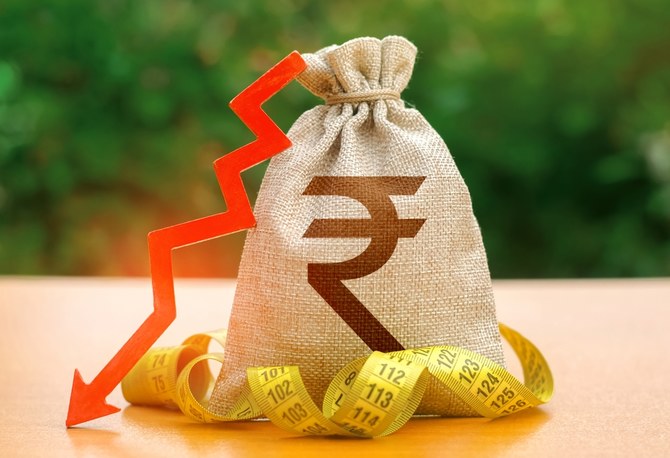
The rupee has lost more than 6 percent against the dollar so far this year. (Shutterstock)
Short Url
Updated 29 June 2022
Follow

India In-Focus — Rupee hits record low; Shares fall; UltraTech Cement paying for Russian coal in Chinese yuan

MUMBAI: The Indian rupee on Wednesday touched record lows for a second straight session on persisting concerns about rising inflation and weak growth, even as the central bank sold dollars to limit losses.

The partially convertible rupee ended at 78.9650 per dollar after touching a lifetime low of 78.97. The currency had closed at 78.77 on Tuesday.

The rupee has lost more than 6 percent against the dollar so far this year, and analysts believe it is likely to weaken further.

“The Indian Rupee has been adversely affected mainly by the FIIs pulling out funds from the equity market, rising crude prices, the deteriorating trade balance and dollar strengthening,” analysts at Emkay Wealth Management said in a note.

Indian shares fall

Indian shares fell on Wednesday to snap a four-day winning streak as worries over inflation resurfaced amid surging oil prices, while domestic explorers rose in late trade after the country approved a plan to give marketing freedom to sell crude.

The NSE Nifty 50 index closed 0.32 percent lower to 15,799.10 and the S&P BSE Sensex slipped 0.3 percent to 53,026.97. 

India cement maker paying for Russian coal in Chinese yuan

Indian cement producer, UltraTech Cement, is importing a cargo of Russian coal and paying using Chinese yuan, according to an Indian customs document reviewed by Reuters, a rare payment method that traders say could become more common.

UltraTech is bringing in 157,000 tons of coal from Russian producer SUEK that loaded on the bulk carrier MV Mangas from the Russian Far East port of Vanino, the document showed. It cites an invoice dated June 5 that values the cargo at 172,652,900 yuan ($25.81 million).

Two trade sources familiar with the matter said the cargo’s sale was arranged by SUEK’s Dubai-based unit, adding that other companies have also placed orders for Russian coal using yuan payments.

The increasing use of the yuan to settle payments could help insulate Moscow from the effects of western sanctions imposed on Russia over its invasion of Ukraine and bolster Beijing’s push to further internationalize the currency and chip away at the dominance of the US dollar in global trade.

(With inputs from Reuters)


European gas prices soar almost 50% as Iran conflict halts Qatar LNG output

Updated 02 March 2026
Follow

European gas prices soar almost 50% as Iran conflict halts Qatar LNG output

  • Analysts warn prolonged disruption could push prices higher
  • Some shipments of oil, LNG through Strait of Hormuz suspended
  • Benchmark Asian LNG price up almost 39 percent

LONDON: ​Benchmark Dutch and British wholesale gas prices soared by almost 50 percent on Monday, after major liquefied natural gas exporter Qatar Energy said it had halted production due to attacks in the Middle East.

Qatar, soon to cement its role as the world’s second largest LNG exporter after the US, plays a major role in balancing both Asian and European markets’ demand of LNG.

Most tanker owners, oil majors and ‌trading houses ‌have suspended crude oil, fuel and liquefied natural ​gas shipments ‌via ⁠the ​Strait of ⁠Hormuz, trade sources said, after Tehran warned ships against moving through the waterway.

Europe has increased imports of LNG over the past few years as it seeks to phase out Russian gas following Russia’s invasion of Ukraine.

Around 20 percent of the world’s LNG transits through the Strait of Hormuz and a prolonged suspension or full closure would increase global competition for other ⁠sources of the gas, driving up prices internationally.

“Disruptions to ‌LNG flows would reignite competition between ‌Asia and Europe for available cargoes,” said ​Massimo Di Odoardo, vice president, gas ‌and LNG research at Wood Mackenzie.

The Dutch front-month contract at the ‌TTF hub, seen as a benchmark price for Europe, was up €14.56 at €46.52 per megawatt hour, or around $15.92/mmBtu, by 12:55 p.m. GMT, ICE data showed.

Prices were already some 25 percent higher earlier in the day but extended gains ‌after QatarEnergy’s production halt.

Benchmark Asian LNG prices jumped almost 39 percent on Monday morning with the S&P Global ⁠Energy Japan-Korea-Marker, widely used ⁠as an Asian LNG benchmark, at $15.068 per million British thermal units, Platts data showed.

“If LNG/gas markets start to price in an extended period of losses to Qatari LNG supply, TTF could potentially spike to 80-100 euros/MWh ($28-35/mmBtu),” Warren Patterson, head of commodities strategy at ING, said. The British April contract was up 40.83 pence at 119.40 pence per therm, ICE data showed.

Europe is also relying on LNG imports to help fill its gas storage sites which have been depleted over the winter and are currently around 30 percent full, the latest data from Gas Infrastructure ​Europe showed. In the European carbon ​market, the benchmark contract was down €1.10 at €69.17 a tonne