

US aims to raise $200bn as part of G7 rival to China’s Belt & Road

Short Url
Updated 26 June 2022
Follow

US aims to raise $200bn as part of G7 rival to China’s Belt & Road

WASHINGTON: The US aims to raise $200 billion in private and public funds over five years to fund needed infrastructure in developing countries under a G7 initiative aimed at countering China’s multitrillion-dollar Belt and Road project, the White House said on Sunday.
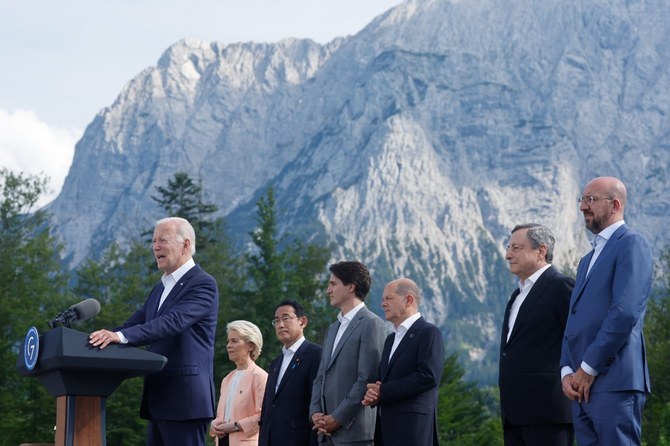
US President Joe Biden will unveil the plans, flanked by other Group of Seven leaders, some of whom have already unveiled their own separate initiatives, at their annual gathering being held this year at Schloss Elmau in southern Germany.

Partnership
Increasingly worried about China, G7 leaders first floated plans for the project last year, and are formally launching it now under a fresh title, “Partnership for Global Infrastructure and Investment” while dropping the moniker “Build Back Better World” first coined by Biden during his presidential campaign.
Biden will unveil several specific projects at a G7 side event, joined by leaders from Britain, Germany, Japan, the European Union and Canada, vowing to focus on projects that help tackle climate change as well as improve global health, gender equity and digital infrastructure. Notably absent will be French President Emmanual Macron who had formally joined the Chinese infrastructure program.
“The president’s not thinking that we need to spend dollar for dollar versus China ... though if you add up what the US and the G7 partners are going to be announcing, it comes pretty close to the number,” one senior US official told reporters.
The funds would be raised through grants and federal funds, and by leveraging private-sector investments, the White House said, adding that hundreds of billions of additional dollars could come from multilateral development banks, development finance institutions, sovereign wealth funds and others.

BRI scheme
China’s Belt and Road Initiative scheme, which Chinese President Xi Jinping launched in 2013, involves development and investment initiatives in over 100 countries, with a range of projects including railways, ports and highways.
White House officials say Xi’s plan to create a modern version of the ancient Silk Road trade route has provided little tangible benefit for many developing countries, with top jobs going to Chinese workers, while increasing rates of forced and child labor.
Biden will highlight several flagship projects, including a $2 billion solar development project in Angola with support from the Commerce Department, the US Export-Import Bank, US firm AfricaGlobal Schaffer, and US project developer Sun Africa.
Together with G7 members and the EU, Washington will also provide $3.3 million in technical assistance to Institut Pasteur de Dakar in Senegal as it develops an industrial-scale flexible multi-vaccine manufacturing facility in that country that can eventually produce COVID-19 and other vaccines.

Childcare Incentive Fund
The US Agency for International Development will also commit up to $50 million over five years to the World Bank’s new global Childcare Incentive Fund, a project aimed at address the gap in suitable childcare infrastructure.


Saudi Aramco achieves significant progress in its gas production plan

Updated 26 February 2026
Follow

Saudi Aramco achieves significant progress in its gas production plan

RIYADH: Saudi Aramco has announced the achievement of significant progress in its plan to expand gas production, with the start of production at the Jafurah field, the largest unconventional gas field in the Middle East, and the commencement of operational activities at the Tanajib Gas Plant, one of the largest gas plants in the world.

The oil giant aims to increase its sales gas production capacity by approximately 80 percent by 2030 compared to 2021 production levels, reaching nearly 6 million barrels of oil equivalent per day from total gas and associated liquids production, according to the Saudi Press Agency.

This is expected to generate additional operating cash flows ranging between $12 billion and $15 billion in 2030, subject to future demand for sales gas and liquids prices.

President and CEO of Saudi Aramco, Amin Al-Nasser, said: “We are proud to commence production at the Jafurah field and begin operations at the Tanajib Gas Plant. These are major achievements for Saudi Aramco and the future of energy in the Kingdom. Our ambitious gas program is expected to become a key source of profitability.”

He affirmed that these mega-projects contribute to meeting the growing domestic demand for gas, supporting industrialization and development in several key sectors, in addition to producing significant quantities of high-value liquids.

Al-Nasser expressed his gratitude for the support, trust, and attention that Saudi Aramco receives from the Custodian of the Two Holy Mosques, King Salman bin Abdulaziz Al Saud, and His Royal Highness Prince Mohammed bin Salman bin Abdulaziz Al Saud, crown prince and prime minister, noting that this has had the most profound impact on the company’s achievements and distinguished projects that serve the Kingdom’s Vision 2030.

The gas extracted from the Jafurah field is expected to support the Kingdom’s growth targets in key sectors such as energy, artificial intelligence, major industries, and petrochemicals, potentially providing a major boost to the Kingdom’s economy and strengthening its position among the world’s top ten gas producers.

Saudi Aramco began first producing unconventional shale gas from the Jafurah field in December 2025, with technology playing a pivotal role in unlocking the potential of the Jafurah field and establishing it as a global benchmark for unconventional gas development. 

Since its inception, the project has leveraged technology to help reduce drilling and stimulation costs and enhance well productivity, contributing to its strong economic prospects.

The Jafurah area covers 17,000 sq. km and is estimated to contain 229 trillion standard cubic feet of raw gas and 75 billion barrels of condensates. The Jafurah field project aims to produce 2 billion standard cubic feet per day of sales gas, 420 million standard cubic feet per day of ethane, and approximately 630,00 barrels per day of gas liquids and condensates by 2030.

The Tanajib Gas Plant is a key pillar in Aramco’s strategy to increase gas processing capacities and diversify its energy product portfolio, helping to foster long-term economic growth. 

Operations began in December 2025, and its raw gas processing capacity is expected to reach 2.6 billion standard cubic feet per day in 2026. The start of operations at the Tanajib Plant coincided with the commencement of production from the Marjan field expansion and development program. 

The plant is distinguished by its digital integration, enhanced operational efficiency, capability to execute complex projects, and optimal use of resources. It processes raw gas associated with crude oil production from the offshore Marjan and Zuluf fields.

Aramco’s gas expansion is expected to create thousands of direct and indirect job opportunities, generating significant added value and strengthening its position as a reliable energy provider. 

It also helps meet the growing demand for natural gas and enhances its supply to national industries. 

The expansion strategy supports efforts aimed at achieving the optimal energy mix for local electricity generation, advancing the Kingdom’s liquid fuel displacement program, which will have a positive environmental impact, supporting the Kingdom’s ambition to achieve net-zero emissions by 2060, enhancing energy security, and contributing to building a more diversified national economy.