Myanmar says seized drugs worth half a billion dollars torched

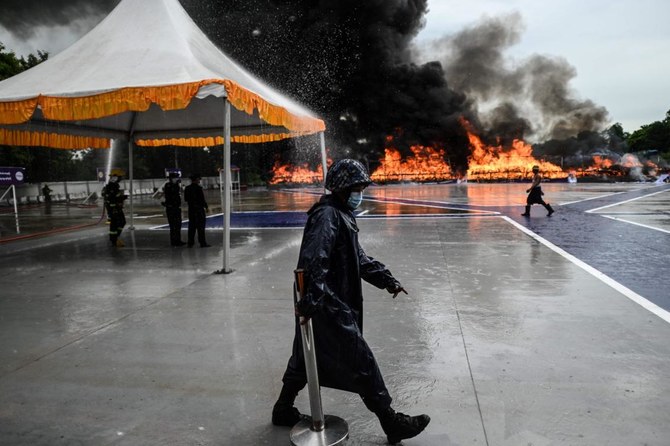
Some analysts caution the $642 million bonfires are part of a long-running game of smoke and mirrors played by the Myanmar junta government. (AFP)
Short Url
Updated 26 June 2022
Follow

Myanmar says seized drugs worth half a billion dollars torched

  • Almost two tons of heroin and more than 630 million meth pills go up

YANGON: Myanmar authorities said they torched more than half a billion dollars worth of narcotics on Sunday as part of eradication efforts for World Drug Day, as the UN warns that production of methamphetamine in the region is hitting record levels.
Almost two tons of heroin and more than 630 million “yaba” meth pills went up in smoke at ceremonies in Myanmar’s commercial hub of Yangon, the central city of Mandalay and Shan state in the north, authorities said.
But some analysts cautioned that the $642 million bonfires are part of a long-running game of smoke and mirrors played by a junta government not serious about tackling the problem.
The televised burnings represent a “decade-long delusion” about Myanmar’s multibillion-dollar drug industry, independent analyst David Mathieson said.
“The military pretends to get serious about drug eradication and the West pretends to believe them,” he said.
There was “active military complicity in protecting large-scale drug production to ensure stability in conflict zones,” Mathieson added.
This includes Shan state — Southeast Asia’s primary source of meth according to the United Nations.
The state is home to militias and has seen relatively little violence in opposition to the military since Myanmar’s generals seized power in a coup last year.
At the ceremony in Yangon, bundles of meth wrapped in innocuous-looking Chinese tea packaging sat alongside bricks of cannabis as well as bags of ketamine and MDMA.
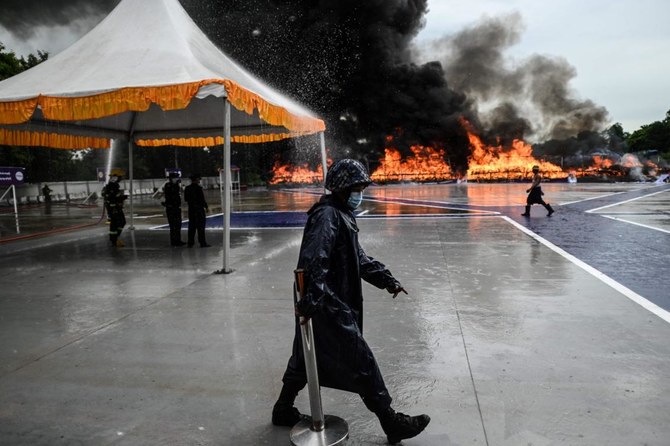
A series of small explosions sent the contraband up in flames before thick plumes of black smoke billowed into the sky.
Firefighters moved in for safety and police officers took selfies against the backdrop of the blaze while Burmese pop music blared through speakers.
Last month the UN said law enforcement across Southeast and East Asia netted nearly 172 tons of meth in 2021 — about seven times more than a decade ago.
The surge in supply has sent street prices in Thailand and Malaysia crashing to all-time lows.
From Shan state the drugs are increasingly shipped to Laos, then Thailand before reaching Malaysia, where they are trafficked onwards to countries throughout the Asia-Pacific, the UN report said.


Nigerian police deny church attacks as residents insist 168 people are held by armed groups

Updated 11 sec ago
Follow

Nigerian police deny church attacks as residents insist 168 people are held by armed groups

Kaduna State Police Commissioner Muhammad Rabiu described news reports of the attacks as rumors
It is common for police and locals to have contradicting accounts of attacks in Nigeria’s hard-hit villages

KADUNA, Nigeria: Nigerian police denied reports of simultaneous church attacks in northwestern Kaduna state over the weekend, even as residents shared accounts of kidnappings at the churches in interviews Tuesday.
A state lawmaker, Usman Danlami Stingo, told The Associated Press on Monday that 177 people were abducted by an armed group Sunday. Eleven escaped and 168 are still missing, according to the lawmaker and residents interviewed by AP.
Kaduna State Police Commissioner Muhammad Rabiu described news reports of the attacks as rumors, saying the police visited one of the three churches in the district of Kajuru and “there was no evidence of the attack.”
It is common for police and locals to have contradicting accounts of attacks in Nigeria’s hard-hit villages.
“I am one of the people who escaped from the bandits. We all saw it happen, and anyone who says it didn’t happen is lying,” said Ishaku Dan’azumi, the village head of Kurmin Wali.
Nigeria is struggling with several armed groups that launch attacks across the country, including Boko Haram and Daesh-WAP, which are religiously motivated, and other amorphous groups commonly called “bandits.”
Rights group Amnesty International condemned the “desperate denial” of the attack by the police and government.
“The latest mass abduction clearly shows President Bola Tinubu and his government have no effective plan for ending years of atrocities by armed groups and gunmen that killed thousands of people,” the group said in a statement.
A Kaduna-based Christian group, the Christian Solidarity Worldwide Nigeria, said in a press release that security operatives did not allow its members to visit the sites of the attacks.
“The military officer who stopped the CSWN car said there was a standing order not to allow us in,” Reuben Buhari, the group’s spokesperson, said.
The Chikun/Kajuru Active Citizens Congress, a local advocacy group, published a list of the hostages. The list could not be independently verified by the AP. Police did not respond to a request for questions on the list.
The Christian Association of Nigeria also verified the attacks and has a list of the hostages, according to a senior Christian leader in the state who spoke on condition of anonymity for fear of his safety.
“This happened, and our job is to help them. These people came, attacked and picked people from churches,” he said. “But I think they prefer to play the politics of denying, and I don’t think that’s what we want.”
Attacks against religious worship centers are common in Nigeria’s conflict-battered north. They are a part of the country’s complex security crisis that also affects schools, such as in November when hundreds of schoolchildren and their teachers were abducted in another part of Kaduna.
In the past few months, the West African nation has been in the crosshairs of the US government, which has accused the Nigerian government of not protecting Christians in the country, leading to a diplomatic rift. The USlaunched an attack against an alleged Daesh group members on Nigerian territory on Dec. 25, an operation the Nigerian government said it was aware of.