

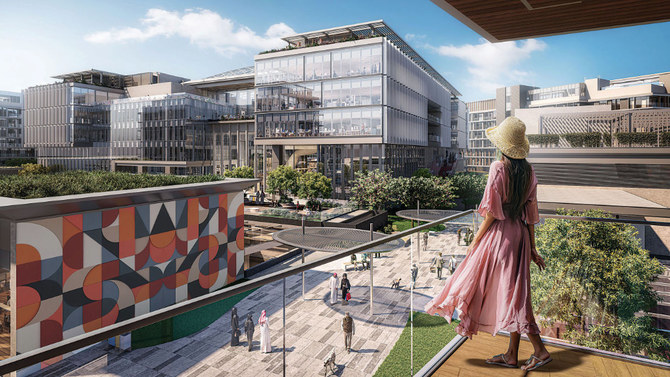
Aldar launches Grove District on UAE’s Saadiyat Island

Grove District will also offer access to a landscape deck with greenery to enhance physical and mental well-being within the community.
Short Url
Updated 25 June 2022
Follow

Aldar launches Grove District on UAE’s Saadiyat Island

Aldar Properties has announced the launch of apartments at Grove District, a new project that seeks to bring inspirational living to the heart of Abu Dhabi’s cultural epicenter on Saadiyat Island.

Grove District sits within Aldar’s flagship Saadiyat Grove development, and its apartments boast partial views of the sea, as well as the island’s three iconic landmarks: Zayed National Museum, Louvre Abu Dhabi, and Guggenheim Abu Dhabi. The development, when completed, will comprise 612 units in five residential buildings across luxury, lifestyle, and urban themed districts.

Each building will be interconnected with a unique retail-focused experience associated with the district in which it is located, intertwining art, dining, and lifestyle to create a culture-focused retail oasis in the UAE like no other. In a first for Aldar, Grove District will also feature amenity-themed lobbies in each building, which will aim to inspire and facilitate creativity among residents in engaging and open spaces.

Available for buyers of all nationalities, Grove District will be launched in phases, with 102 studios, one- and two-bedroom units available in the first building (Grove Museum Views), which is located in the lifestyle-themed district. Sales will start on June 25, with units starting from 905,000 dirhams ($246,400) for a studio, 1,400,000 dirhams for a one-bedroom apartment, and 2,399,000 dirhams for a two-bedroom unit.

Saadiyat Grove, Aldar’s iconic 10-billion-dirham landmark destination, will feature 60,000 square meters of experiential retail, entertainment and leisure spaces designed to create a lively and inclusive community. Including Grove District, the mixed-use destination will feature approximately 3,000 residential units, two hotels and co-working spaces for new enterprises and startups.

Rashed Al-Omaira, chief commercial officer at Aldar Development, said: “Since its launch, Saadiyat Grove has become Abu Dhabi’s most anticipated lifestyle destination, due to the array of cultural, leisure, and entertainment experiences it will bring to residents and visitors of Abu Dhabi. Grove District is Aldar’s latest residential offering within Saadiyat Grove, closely following the successful launch of Louvre Residences Abu Dhabi, and is set to bring a new dimension of vibrancy and modern living to the Island. The new destination will attract residents seeking a lively community that celebrates art, culture, retail, and entertainment in all types and forms.”

Each of the three districts at the development have been carefully designed to create and deliver memorable experiences, in line with Aldar’s commitment to customer centricity. Residents will benefit from a wide range of high-quality amenities, including a residents’ lounge, art workshop spaces, swimming pools, gyms, luxury games room and more, as well as direct access to a jogging track and meditation lawns. The development will also offer access to a landscape deck with greenery to enhance physical and mental well-being within the community.

As with Saadiyat Grove, the entire Grove District development has been designed with sustainability at its heart. Units have been built to meet the highest sustainability standards, with residential buildings targeted to achieve an Estidama two-pearl rating and an international LEED silver certification. Construction of the development commenced earlier this year, with handovers expected to begin in Q2 2025.


More crop per drop: NADEC and EF Polymer deploy breakthrough technology to cut agricultural water use by 40%

Updated 14 January 2026
Follow

More crop per drop: NADEC and EF Polymer deploy breakthrough technology to cut agricultural water use by 40%

Following a strategic technology-scouting framework led by Universal Materials Incubator, the National Agricultural Development Company has entered into a partnership to launch large-scale field trials of EF Polymer, marking a significant step in deploying deep-technology solutions to strengthen the Kingdom’s food and water security.

The collaboration initiates field trials of EF Polymer’s proprietary solution — a 100 percent organic, biodegradable powder that performs like a “soil battery” upcycled from food waste. Engineered to address water scarcity in arid and semi-arid regions, the material can absorb up to 50 times its own weight in water and gradually release moisture directly to plant roots. This mechanism has the potential to reduce irrigation water use by up to 40 percent, while enhancing crop yield and long-term agricultural productivity.

Beyond water efficiency, EF Polymer improves nutrient retention by minimizing fertilizer leaching, thereby reducing overall fertilizer requirements. After approximately one year in the soil, the material fully biodegrades into organic carbon, organic matter, and trace nutrients such as magnesium, calcium, and nitrogen — contributing directly to improved soil health and long-term fertility.

The solution is affordable, easy to apply, and suitable for a wide range of crops, making it viable both for individual farmers and for industrial-scale agricultural operations such as NADEC’s. 

EF Polymer has already achieved significant commercial adoption across multiple global markets, including Japan, the US, India and Turkiye, where it is actively used by farmers and agribusiness operators to improve water efficiency, soil health, and crop resilience under varying climatic conditions.

Its organic credentials are certified by OMRI and Ecocert, reinforcing its alignment with sustainable and regenerative agricultural practices.

The stakes for this alliance are high. By 2030, global freshwater demand is projected to exceed supply by 40 percent. In Saudi Arabia, the challenge is localized but intense: the agricultural sector alone consumes approximately 11.4 billion cubic meters of water annually. This partnership underscores NADEC’s commitment to adopting innovative, scalable technologies that conserve natural resources while supporting resilient food systems across the Kingdom.

Mohamed Al-Rajhi, VP of supply chain sector at NADEC, said: “Strategic agriculture today requires a long-term commitment to soil health and resource circularity. NADEC is leading the shift toward regenerative practices that restore our natural capital rather than merely consuming it. By diversifying our crop portfolio and investing in closed-loop nutrient management, we are insulating our operations against global price volatility and environmental shifts.”

“We are aggressively deploying AI-driven irrigation systems and satellite-based crop monitoring to optimize every drop of water and every hectare of land. This strategic pivot toward agri-digitization allows us to mitigate climate risks in real-time while significantly reducing our carbon footprint. Our commitment to sustainability is our greatest competitive advantage, ensuring that NADEC remains the cornerstone of the Middle East’s agri-food sector for decades to come. These trials focus on strategic scalable crops like wheat and olive trees to ensure the future of the Kingdom’s food security is both sustainable and locally rooted,” he added.

Strategic trial milestones:

  • Wheat: Trials have commenced to demonstrate water retention in this water-intensive crop.
  • Olive and blueberry: Specialized testing is scheduled for March to evaluate yield improvements and nutrient efficiency.

This collaboration supports Saudi Vision 2030 goals of reducing non-renewable groundwater use by 90 percent.