KABUL/PESHAWAR: Relief goods from the Middle East, Pakistan and India have started reaching earthquake-hit parts of eastern Afghanistan, as Taliban authorities said on Friday they had ended rescue efforts after the deadliest quake in decades.
The 6.1-magnitude quake hit several areas of Paktika and Khost provinces that border Pakistan on Tuesday night, flattening homes as people slept. Paktika was worst affected by the calamity. Afghanistan’s state-run Bakhtar news agency reported that the death toll had risen to 1,150 people, including at least five killed by an aftershock in Gayan on Friday.
The emergency response has been complicated and rescuers have been working without proper equipment, as many international organizations pulled out of the aid-dependent country when the Taliban seized power in August 2021. Efforts were also hampered by heavy rain and poor connectivity in the affected areas.
The Taliban government has requested foreign assistance, some of which has already arrived from the Middle East and neighboring India and Pakistan to help survivors.
“Search operations are over, but helicopters are still on the ground if any injured people are found,” Ministry of Defense official Rohullah Omar told Arab News from Paktika. “There’s adequate emergency aid reaching the area.”
Afghan authorities said on Thursday that aircraft with aid had also arrived from Qatar, Iran, and India, and trucks with food and medical supplies reached Paktika by road from Pakistan. Bakhtar news agency said that on Friday an aircraft with food assistance from the United Arab Emirates (UAE) landed in Khost, from where the aid will quickly reach Paktika by road and military helicopters.
The provincial government in Pakistan’s northwestern Khyber Pakhtunkhwa (KP) province continued to dispatch medical aid and relief items to Khost on Friday, Pakistani officials confirmed.
“Today (Friday), we dispatched 16 trucks loaded with 500 tents, 500 kitchen kits, 500 hygiene sets, 500 mattresses and 200 tarpaulin sheets to North Waziristan for distribution onwards among the survivors in Khost and other quake-hit areas of the neighboring country,” Shareef Hussain, director-general of the KP Provincial Disaster Management Authority, told Arab News.
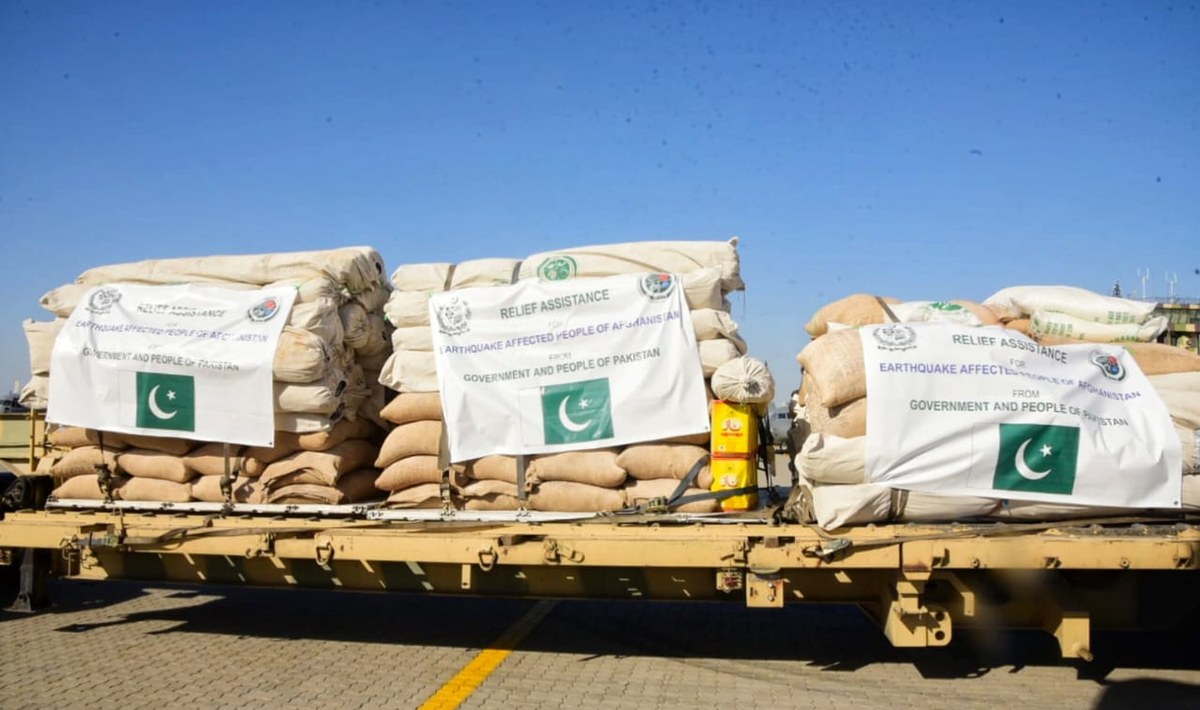
Pakistan dispatches second tranche of humanitarian assisstance to Afghanistan on June 24, 2022. (NDMA)
Khateer Ahmad, director-general of Pakistan’s Rescue 1122 service, said his department had established a relief camp in Khost for the treatment of survivors.
“For now, at least 40 persons with multiple injuries have been provided medical aid at the center,” Ahmad said. “Those seriously wounded will be transported to Pakistan via ambulances.”
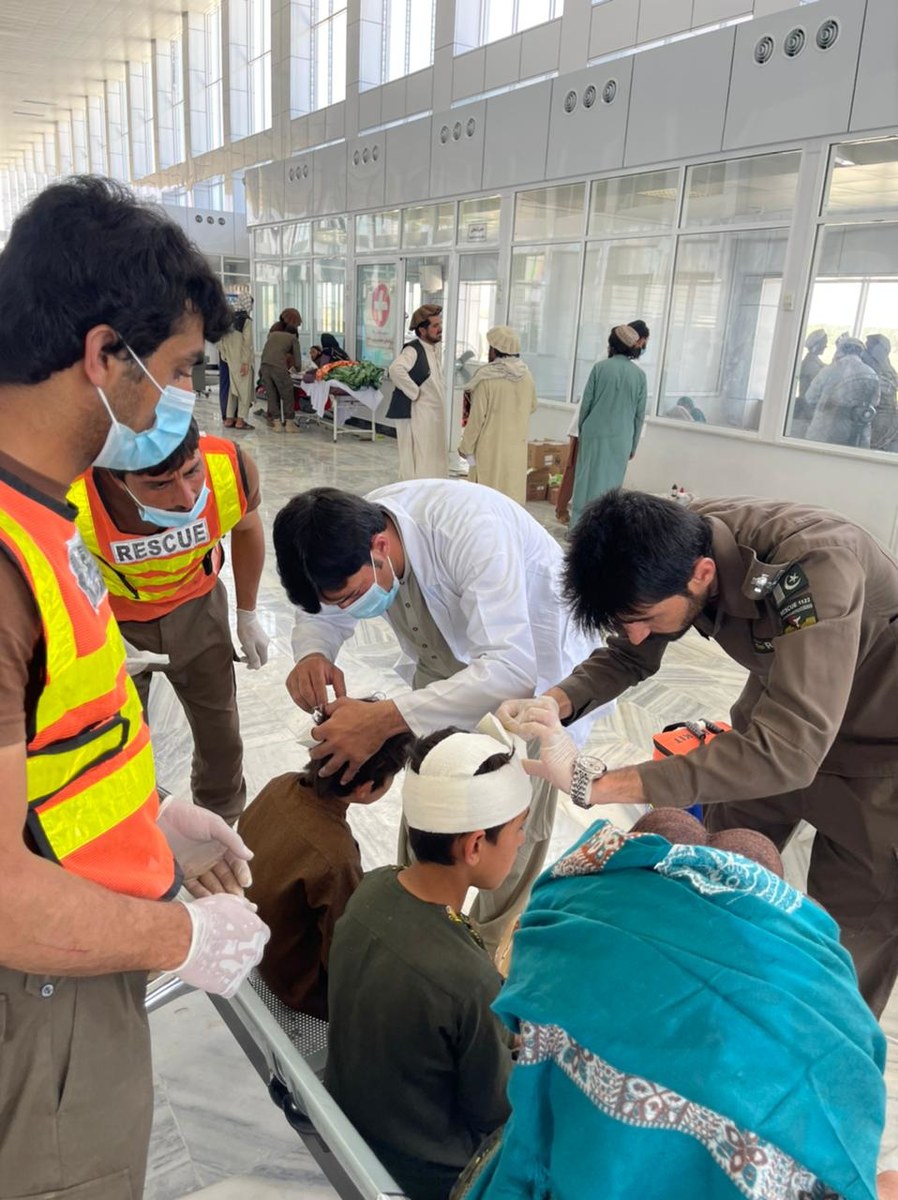
Pakistan’s Rescue 1122 service provide medical help to the wounded in Khost, Afghanistan, on June 24, 2022. (Rescue 1122)
Iqbal Wazir, the KP provincial minister for relief, rehabilitation and settlement, told Arab News from North Waziristan tribal district that a medical camp had already been established in Alwarra, a town on the Pakistan-Afghanistan border. “Civil and military officials in North Waziristan have stepped up efforts to facilitate the quake victims in every possible way. We plan to establish more medical camps, including the one at Ghulam Khan border [crossing],” he added.
As food supplies have already arrived in the affected areas, the most urgent need now was shelter since the majority of the region’s inhabitants were left homeless.
“People need shelter, and we would want aid organizations to help people with building their houses,” Omar said, as the extent of the destruction in the villages tucked away in the mountains was slowly coming to light.
The quake was the deadliest in Afghanistan since 1998, when magnitude 6.5 tremors killed more than 4,000 people in Takhar province in the country’s north.
UN teams deployed to deliver emergency supplies estimated more than 70 percent of homes in the worst-hit regions had been destroyed.
Abdulfatah Jawad, the head of Ehsas Welfare and Social Services Organization, one of the local NGOs delivering assistance to Paktika, told Arab News that immediate food relief was sufficient and regularly distributed, but more tents and blankets were needed.