

Aid from Pakistan, Middle East reaches eastern Afghanistan after deadly quake

An Afghan man stands besides the ruins of a house damaged after an earthquake in Gayan district, Paktika province, on June 24, 2022. (AFP)
Short Url
Updated 24 June 2022
Follow

Aid from Pakistan, Middle East reaches eastern Afghanistan after deadly quake

  • A 6.1-magnitude quake struck Afghanistan’s Paktika, Khost provinces on Tuesday
  • Pakistan dispatches over 16 trucks of relief items, sets up medical camp in Khost

KABUL/PESHAWAR: Relief goods from the Middle East, Pakistan and India have started reaching earthquake-hit parts of eastern Afghanistan, as Taliban authorities said on Friday they had ended rescue efforts after the deadliest quake in decades. 

The 6.1-magnitude quake hit several areas of Paktika and Khost provinces that border Pakistan on Tuesday night, flattening homes as people slept. Paktika was worst affected by the calamity. Afghanistan’s state-run Bakhtar news agency reported that the death toll had risen to 1,150 people, including at least five killed by an aftershock in Gayan on Friday. 

The emergency response has been complicated and rescuers have been working without proper equipment, as many international organizations pulled out of the aid-dependent country when the Taliban seized power in August 2021. Efforts were also hampered by heavy rain and poor connectivity in the affected areas. 

The Taliban government has requested foreign assistance, some of which has already arrived from the Middle East and neighboring India and Pakistan to help survivors. 

“Search operations are over, but helicopters are still on the ground if any injured people are found,” Ministry of Defense official Rohullah Omar told Arab News from Paktika. “There’s adequate emergency aid reaching the area.” 

Afghan authorities said on Thursday that aircraft with aid had also arrived from Qatar, Iran, and India, and trucks with food and medical supplies reached Paktika by road from Pakistan. Bakhtar news agency said that on Friday an aircraft with food assistance from the United Arab Emirates (UAE) landed in Khost, from where the aid will quickly reach Paktika by road and military helicopters. 

The provincial government in Pakistan’s northwestern Khyber Pakhtunkhwa (KP) province continued to dispatch medical aid and relief items to Khost on Friday, Pakistani officials confirmed. 

“Today (Friday), we dispatched 16 trucks loaded with 500 tents, 500 kitchen kits, 500 hygiene sets, 500 mattresses and 200 tarpaulin sheets to North Waziristan for distribution onwards among the survivors in Khost and other quake-hit areas of the neighboring country,” Shareef Hussain, director-general of the KP Provincial Disaster Management Authority, told Arab News. 
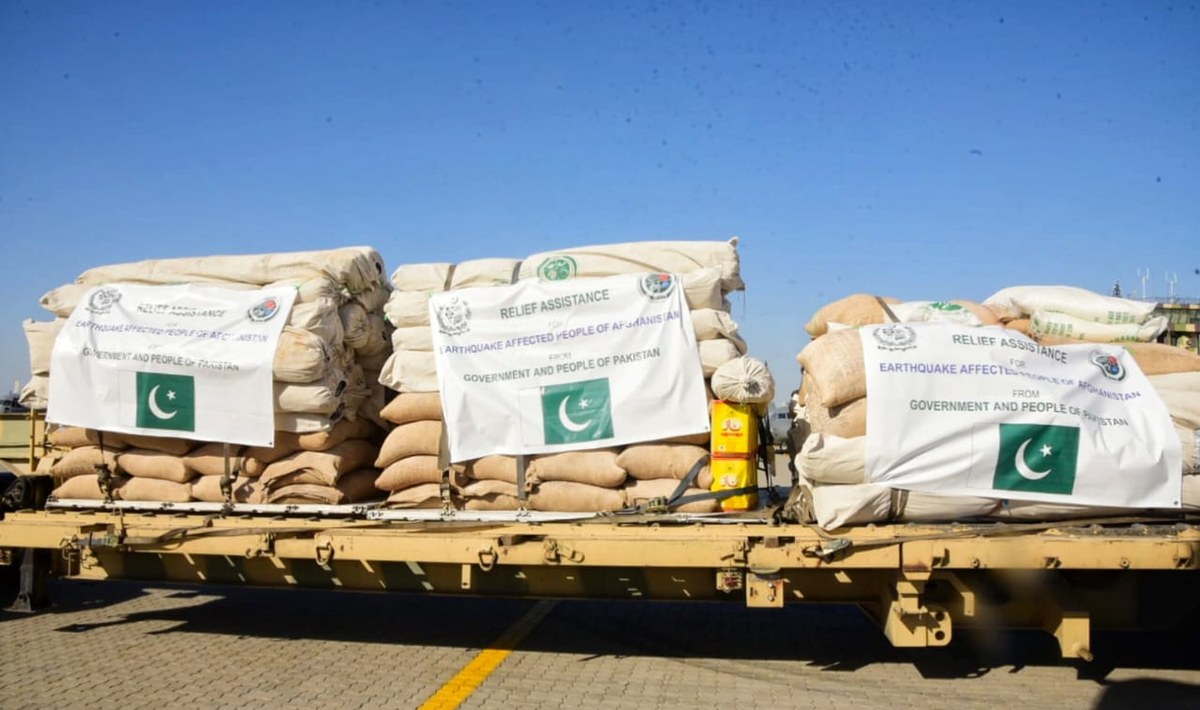


Pakistan dispatches second tranche of humanitarian assisstance to Afghanistan on June 24, 2022. (NDMA)

Khateer Ahmad, director-general of Pakistan’s Rescue 1122 service, said his department had established a relief camp in Khost for the treatment of survivors. 

“For now, at least 40 persons with multiple injuries have been provided medical aid at the center,” Ahmad said. “Those seriously wounded will be transported to Pakistan via ambulances.” 
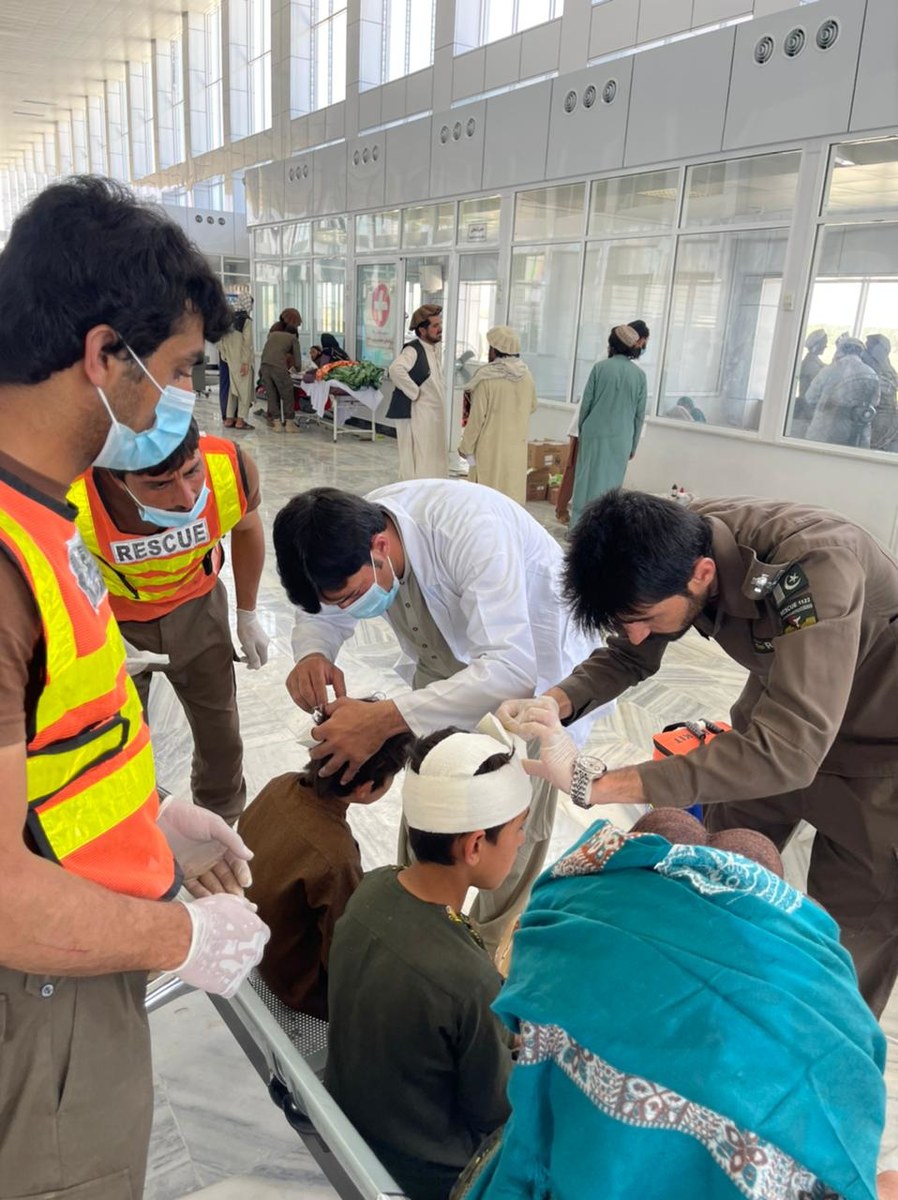


Pakistan’s Rescue 1122 service provide medical help to the wounded in Khost, Afghanistan, on June 24, 2022. (Rescue 1122)

Iqbal Wazir, the KP provincial minister for relief, rehabilitation and settlement, told Arab News from North Waziristan tribal district that a medical camp had already been established in Alwarra, a town on the Pakistan-Afghanistan border. “Civil and military officials in North Waziristan have stepped up efforts to facilitate the quake victims in every possible way. We plan to establish more medical camps, including the one at Ghulam Khan border [crossing],” he added. 

As food supplies have already arrived in the affected areas, the most urgent need now was shelter since the majority of the region’s inhabitants were left homeless. 

“People need shelter, and we would want aid organizations to help people with building their houses,” Omar said, as the extent of the destruction in the villages tucked away in the mountains was slowly coming to light. 

The quake was the deadliest in Afghanistan since 1998, when magnitude 6.5 tremors killed more than 4,000 people in Takhar province in the country’s north. 

UN teams deployed to deliver emergency supplies estimated more than 70 percent of homes in the worst-hit regions had been destroyed. 

Abdulfatah Jawad, the head of Ehsas Welfare and Social Services Organization, one of the local NGOs delivering assistance to Paktika, told Arab News that immediate food relief was sufficient and regularly distributed, but more tents and blankets were needed. 


Pakistan to import 7 million cotton bales as domestic output nearly halves — stakeholders

Updated 54 min 29 sec ago
Follow

Pakistan to import 7 million cotton bales as domestic output nearly halves — stakeholders

  • Pakistan produced 5.3 million cotton bales by mid-December against 10 million targeted, government data shows
  • While the imports may ensure smooth supply of raw material, they may put pressure on foreign exchange reserves

KARACHI: Pakistan will need to import around 7 million cotton bales this year owing to a decline of nearly half the annual target set by the Federal Committee on Agriculture (FCA), industry stakeholders said on Tuesday.

Pakistan’s cotton production stood at 5.3 million bales each weighing 170 kilograms as of Dec. 15, according to state-run Pakistan Central Cotton Committee (PCCC) data. The FCA had set a target of 10.2 million bales in April.

Karachi Cotton Brokers Forum (KCBF) Chairman Naseem Usman Osawala sees the country’s cotton production declining by 46 percent this season, compared to the FCA target.

“The country is expected to produce about 5.5 million bales this year,” he told Arab News, adding Pakistan would have to import around 7 million bales to meet requirement of its textile industry which consumes about 12 million bales a year.

The country had sown cotton over 2.002 million hectares, which was down by 11 percent from the targeted 2.26 million hectares.

Muhammad Waqas Ghani, head of research at Karachi-based JS Global Capital brokerage firm, said the South Asian country is likely to miss its cotton output target of 10 million bales.

“At the current rate of arrival, the output can reach 7 million bales at its best,” he added.

Cotton is a raw material for Pakistan’s largest textile industry and was the worst hit crop by climate-induced floods earlier this year.

Osawala said Pakistan’s cotton production has been falling because of an increasing number of sugar mills being established in the country’s cotton-producing regions.

Courts in Pakistan have been issuing significant rulings to bar the establishment of sugar mills in the designated cotton belt areas of the Punjab province. In 2018, the Supreme Court ordered relocation of three sugar mills from cotton-producing districts in southern Punjab to protect the crop.

Since cotton prices are low in the international market, textile millers would go for more imports, according to the KCBF chairman.

On Dec. 22, the price of cotton in the New York market stood at as much as 65.85 cents per pound, 1.64 cents lower than last year, according to the PCCC data.

Osawala said Pakistan’s increasing textile imports are also “hurting local cotton production.”

According to the Pakistan Bureau of Statistics’ (PBS) July-November data, the country had imported raw cotton, synthetic fiber, synthetic and artificial silk yarn and worn clothing worth $2.82 billion, 5 percent more than the imports during the same period last year.

Speaking of the impact of Pakistan’s falling cotton production, Kamran Arshad, chairman of All Pakistan Textile Mills Association (APTMA), said the millers would have to import “a lot of cotton” this year.

“I think approximately 7-7.5 million bales will have to be imported this year,” he said.

The textile and apparel sector is Pakistan’s largest exporter, accounting for more than half of the country’s overall exports and contributing around 8.5 percent of the gross domestic product (GDP) by employing nearly 40 percent of the industrial labor force. But high energy costs and outdated infrastructure among other factors continue to slow growth and leave the country trailing regional peers.

In the last fiscal year, Pakistan imported as much as 6.2 million cotton bales each weighing 220 kilograms, mostly from Brazil and the United States, according to KCBF Chairman Arshad.

Shankar Talreja, head of research at Karachi-based Topline Securities, said Pakistan is likely to import cotton worth $1.2 billion this year “considering the requirement.”

“The full-year import of cotton is likely to remain over $1 billion,” Talreja said.

Economic experts say while importing more cotton would ensure smooth supply of raw material to Pakistan’s textile sector, it may put pressure on the country’s foreign exchange reserves that rose to $15.9 billion last week after the International Monetary Fund (IMF) released a $1.2 billion tranche under Pakistan’s $7 billion loan program.