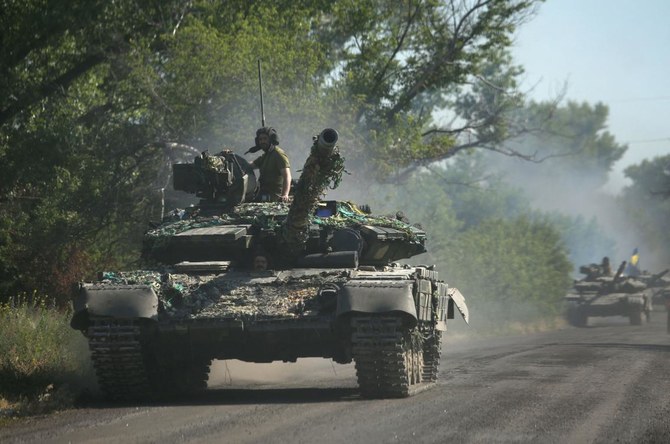
KYIV: Ukrainian forces will retreat from Severodonetsk in the face of a brutal Russian offensive that is reducing the battleground city to rubble, a senior Ukrainian official said Friday.
The news came shortly after the European Union made a strong show of support for Ukraine, granting the former Soviet republic candidate status, although there is still a long path ahead to membership.
Capturing Severodonetsk, in the Donbas region, has become a key goal of the Russians as they focus their offensive on eastern Ukraine after being repelled from Kyiv following their February invasion.
The strategically important industrial hub has been the scene of weeks of street battles as the outgunned Ukrainians put up a fierce defense.
But Sergiy Gaiday — governor of Lugansk, which includes the city — said the Ukrainian military would have to retreat.
“They have received an order to do so,” he said on Telegram.
“Remaining in positions that have been relentlessly shelled for months just doesn’t make sense.”
The city has been “nearly turned to rubble” by continual bombardment, he added.
“All critical infrastructure has been destroyed. Ninety percent of the city is damaged, 80 percent (of) houses will have to be demolished,” he said.
The Ukrainians had already been pushed back from much of the city, leaving them in control of only industrial areas.
Capturing Severodonetsk and its twin city of Lysychansk would give the Russians control of Lugansk, and allow them to push further into the wider Donbas.
Gaiday said the Russians were now advancing on Lysychansk, which has been facing increasingly heavy Russian bombardment.
AFP journalists driving out of the city Thursday twice had to jump out of cars and lie on the ground as Russian forces shelled the city’s main supply road.
They saw dark smoke rising over the road ahead, and heard artillery fire and saw flashes of light, while the road was strewn with trees felled by shelling.
The situation for those that remain in the city was increasingly bleak.
Liliya Nesterenko said her house had no gas, water or electricity and she and her mother were cooking on a campfire. She was cycling along the street, and had come out to feed a friend’s pets.
But the 39-year-old was upbeat about the city’s defenses: “I believe in our Ukrainian army, they should (be able to) cope.
“They’ve prepared already.”
A representative of pro-Russian separatists in Ukraine earlier told AFP the resistance of Ukrainian forces trying to defend Lysychansk and Severodonetsk was “pointless and futile.”
“At the rate our soldiers are going, very soon the whole territory of the Lugansk People’s Republic will be liberated,” said Andrei Marochko, a spokesman for the Moscow-backed army of Lugansk.
With Ukraine pleading for accelerated weapon deliveries, the United States announced it was sending another $450 million in fresh armaments, including Himars rocket systems.
The systems can simultaneously launch multiple precision missiles at an extended range.
At a Brussels summit Thursday, EU leaders granted candidate status to Ukraine, as well as Moldova.
Ukraine’s President Volodymyr Zelensky hailed the news as “a unique and historic moment,” adding: “Ukraine’s future is within the EU.”
French President Emmanuel Macron said the decision by EU leaders sent a “very strong signal” to Russia that Europeans support the pro-Western aspirations of Ukraine.
President Vladimir Putin had declared Ukraine to be part of Moscow’s sphere and insisted he was acting due to attempts to bring the country into NATO, the Western alliance that comes with security guarantees.
European powers before the invasion had distanced themselves from US support for Ukraine’s NATO aspirations, and EU membership is at least years away.
Ukraine and Moldova will have to go through protracted negotiations and the European Union has laid out steps that Kyiv must take even before that, including bolstering the rule of law and fighting corruption.
Western officials have also accused Russia of weaponizing its key exports of gas as well as grain from Ukraine, contributing to global inflation and rising hunger in the world.
A US official warned of new retaliatory measures against Russia at the Group of Seven summit being attended by President Joe Biden in Germany starting Sunday.
Germany ratcheted up an emergency gas plan to its second alert level, just one short of the maximum that could require rationing in Europe’s largest economy, after Russia slashed supplies.
“Gas is now a scarce commodity,” German Economy Minister Robert Habeck told reporters, urging households to cut back on use.
Demand for gas is lower in the summer but shortages could cause problems with heating in the winter.
A Kremlin spokesman reiterated its claim that the supply cuts were due to maintenance and that necessary equipment from abroad had not arrived.


![]()

Ukraine forces to retreat from battleground city: governor
Short Url
https://arab.news/r8d38
Ukraine forces to retreat from battleground city: governor
- Capturing Severodonetsk, in the Donbas region, has become key goal of Russia
- News came after EU granted Ukraine candidate status in a strong show of support
Latest updates



© 2026 SAUDI RESEARCH & PUBLISHING COMPANY, All Rights Reserved And subject to Terms of Use Agreement.