

O’Callaghan overcomes ‘panic’ to win world 100m freestyle title

1 / 2
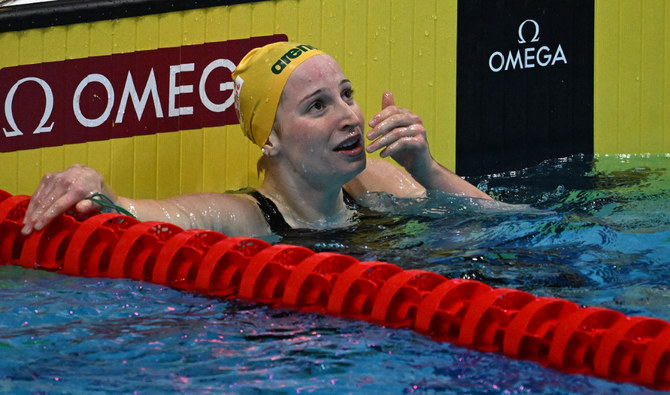
Australia's Mollie O'Callaghan reacts after taking gold in the women's 100m freestyle finals during the 19th FINA World Championships at Duna Arena in Budapest on June 23, 2022. (AFP)
2 / 2
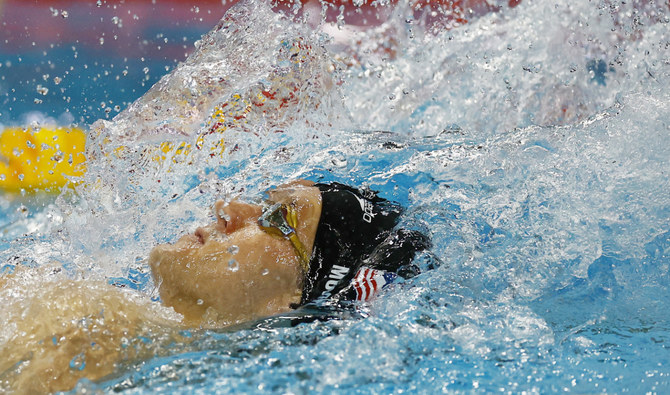
Ryan Murphy of the US on his way to the gold medal in the men's 200m backstroke final. (Reuters)
Short Url
Updated 24 June 2022
Follow

O’Callaghan overcomes ‘panic’ to win world 100m freestyle title

  • At 18 years and 82 days, O’Callaghan became the youngest winner of the 100m freestyle since 1991, when Nicole Haislett of the US won the title at 18 years and 22 days

BUDAPEST: Australian 18-year-old Mollie O’Callaghan overcame “panic” to edge world record holder Sarah Sjostrom and become the youngest women’s 100m freestyle world champion in more than 30 years on Thursday.

Lilly King added to her collection of gold medals when she won the women’s 200m breaststroke while another American veteran Ryan Murphy won the men’s 200m backstroke.

Australian Zac Stubblety-Cook took the men’s 200m breaststroke.

The American men finished the evening by winning the mens 200m relay.

O’Callaghan, a double Olympic relay gold medallist, edged the 28-year-old Sjostrom of Sweden by 0.13sec. American Torri Huske took bronze.

At 18 years and 82 days, she became the youngest winner of the 100m freestyle since 1991, when Nicole Haislett of the US won the title at 18 years and 22 days.

O’Callaghan said she had suffered badly from pre-race nerves.

“It was bad, the worst ever,” she said.

“I was panicking in my bed, having a little bit of a cramp in my leg, just feeling dizzy, feeling out of it, starting to panic, but I knew I had my teammates there... I guess that kind of uplifted me for the race.”

It was Sjostrom’s 16th World Championship medal but while she has eight golds, she has never won the 100m free. This was her fourth silver.

She also has world-championship and Olympic bronzes in the race.

King had dominated the 50m and 100m breaststroke at the last two world championships and also won gold in the 2016 Olympics in the 100m breaststroke.

After she missed a medal in the 100m breast on Tuesday, her college coach, Ray Looze, told American media that she was racing at “80 percent.”

On Thursday, she came from fifth to grab victory in 2min 22.41sec. Australian Jenna Strauch was second at 0.63 with American Kate Douglass third.

“It’s really nice to be able to complete the set, I guess I’m a distance swimmer now,” said King after her first gold at the longest breaststroke distance.

King said the setback earlier in the competition had motivated her.

“Anytime I have a bad swim I feel like I have a lot of haters out there, so just to prove them wrong is good,” she said

Murphy ended a long streak of duller colored medals when he won the men’s 200m backstroke.

Since grabbing two individual Olympic golds in Rio in 2016, the American had collected six silvers and two bronzes in Olympics and worlds, including a silver in the 100m backstroke in Budapest.

The 26-year-old won in 1:54.52, 0.64sec ahead of Briton Luke Greenbank with another American, Shaine Casas third.

“That ws a far from perfect race but I managed it,” Murphy said.

Australian Stubblety-Cook, the Olympic champion, came from last after the first lap to win the men’s 200m breaststroke.

Dutchman Caspar Corbeau started off at world record pace, but faded and Stubblety-Cook, Yu Hanaguruma and Erik Persson, who had conserved energy at the back, came through.

The Australian won in 2:07.07, 1.31sec ahead of the Japanese and the Swede who tied for the silver.

Kristof Milak, the Hungarian who said after winning the 200m butterfly that the Duna “is my pool,” strolled out for butterfly 100m semis like a lord strolling his estate.

Milak has struggled to catch American Olympic and world champion Caeleb Dressel in the 100m butterfly.

With the American heading home, the Hungarian star justified his aura of confidence by comfortably swimming the fastest time.

He finished in 50.14sec, 0.67sec quicker than Naoki Mizunuma of Japan.

In the 50m, another event that Dressel has dominated in recent seasons, Briton Benjamin Proud was fastest in the semis.


Matt Kuchar lost his father in February and ends the year with emotional PNC victory with his son

Updated 10 sec ago
Follow

Matt Kuchar lost his father in February and ends the year with emotional PNC victory with his son

  • The tournament that is all about family and fun ended with Kuchar wiping away tears as his voice cracked while speaking about how much it meant without his father, who died in February
  • Cameron Kuchar, who was able to use one tee box forward as a high school student, hammered another drive and watched his father hit 7-iron to 18 inches
  • The PNC Championship, which began in 1995 as the Father-Son Challenge, is for major champions and their children

ORLANDO, Fla.: Matt Kuchar couldn't imagine a better ending to a year when he lost his father than to finally win the PNC Championship with his son.

There was no stopping them Sunday in a record-smashing performance that led to an 18-under 54 and a whopping seven-shot victory.

The tournament that is all about family and fun ended with Kuchar wiping away tears as his voice cracked while speaking about how much it meant without his father, who died in February.

The finish was simply surreal to him.

Cameron Kuchar, who was able to use one tee box forward as a high school student, hammered another drive and watched his father hit 7-iron to 18 inches. Kuchar gave his son the honor of tapping in for the final touch on an unforgettable week for the Kuchar family.

“I don’t know if you believe in karma, if you believe in fate, whatever you believe in, there’s something magical that does exist,” Kuchar said as tears began to form. “I’m a believer in God that Dad is up above looking down, and what happened on 18, I could hardly stand up and hit a shot. For me to hit it to a foot, makes me think there’s something more out there. Just miss Pops.”

Peter Kuchar, who at one time was the top-ranked doubles tennis player in Florida, first became a presence on the golf scene when he caddied for his son when Kuchar won the US Amateur in 1997, and when he was low amateur at the Masters and U.S. Open the following year.

He played with Kuchar at the PNC Championship before yielding the stage to Kuchar's sons.

Peter Kuchar died in February of a heart attack while swimming when he was on a Caribbean cruise with his wife, Meg, to celebrate her birthday.

Kuchar and his son each got the Willie Park Trophy, a red belt that Kuchar jokingly said would wear well with his tartan jacket he won from Harbour Town at the RBC Heritage.

The PNC Championship, which began in 1995 as the Father-Son Challenge, is for major champions and their children. It has been expanded over the years to include The Players Championship winners, senior and LPGA major champions. Players have brought parents or daughters.

Kuchar, who won The Players Championship in 2012, said he keeps photos to go with the trophies from most of his nine PGA Tour victories. In early victories he could hold both sons. And then they were too big too hold. The most recent photo taken Sunday afternoon leaves him heartbroken.

“And now to have this shot with the family, it’s clearly missing ... missing one,” he said, pausing because his voice was so choked with emotion. “But it’s special, very special.”

So was their golf, and it was a runaway from the start. Cameron Kuchar, who has signed to play for TCU next year, birdied the first hole and his father hit hybrid to 12 feet for eagle on the third.

They made only two pars in the scramble format and countered that with two eagles. They finished at 33-under 111 to break the tournament record by five shots.

Lee Trevino delivered the highlight when the 86-year-old holed out from the fairway with a lob wedge for eagle on the 13th hole.

John Daly and John Daly II, a senior at Arkansas and the Southern Amateur champion, made eagle on the last hole for a 59 to tie for second with Davis Love III and Dru Love (58). Nelly Korda and her father, and Steve Stricker and his daughter, finished another shot behind.

All of them looked at scoreboards coming in and saw there was no chance of catching the Kuchars, certainly not on this day.

“If they end up getting to 30 (under), you’re talking about only six holes missed in 36 holes. That’s remarkable,” Duval said.

Turns out the Kuchar duo was even better — 36 holes, 33 under. Fate or otherwise, it was some remarkable golf. Twice before, they held the lead going into the final day and didn't hold it. On Sunday they started with a two-shot lead and ran away with it. It was their time.