

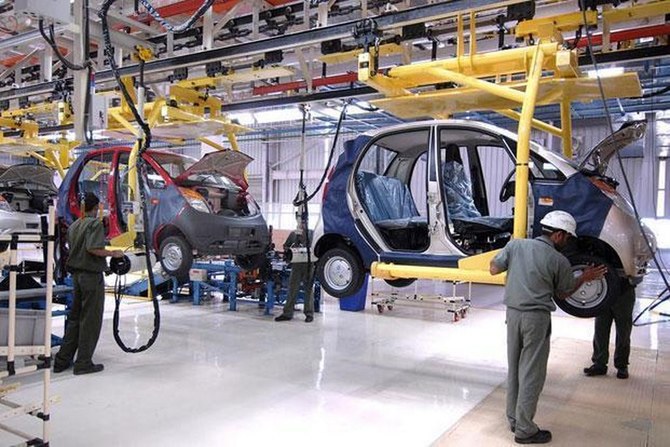
India In-Focus — Shares buck a broader downturn; probe underway in Tata Motors EV fire incident

India has ordered an investigation into a fire incident involving a Tata Motors’ electric vehicle, a government official said on Thursday.
Short Url
Updated 23 June 2022
Follow

India In-Focus — Shares buck a broader downturn; probe underway in Tata Motors EV fire incident

MUMBAI: Indian shares bucked a broader downturn on Thursday as weak metal and oil prices drove beaten-down automakers to their best day since April 2020.

The NSE Nifty 50 index rose 0.93 percent to 15,556.65, while the S&P BSE Sensex climbed 0.86 percent to 52,265.72.

The indexes have added around 1.7 percent so far this week, after two consecutive weeks of decline fueled by concerns over interest rate hikes and growth.

Tata Motors EV fire incident

India has ordered an investigation into a fire incident involving a Tata Motors’ electric vehicle, a government official said on Thursday, after the automaker described it as an “isolated thermal incident.”

A video on social media, which has gone viral, showed one of the company’s electric cars engulfed in flames. The video showed firefighters trying to extinguish the fire in a Nexon model electric vehicle in a suburb of Mumbai. 

Defense Research and Development Organization, a government agency, will lead the investigation, the official said.

“A detailed investigation is currently being conducted to ascertain the facts of the recent isolated thermal incident that is doing the rounds on social media. We will share a detailed response after our complete investigation,” India’s biggest manufacturer of electric cars said in a statement.

The company said this was the first such incident, having sold more than 30,000 EVs, the bulk of which are its Nexon model.

The incident follows a spate of e-scooter fires that have triggered an investigation by the Indian government.

India to support Lanka

India’s top diplomat held talks with Sri Lanka’s president and prime minister on Thursday as India signaled its willingness to go beyond the $4 billion in loans, swaps and aid that it has already provided its cash-strapped neighbor.

Sri Lanka is facing its worst economic crisis in seven decades, with a severe foreign exchange shortage hampering the import of essentials, including food, fuel and medicines.

The island nation off the tip of southern India needs about $5 billion in the next six months to cover basic necessities for its 22 million people, who have been struggling with long queues for basic items, worsening shortages and power cuts.

Indian Foreign Secretary Vinay Kwatra, accompanied by other officials, held talks with President Gotabaya Rajapaksa and Prime Minister Ranil Wickremesinghe on providing further financial assistance to the country, the president’s office said in a statement.

“Indian Foreign Secretary Vinay Kwatra has said that the government of India will extend its fullest support to Sri Lanka in overcoming the current difficult situation as a close friend,” the statement said.

“The Indian delegation stated that the government of India and the political authorities are committed to provide continued support to Sri Lanka,” it added.


Acwa signs key terms to develop 5GW of renewable energy capacity in Turkiye

Updated 23 February 2026
Follow

Acwa signs key terms to develop 5GW of renewable energy capacity in Turkiye

JEDDAH: Saudi utility giant Acwa has signed key investment agreements with Turkiye’s Ministry of Energy and Natural Resources to develop up to 5 gigawatts of renewable energy capacity, starting with 2GW of solar power across two plants in Sivas and Taseli.

Under the investment agreement, Acwa will develop, finance, and construct, as well as commission and operate both facilities, according to a press release.

The program builds on the company’s first investment in Turkiye, the 927-megawatt Kirikkale Independent Power Plant, valued at $930 million, which offsets approximately 1.8 million tonnes of carbon dioxide annually, the statement added.

A separate power purchase agreement has been concluded with Elektrik Uretim Anonim Sirketi for the sale of electricity generated by each facility.

Turkiye aims to boost solar and wind capacity to 120GW by 2035, supported by around $80 billion in investment, while recent projects have already helped prevent 12.5 million tonnes of CO2 emissions and reduced reliance on imported natural gas.

Turkiye’s energy sector has undergone a rapid transformation in recent years, with renewable power emerging as a central pillar of its strategy.

Raad Al-Saady, vice chairman and managing director of ACWA, said: “The signing of the IA (implementation agreement) and PPA key terms marks a pivotal moment in Acwa’s partnership with Turkiye, reflecting the country’s strong potential as a clean energy leader and manufacturing powerhouse.”

He added: “Building on our long-standing presence, including the 927MW Kirikkale Power Plant commissioned in 2017, this step elevates our partnership to a new level,” Al-Saady said.

In its statement, Acwa said the 5GW renewable energy program will deliver electricity at fixed prices, enhancing predictability for grid planning and supporting long-term industrial investment.

By replacing imported fossil fuels with domestically generated clean energy, the initiative is expected to reduce Turkiye’s exposure to global energy market volatility, strengthening energy security and lowering long-term power costs.

The company added that the economic impact will extend beyond the anticipated investment of up to $5 billion in foreign direct investment, with thousands of jobs expected during the construction phase and hundreds of high-skilled roles created during operations.

The energy firm concluded that its existing progress in Turkiye reflects a strong appreciation for Turkish engineering, construction, and manufacturing capacity, adding that localization has been a strategic priority, and it has already achieved 100 percent local employment at its developments in the country.