

Saudi Arabia’s oil exports hit 25-month high in April: JODI

1 / 2
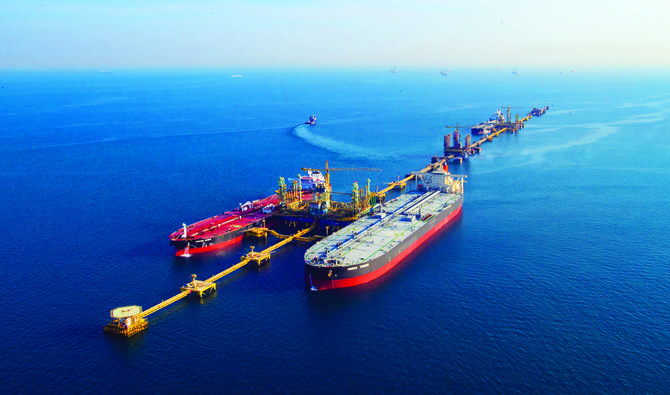
Saudi Arabia trailed as the second-largest crude supplier to China, with May volumes up 9 percent on year at 7.82 million tons, or 1.84 million bpd. (Supplied)
2 / 2
This is the highest monthly level of volume since March 2020 when the Kingdom’s exports were 7.39 million bpd. (Shutterstock)
Short Url
Updated 21 June 2022
Follow

Saudi Arabia’s oil exports hit 25-month high in April: JODI

  • Production grew by 141,000 barrels per day to 10.44 million bpd in April: JODI

RIYADH: Saudi Arabia’s crude oil exports grew 147,000 barrels per day in April to 7.38 million, according to the latest monthly data released by the Joint Organisations Data Initiative.

This is the highest monthly level of volume since March 2020 when the Kingdom’s exports were 7.39 million bpd.
Exports of crude rose by 2 percent in April from 7.24 million bpd in March 2022.
Year-on-year, the Kingdom’s shipments of crude abroad surged by 1.97 million bpd — an increase of 36.5 percent. 
As for the production of crude, in April it grew by 141,000 bpd to 10.44 million bpd. Production rose by 1.4 percent from 10.3 million bpd in March.

Opinion

This section contains relevant reference points, placed in (Opinion field)

Russia overtakes KSA China’s crude oil imports from Russia soared 55 percent from a year earlier to a record level in May, displacing Saudi Arabia as the top supplier, as refiners cashed in on discounted supplies amid sanctions on Moscow over its invasion of Ukraine, reported Reuters.
Imports of Russian oil, including supplies pumped via the East Siberia Pacific Ocean pipeline and seaborne shipments from Russia’s European and Far Eastern ports, totaled nearly 8.42 million tons, according to data from the Chinese General Administration of Customs.

FASTFACTS

• Year-on-year, the Kingdom’s shipments of crude abroad surged by 1.97 million bpd — an increase of 36.5 percent.  

• Crude production rose by 1.4 percent from 10.3 million bpd in March.

• China’s crude oil imports from Russia soared 55 percent from a year earlier to a record level in May, displacing Saudi Arabia as the top supplier.

That is equivalent to roughly 1.98 million barrels per day (bpd) and up a quarter from 1.59 million bpd in April. China is the world’s biggest crude oil importer.
Chinese firms, including state refining giant Sinopec and state-run Zhenhua Oil, have ramped up purchases of Russian oil, enticed by steep discounts after Western oil majors and trading houses pulled back due to sanctions.
Saudi Arabia trailed as the second-largest supplier, with May volumes up 9 percent on year at 7.82 million tons, or 1.84 million bpd.
This was down from April’s 2.17 million bpd. Russia took back the top ranking after a gap of 19 months.
Customs data released on Monday also showed China imported 260,000 tons of Iranian crude oil last month, its third shipment of Iran oil since last December, confirming an earlier Reuters report.
Despite US sanctions on Iran, China has kept taking Iranian oil, usually passed off as supplies from other countries. The import levels are roughly equivalent to 7 percent of China’s total crude oil imports.
China’s overall crude oil imports rose nearly 12 percent in May from a low base a year earlier to 10.8 million bpd, versus the 2021 average of 10.3 million bpd.
Customs reported zero imports from Venezuela. State oil firms have shunned purchases since late 2019 for fear of falling foul of secondary US sanctions.
Imports from Malaysia, often used as a transfer point in the last two years for oil originating from Iran and Venezuela, amounted to 2.2 million tons, steady versus April but more than double the year-earlier level.
Imports from Brazil fell 19 percent from a year earlier to 2.2 million tons, as supplies from the Latin American exporter faced cheaper competition from Iranian and Russian barrels.


Global brands shut Middle East stores as conflict causes chaos

Updated 03 March 2026
Follow

Global brands shut Middle East stores as conflict causes chaos

  • Luxury brands and retailers close stores in Middle East
  • Conflict threatens the region that has ‌been luxury’s fastest growing
  • Mass-market retailers monitor situation, adjust operations in region

PARIS: In Dubai and other major Middle Eastern shopping hubs, many stores are closed or operating with a skeleton staff as the escalating conflict in the ​region causes chaos for businesses and travel.

The US-Israeli air war against Iran expanded on Monday with no end in sight, with Tehran firing missiles and drones at Gulf states as it retaliates for a weekend of bombing that killed Iran’s supreme leader and reportedly killed scores of Iranian civilians, including a strike on a girls’ primary school.

Chalhoub Group, which runs 900 stores for brands from Versace and Jimmy Choo to Sephora across the region, said its stores in Bahrain were closed, while other markets, including the UAE, Saudi Arabia, and Jordan remained open though staff attendance was “voluntary.”

“We operate with a lean team formed of members who volunteered and feel comfortable to come to the store,” Chalhoub’s Vice President of Communications Lynn al ‌Khatib told Reuters, adding ‌that the company’s leadership team personally visited Dubai Mall and Mall of the Emirates ​on ‌Monday ⁠morning to check ​in ⁠with workers.

E-commerce giant Amazon closed its fulfillment center operations in Abu Dhabi, suspended deliveries across the region and instructed its employees in Saudi Arabia and Jordan to remain indoors, Business Insider reported on Monday, citing an internal memo.

Gucci-owner Kering said its stores were temporarily closed in the UAE, Kuwait, Bahrain and Qatar and it has suspended travel to the Middle East.

Luxury growth engine under threat

Shares in luxury groups LVMH, Hermes, and Cartier-owner Richemont were down 4 percent to 5.7 percent on Monday afternoon as investors digested the knock-on impacts of the conflict.

The Middle East still accounts for a small share of global spending on luxury — between 5 percent and 10 percent, according ⁠to RBC analyst Piral Dadhania. But the region was “luxury’s brightest performer” last year, according to consultancy ‌Bain, while sales of expensive handbags have stalled in the rest of the ‌world.

Now, shuttered airports have put an abrupt stop to tourism flows into ​the region and missile strikes — including one that damaged Dubai’s ‌five-star Fairmont Palm hotel — are likely to dissuade travelers, particularly if the conflict drags on.

“If you assume that it’s ‌a $5 billion to $6 billion (travel retail) market and let’s say it’s going to be shut down for a month, we are talking about hundreds of millions of dollars that are definitely at risk,” said Victor Dijon, senior partner at consultancy Kearney.

If Middle Eastern shoppers cannot travel to Paris or Milan, that could also hurt luxury sales in Europe, he added.

Luxury brands have been investing in lavish new stores and exclusive events ‌across the region. Cartier unveiled a “high-jewelry” exhibition in Dubai’s Keturah Park just days before the conflict started.

Cartier and Richemont did not reply to requests for comment.

Luxury conglomerate LVMH ⁠has also bet big on ⁠the region. Last month, its flagship brand Louis Vuitton staged an exhibition at the Jumeirah Marsa Al Arab hotel, and beauty retailer Sephora launched its first Saudi beauty brand.

LVMH does not report specific figures for the region, but in January Chief Financial Officer Cecile Cabanis said the Middle East has been “displaying significant growth.” LVMH did not reply to a request for comment on how its business may be impacted by the conflict.

The Middle East has also attracted new investment from mass-market players. Budget fashion retailer Primark said in January that it plans to open three stores in Dubai in March, April and May, followed by stores in Bahrain and Qatar by the end of the year.

“Primark is set to open its first store in Dubai at the end of March but clearly this is a fast-moving situation which we are monitoring closely,” a spokesperson for Primark-owner Associated British Foods said.

Apple stores in Dubai will remain closed until Thursday morning, the company’s website showed, while Swedish fast-fashion retailer ​H&M said its stores in Bahrain and Israel are ​closed.

Consumer goods group Reckitt has told all employees in the Middle East to work from home, temporarily closed its Bahrain manufacturing site and suspended all business travel to the region until further notice.