

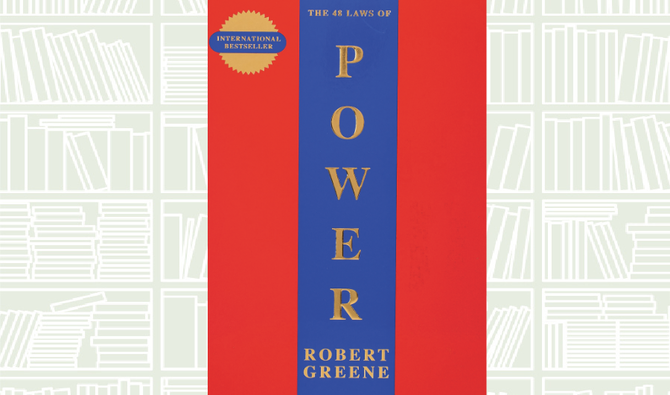
What We Are Reading Today: ‘The 48 Laws of Power’

Short Url
Updated 18 June 2022
Follow

What We Are Reading Today: ‘The 48 Laws of Power’

Author: Robert Greene

“The 48 Laws of Power” is a nonfiction book written by American author and playwright Robert Greene.

The book holds 3,000 years of knowledge about mastering the art of seduction and deception in order to secure power over others.

“The 48 Laws of Power” proposes various means to that end, inferred from historical figures and strategists of great influence such as Niccolo Machiavelli, Sun Tzu and Henry Kissinger.

One of the most prominent laws is the first, which states that an individual must “never outshine the master.”

This law suggests that if your proposed ideas are better than your superior, make sure to attribute this idea to them instead of yourself. Greene explains that disguising your power is a form of strength rather than weakness.

Law 12 teaches the reader to “use selective honesty and generosity to disarm your victim.”

Greene exemplifies this law by introducing the intention and disguise of the Trojan horse.

Law 13 states that “when asking for help, appeal to people’s self-interest, never to their mercy or gratitude.”

While it seems self-explanatory, this law explains that asking for help is inevitable and realistic. But to get a positive response, make sure to appeal to how, by helping you, another person will serve themselves even more.

Greene’s international bestsellers include “The 33 Strategies of War,” “The 50th Law,” “The Art of Seduction,” “Mastery” and “The Laws of Human Nature.”

After attending the University of California, Berkeley, he earned his bachelor’s degree in classical studies from the University of Wisconsin, Madison.

Greene moved to Europe after graduating and in 1998, during his time in Italy, he published “The 48 Laws of Power” which has sold more than 1.2 million copies and been translated into 24 languages.


Book Review: ‘Keep the Memories, Lose the Stuff’

Updated 01 January 2026
Follow

Book Review: ‘Keep the Memories, Lose the Stuff’

If you are someone who adopts a new year, new me mindset every Dec. 31, then Matt Paxton’s 2022 book “Keep the Memories, Lose the Stuff: Declutter, Downsize, and Move Forward with Your Life,” written with Jordan Michael Smith, is worth picking up.

In the process of reading it, I found myself filling four bags with items to donate.

Paxton’s approach is notably different from Marie Kondo’s once-ubiquitous Japanese tidying method, which asks readers to pile all their possessions into one part of the room, hold each item up and ask whether it sparks joy.

While Kondo’s philosophy sounds appealing on paper — thanking objects and dedicating an entire weekend to the process — it is not realistic for everyday life. Paxton’s method feels more practical and gentler.

Paxton knows the emotional terrain of clutter well. For more than 20 years he has helped people declutter and downsize. He was a featured cleaner on the reality show “Hoarders” and later hosted the Emmy-nominated “Legacy List with Matt Paxton” on PBS.

Through this work, Paxton gained insight into why people hold on to things and what makes letting go difficult even of what seemingly looks useless.

What works especially well is how personal the book feels from the outset.

He opens by explaining his anxiety-inducing decision to move to a different US state with his three children, and all of their stuff, to live with his new wife and all of her stuff.

Together, they would be raising seven children — very Brady Bunch style — but with slightly more practical life considerations.

He also talks about how he got into this line of work. When he was in his 20s, his father died and he had to help clear out his belongings. He found that process to be cathartic and special. And he was good at it.

Soon after, short on cash, he accepted a job from someone in his small, close-knit community to help organize her home — likely hired out of pity more than anything else.

That slow process of sifting through items and learning the stories behind each one — directly from the owner of those objects — sparked plenty of joy. He was hooked.

Throughout the book, Paxton makes the case for consistency. His advice is manageable. He encourages readers to dedicate just 10 minutes a day to decluttering to form a habit. We all can spare that.

Paxton also stresses the importance of communication.

Talk to your loved ones about what you want done with your belongings when you are no longer around, and just as importantly, listen to what they want done with theirs, he urges. He offers practical guidance on having these conversations with parents, partners and children.

One critique of this book is that Paxton dedicates a large portion to physical photographs. While this is relevant for many older readers, it may feel less urgent going forward, particularly for Gen Z and younger, whose clutter is more likely to be solely digital.

Ultimately, “Keep the Memories, Lose the Stuff” is less about getting rid of things than about making space; by speaking about objects, sharing their stories and allowing them — and each of us — to move on.