



KARACHI: A Pakistani art school on Friday launched the first ever Urdu version of ‘Romeo and Juliet,’ a 1597 tragedy by William Shakespeare, that the directors described as a “treat” for the Pakistani fans of the iconic English playwright.
The poetic tragedy written by Shakespeare early in his career is about two young Italian lovers whose deaths ultimately reconcile their feuding families. It has inspired numerous films and been staged in theaters the world over.
Translated by Khalid Ahmed and directed by legendary Pakistani actor and TV broadcaster Zia Mohyeddin, this is the first time that the play is being staged in Urdu language by the National Academy of Performing Arts (NAPA) in Karachi, Assistant Director Uzma Sabeen said.
“It’s a treat for the Pakistani fans of Shakespeare, a greatest playwright of all times,” Sabeen told Arab News. “The play hasn’t been localized, it’s not an adaptation but translated to keep it original.”
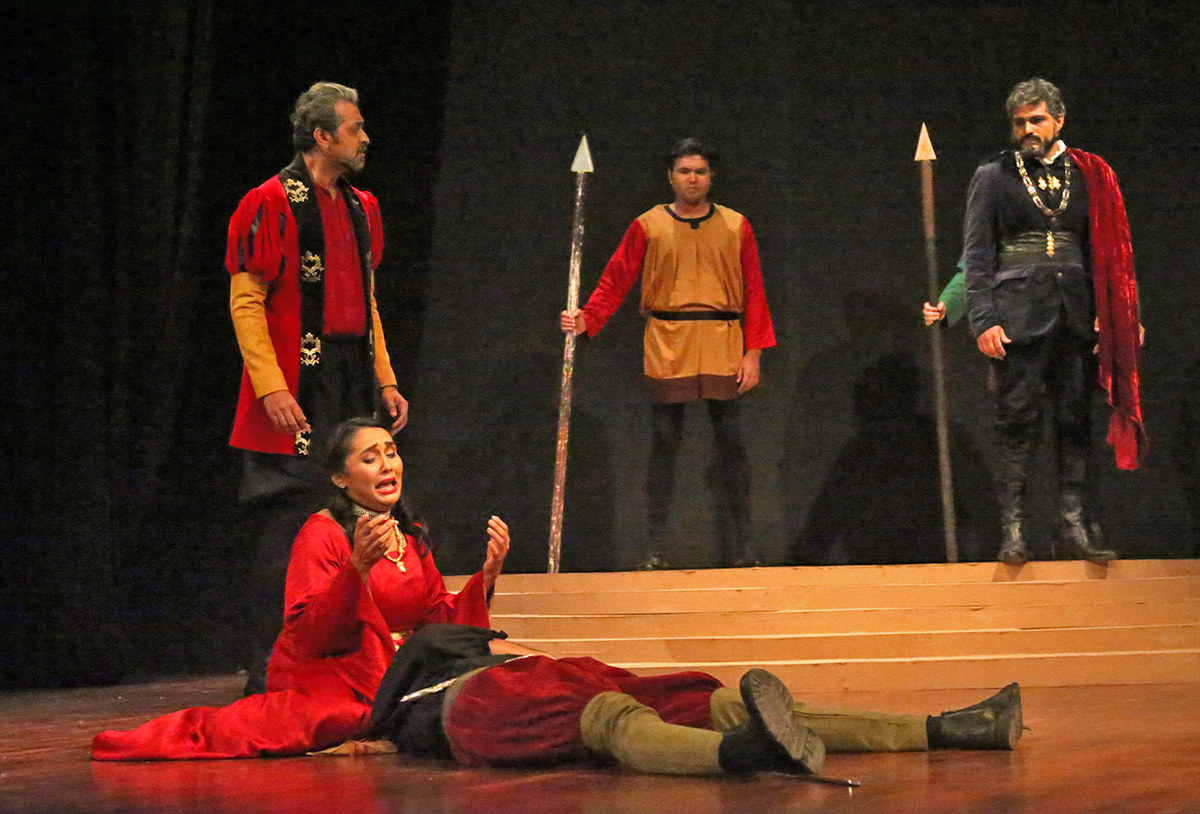
A scene in which Lady Capulet, mother of Juliet, cries over the body of her nephew, Tybalt, who Romeo kills in ‘Romeo and Juliet.’ The play was being rehearsed at Zia Mohyeddin auditorium of the National Academy of Performing Arts in Karachi, Pakistan on June 16, 2022. (AN Photo/S.A.Babar)
She said it was a challenging task but a perfect Urdu script and the finest acting with excellent delivery of dialogues and brilliant expressions by young actors were enough to showcase the Pakistani talent to the world.
“From characters to the set and the wardrobe, every effort has been made to make the audience feel they are watching Romeo and Juliet in Italy’s Verona and Mantua,” the assistant director said.
With simple and sufficient stagecraft, as Mohyeddin put it on the play’s flyer, Shakespeare’s poetic imagery distinguishes his verse from that of others. Turning it into the prose form was not an easy task but translator Ahmed, a famous director and actor who teaches at NAPA, has done justice with it by ensuring the dialogues were humorous.
Noreen Gulwani, who played Juliet, said theater, particularly based on a literary script, was a rarity in Pakistan, but this play proved the South Asian nation had enough talent to stage such plays.
“In Pakistan, theater is very rarely done. And even if it’s done, it’s not very literary or academic or much enriched. There are some commercial forms of theater that do happen sometimes in Pakistan, but they are very similar to what you’d call situational comedy or sitcoms,” she said.
“Theater that is coming from a literature of Shakespeare or Bernard Shaw or Oscar Wilde or any of these playwrights was something Pakistani directors and actors could also do very well.”
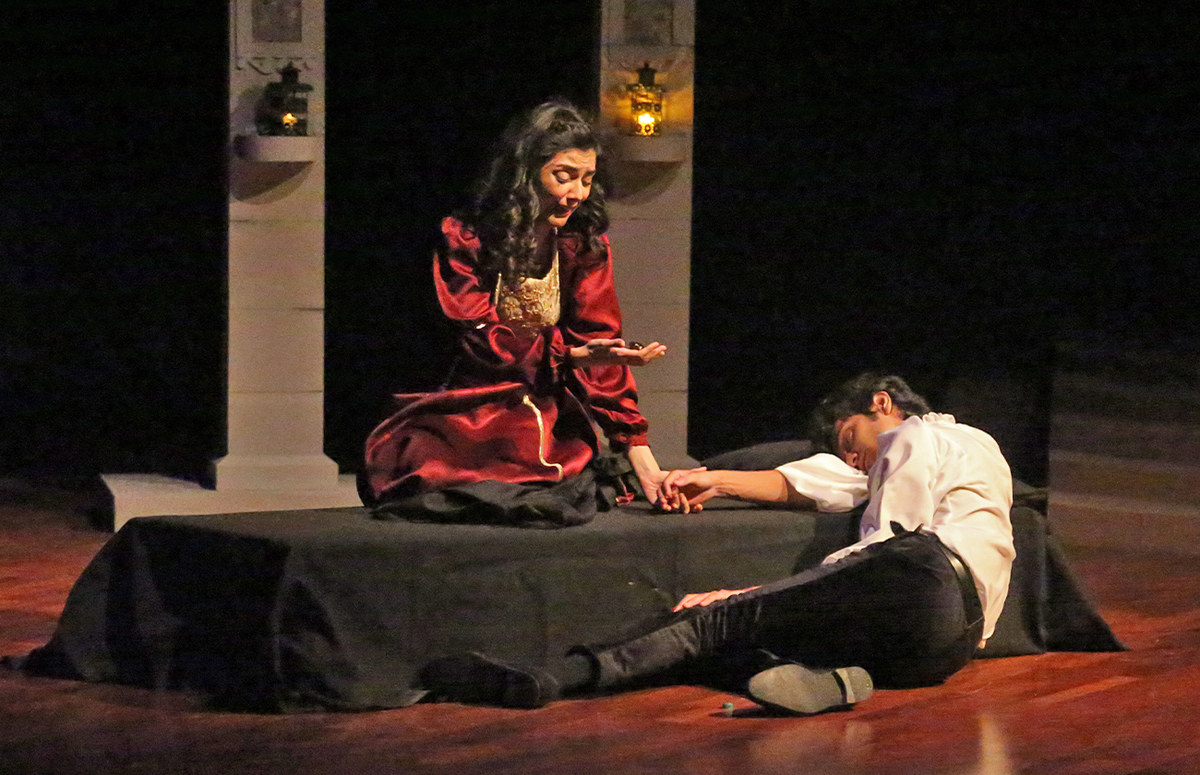
Juliet cries after finding out Romeo had committed suicide in a scene from Urdu-language play ‘Romeo and Juliet’ at Zia Mohyeddin auditorium of the National Academy of Performing Arts in Karachi, Pakistan on June 16, 2022. (AN Photo/S.A.Babar)
About the script, Gulwani said it was prose but still had rhythm to it.
“It’s prose, but it has rhythm,” she added. “It has been written so there’ll be some rhymes here and there, there’ll be different ways of speaking it that will show that it’s still poetic.”
Ali Sher, the Romeo in the play, said it would not only entrain the audience but also give them a “lesson of tolerance, co-existence and love.”
“A play directed by legendary Zia Mohyeddin sahib is always great. But this has a message, very essential for Pakistani audiences,” Sher told Arab News.
“Today we see humanism has vanished, people are enemy to each other, they discriminate on the basis of cast, creed and sect and hate is being spread. But here the play has a perfect message to counter it.”
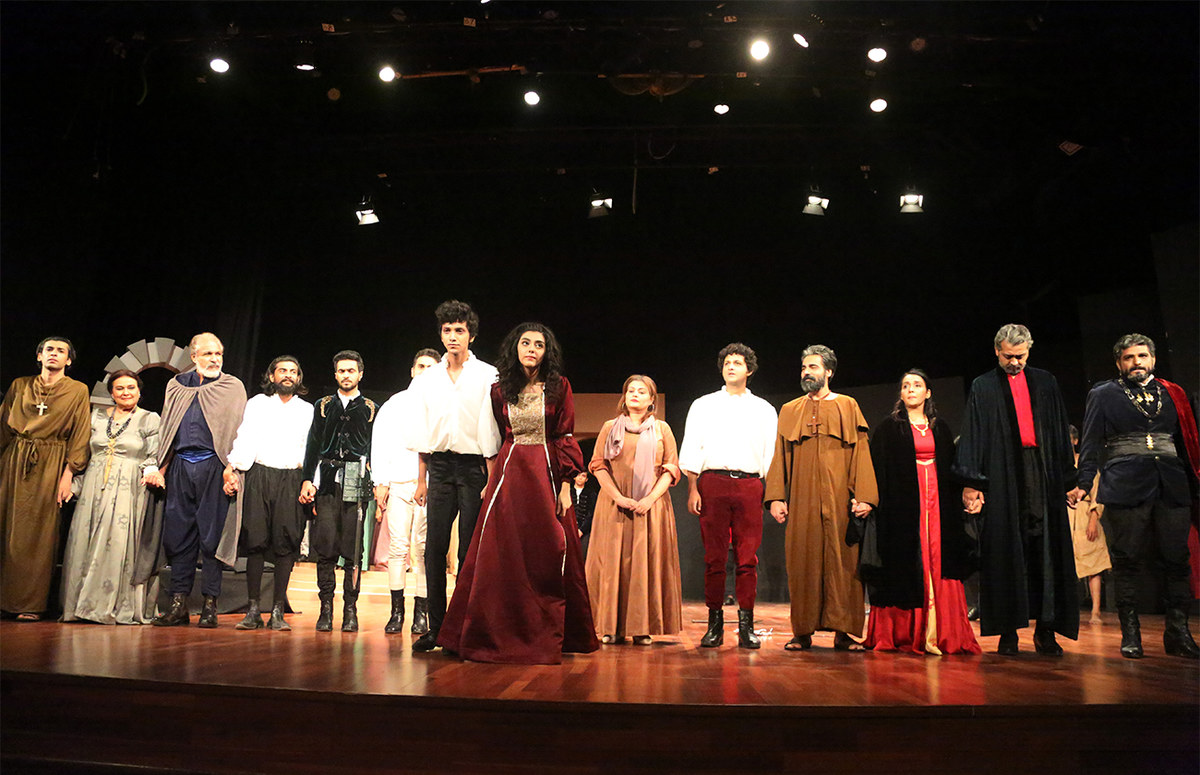
Cast of Urdu-language play ‘Romeo and Juliet’ at Zia Mohyeddin auditorium of the National Academy of Performing Arts in Karachi, Pakistan on June 16, 2022. (AN Photo/S.A.Babar)
Fawad Khan, who has played Romeo’s friend Mercutio, said Ahmed had very beautifully translated some of the balcony scenes.
“The balcony scene that is an iconic Romeo and Juliet scene has been translated very beautifully. My own character creates some laughter at the theater,” Khan told Arab News.
“It is extremely difficult to translate humor, because Shakespeare does a lot of wordplay in the original play. And it was still funny, and to translate it making sure it’s funny is one hell of a job. It has been done so well.”
The play is being staged at NAPA from June 17 till June 26.
Established in 2005 to conserve and teach performing arts and music, NAPA is housed at the historic Hindu Gymkhana in the seaside Pakistani megapolis of Karachi.
The institute has educated and trained at least 12 batches of individuals, who are currently directing, scripting and acting on TV, and in theaters and films.


