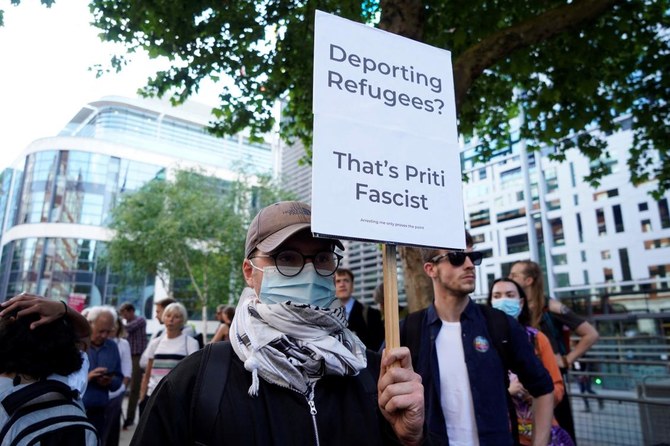
UK condemns court decision to block Rwanda deportation, will not leave convention

The government was thwarted in its attempt to send a handful of migrants on a charter plane to Rwanda on Tuesday after the European Court of Human Rights (ECHR) stepped in to issue injunctions, canceling the flight. (File/AFP)
Short Url
Updated 16 June 2022
Follow

UK condemns court decision to block Rwanda deportation, will not leave convention

  • Dominic Raab, who is also Britain’s justice secretary, criticized the Strasbourg-based court for essentially blocking the flight

LONDON: Britain has no plans to leave the European Convention on Human Rights, but the Strasbourg court which enforces it overstepped its powers in blocking the deportation of asylum seekers to Rwanda, deputy prime minister Dominic Raab said on Thursday.
The government was thwarted in its attempt to send a handful of migrants on a charter plane more than 4,000 miles (6,4000 km) to Rwanda on Tuesday after the European Court of Human Rights (ECHR) stepped in to issue injunctions, canceling the flight.
Raab, who is also Britain’s justice secretary, criticized the Strasbourg-based court for essentially blocking the flight, part of a policy which London says will stem the flow of migrants making dangerous trips across the English Channel from France.
Raab said the flights would take place despite criticism from the United Nations, the leadership of the Church of England and Prince Charles, the heir to the throne, who has privately described the plan as “appalling” according to media reports.
“Our plans involve staying within the Convention, the European Convention. It is also important the Strasbourg court reflects and stays faithful to its mandate as part of the convention,” he told BBC television.
“The Strasbourg court itself has said for many years that there’s no binding power of injunction. And then later on they said: ‘Well actually, we can issue such binding injunctions.’ It is not grounded in the Convention,” Raab told Sky News.
The European court’s late intervention had led some in Prime Minister Boris Johnson’s Conservative Party to call for Britain to pull out of the European Convention on Human Rights altogether.
Challenged over death threats on social media to human rights lawyers, Raab said they were unacceptable but Britain’s Human Rights Act had led to an “industry” of lawyers promoting “elastic interpretations” of the law on behalf of their clients.
He added that the government could not give a fixed date for when it would be able to send asylum seekers to Rwanda.


Venezuela aims to boost oil output but sanctions stand in the way, VP says

Updated 4 sec ago
Follow

Venezuela aims to boost oil output but sanctions stand in the way, VP says

  • Sanchez called the recent capture of Nicolas Maduro a “dark day” for the country

DUBAI: Venezuela’s Vice President for Economy Calixto Ortega Sanchez said on Wednesday that his country needed vast foreign investment and sanctions relief to tap its huge oil reserves and restart its ailing economy.

“We know that the reference for Venezuela is that (it is) the country with the biggest oil reserves, and we want to stop being known for this, and we want to be known as one of the countries with the highest production levels,” Sanchez said.

Responding to questions by American journalist Tucker Carlson, Sanchez called the recent capture of Nicolas Maduro a “dark day” for the country but said Venezuela was working to reestablish a relationship with the US, which he described as a “natural partner” for the country.

“The Venezuelan people and authorities have shown that they are ready to peacefully move forward and to build opportunities,” he said during a session at the World Government Summit.

Sanchez, who headed Venezuela’s central bank, said the most pertinent issue facing his country is continued US sanctions.

Despite failing to result in regime change, the sanctions had effectively stifled the economy from growing, he added.

He said the Venezuelan government was now working to reform its laws to allow foreign investment and hoped the US would ease sanctions to aid their work.

“The first decisions that interim President Rodriguez took was to go to the National Assembly and ask for reform to the hydrocarbon law … this law will allow international investors to go to Venezuela with favorable conditions, with legal assurance of their investments,” he added.

“The economy is ready for investment. The economy is ready for the private sector; it is ready to build up a better future for the Venezuelan people.”

Sanchez played down inferences by Carlson that his government had been taken over, insisting that the regime still held authority in the country. He said the country had set up two funds to receive money from oil production that would fund better welfare and social conditions for Venezuelans.

“Allow us to have access to our own assets … we don’t have access to our own money,” he added.

“If you allow us to function like a regular country, Venezuela will show extraordinary improvement and growth.”