ATALAIA DO NORTE, Brazil: A federal police investigator said Wednesday night a suspect confessed to fatally shooting an Indigenous expert and a journalist in a remote part of the Amazon and took officers to where the bodies were buried.
Police said at a news conference in the Amazon city of Manaus that the prime suspect in the case confessed Tuesday night and detailed what happened to the pair who went missing June 5.
The federal investigator, Eduardo Alexandre Fontes, said Amarildo da Costa de Oliveira, 41, nicknamed Pelado, told officers he used a firearm to kill Indigenous expert Bruno Pereira of Brazil and freelance reporter Dom Phillips of Britain.
Torres said Pelado took police to a spot Wednesday where they recovered human remains. The remains had not yet been positively identifiedy, Torres said.
“We found the bodies three kilometers (nearly two miles) into the woods,” the investigator said.
He said other arrests would be made soon in the case.
Another officer, Guilherme Torres of the Amazonas state police, said the missing men’s boat had not been found yet but police knew the area where it purportedly was hidden by those involved in the crime.
“They put put bags of dirt on the boat so it would sink,” he said.
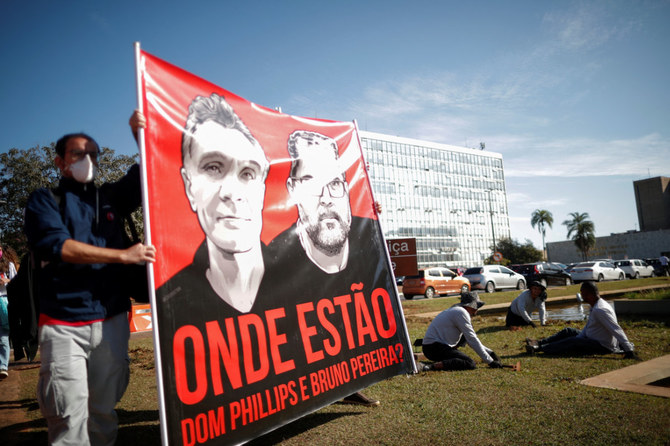
As federal police announced they would hold a news conference, colleagues of Pereira called a vigil outside the headquarters of the Brazilian government’s Indigenous affairs agency in Brasilia. Pereira was on leave from the agency.
Pereira, 41, and Phillips, 57, were last seen on their boat in a river near the entrance of the Javari Valley Indigenous Territory, which borders Peru and Colombia. That area has seen violent conflicts between fishermen, poachers and government agents.
Davelopments began moving Wednesday when federal police officers took a suspect they didn’t identify at the time out on the river toward search parties looking for Phillips and Pereira.
An Associated Press photographer in Atalaia do Norte, the city closest to the search zone, witnessed police taking the suspect, who was in a hood.
On Tuesday, police said they had arrested a second suspect in connection with the disappearance. He was identified as Oseney da Costa de Oliveira, 41, a fisherman and a brother of Pelado, who police already had characterized as their main suspect.
De Oliveira told AP on Friday that he had visited Pelado in jail and was told that local police had tortured him in attempts to get a confession. De Oliveira said his brother was innocent.
Indigenous people who were with Pereira and Phillips have said that Pelado brandished a rifle at them on the day before the two men disappeared.
Pelado’s family had told AP that he denied any wrongdoing and claimed police tortured him to try to get a confession.
Official search teams had concentrated their efforts around a spot in the Itaquai river where a tarp from the boat used by the missing men was found Saturday by volunteers from the Matis Indigenous group.
“We used a little canoe to go to the shallow water. Then we found a tarp, shorts and a spoon,” one of the volunteers, Binin Beshu Matis, told The Associated Press.
Authorities began scouring the area and discovered a backpack, laptop and other personal belongings submerged underwater Sunday. Police said that evening that they had identified the items as the belongings of both missing men, including a health card and clothes of Pereira. The backpack was determined to belong to Phillips.
Police previously reported finding traces of blood in Pelado’s boat. Officers also found organic matter of apparent human origin in the river that was sent for analysis.
Authorities have said a main line of the police investigation into the disappearance has pointed to an international network that pays poor fishermen to fish illegally in the Javari Valley reserve, which is Brazil’s second-largest Indigenous territory.
One of the most valuable targets is the world’s largest freshwater fish with scales, the arapaima. It weighs up to 200 kilograms (440 pounds) and can reach 3 meters (10 feet). The fish is sold in nearby cities, including Leticia, Colombia, Tabatinga, Brazil, and Iquitos, Peru.
Pereira, who previously led the local bureau of the Brazilian government’s Indigenous agency, known as FUNAI, has taken part in several operations against illegal fishing. In such operations, as a rule the fishing gear is seized or destroyed, while the fishermen are fined and briefly detained. Only the Indigenous can legally fish in their territories.
“The crime’s motive is some personal feud over fishing inspection,” Atalaia do Norte’s Mayor Denis Paiva speculated to reporters without providing more details.
AP had access to information police shared with Indigenous leadership. While some police, the mayor and others in the region link the pair’s disappearances to the “fish mafia,” federal police have not ruled rule out other lines of investigation, such as narco trafficking.
Torres, the federal police officer, reiterated that point Wednesday night, saying he could not discuss specifics of the investigation.
“We are working with several lines of investigation,” he said..
In 2019, Funai official Maxciel Pereira dos Santos was gunned down in Tabatinga in front of his wife and daughter-in-law. Three years later, the crime remains unsolved. His FUNAI colleagues told AP they believe the slaying was linked to his work against fishermen and poachers.


![]()

Suspect confesses to killing pair missing in Amazon, says Brazil police investigator
Short Url
https://arab.news/8634j
Suspect confesses to killing pair missing in Amazon, says Brazil police investigator
- Brazil indigenous expert Bruno Pereira of Brazil and freelance reporter Dom Phillips of Britain went missing in a remote part of the Amazon
- Pereira's colleagues at FUNAI believe the slaying was linked to his work against illegal fishers and poachers


Latest updates


© 2026 SAUDI RESEARCH & PUBLISHING COMPANY, All Rights Reserved And subject to Terms of Use Agreement.