

Pakistani government chided for ‘Drink less tea, save money’ plea

Men drink a cup of tea at a restaurant in Islamabad, Pakistan, on June 15, 2022. (AFP)
Short Url
Updated 15 June 2022
Follow

Pakistani government chided for ‘Drink less tea, save money’ plea

  • Pakistan spends about $600 million from the central bank’s hard currency reserves for tea imports annually
  • Some people have asked Planning Minister Ahsen Iqbal to resign after his appeal to drink less tea

ISLAMABAD: A minister in Pakistan’s newly elected government faced criticism Wednesday following his plea to the nation to drink less tea to help save on imports amid a deepening economic crisis.

Pakistan is among the world’s top tea importers, a hugely popular drink among both the rich and the poor in this country of 220 million people. The government has to spend about $600 million from the central bank’s hard currency reserves for tea imports annually.

A Pakistani is believed to drink at least three cups of tea a day on average, the nation’s caffeinated drink of choice.

Prime Minister Shahbaz Sharif, who took over in April after Imran Khan was ousted in a no-confidence vote in Parliament, has pledged to improve the ailing economy and meet conditions set by the International Monetary Fund in an effort to revive a $6 billion bailout package.

Still, Planning Minister Ahsan Iqbal’s appeal to drink less tea surprised many.

“I appeal to the people to reduce their tea drinking by one or two cups a day because we also borrow money for the tea, which is imported,” Iqbal said at a press conference on Tuesday.
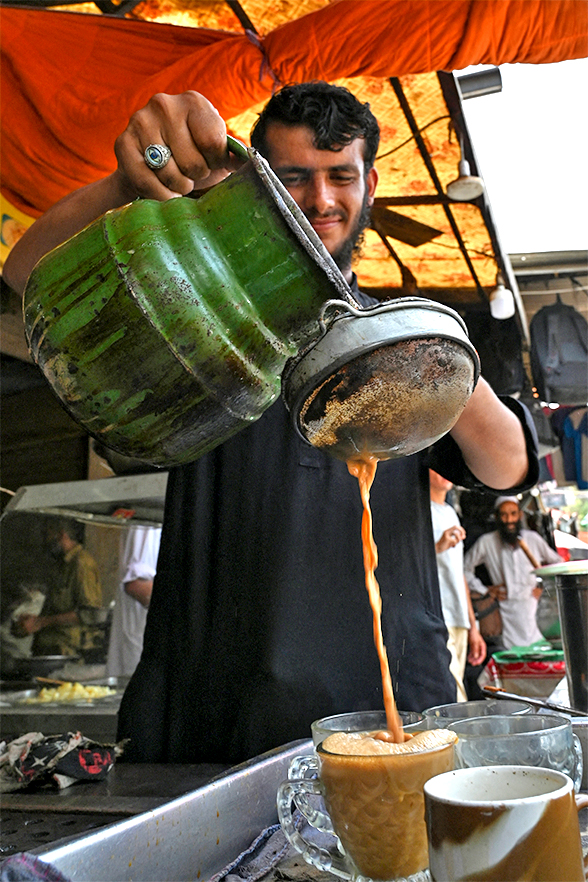


An employee pours tea cups for customers at a restaurant in Islamabad, Pakistan, on June 15, 2022. (AFP)

Some have openly advised Iqbal on social media to resign.

“Yesterday Ahsan Iqbal asked us to consume less tea and tomorrow they may say eat less. Is it a solution?” asked Dil Sher, who owns a roadside tea stall on the outskirts of Islamabad.

The government has so far hiked the price of fuel, natural gas and electricity by up to 45 percent, sending food prices soaring. Last week, Sharif’s Cabinet presented its first budget to Parliament for approval, levying more taxes on the rich and vowing to remove subsidies on energy and fuel as demanded by the IMF.

Hours long power cuts across Pakistan have also made Sharif’s coalition government unpopular.

Now in the opposition, Khan’s Pakistan Tehreek-e-Insaf party also took to Twitter, claiming Sharif’s government has damaged the economy, barely two months since taking office. Sharif, however, says he is paying the price for the mismanagement of his predecessor’s government.

During his 3 1/2 years in power, Khan’s government also faced criticism, including when a lawmaker from his party, Riaz Fatyana, appealed on people to use less sugar and eat just one flatbread with every meal instead of more amid a shortage of sugar and wheat at the time. In Pakistan, most people consume roti, a flatbread similar to India’s naan.

Pakistan’s currency, the rupee, plummeted to a record low in trading against the US dollar on Wednesday. According to the central bank, the rupee slid to 206 against the US dollar.



‘Good sense’ hailed as blockbuster Pakistan-India match to go ahead

Updated 11 sec ago
Follow

‘Good sense’ hailed as blockbuster Pakistan-India match to go ahead

  • Pakistan ends week-long standoff after ICC and regional boards intervene over boycott threat
  • India-Pakistan clash seen as financial linchpin for tournament, with cancelation hurting all members

MUMBAI: Pakistan’s decision to U-turn and go ahead with their blockbuster Group A match against India at the T20 World Cup on February 15 was hailed Tuesday as an outbreak of “good sense” and “good for cricket.”

The Pakistan government in Islamabad late on Monday night ended a week-long stand-off by rescinding its order for the cricket team to boycott the match in Colombo.

The biggest and most lucrative clash in world cricket was revived after a frantic weekend of negotiations.

It culminated in International Cricket Council (ICC) and Bangladesh Cricket Board (BCB) chiefs flying to Lahore on Sunday for talks with the Pakistan Cricket Board (PCB).

The governments of Bangladesh and Sri Lanka both wrote to the Islamabad government on Monday urging it to change its stance and allow the game to go ahead, and just before midnight they got their wish.

After “multilateral discussions, as well as the request of friendly countries, the Government of Pakistan hereby directs the Pakistan National Cricket Team to take the field on February 15,” the Islamabad government said on its official X account late Monday night.

The decision had been taken with the aim of “protecting the spirit of cricket,” it added.

Former India cricketer Madan Lal told AFP on Tuesday: “Pakistan did shake up the ICC by repeatedly saying they would not play.

“Eventually, the ICC had to send officials to Pakistan to sort out the issue” and that was “good for cricket.”

“We want strong teams to play so that the charm of the World Cup is not lost,” he added.

‘LOSS-LOSS SITUATION’

Sri Lanka, who will host the match which generates multi-millions of dollars in advertising, broadcast rights, sponsorship and tourism, also hailed the decision.

Sri Lankan President Anura Kumara Dissanayake thanked Pakistan’s Prime Minister Shehbaz Sharif for “ensuring the game we all love goes on.”

“Delighted that the eagerly awaited India and Pakistan match at the ongoing T20 Cricket World Cup in Colombo will proceed as planned,” Dissanayake said in a social media post.

Veteran Indian journalist Pradeep Magazine told AFP “good sense has prevailed on all sides.”

Financial considerations would have been taken into account, he added.

“India-Pakistan is not just about cricket revenue — it also means wider commercial revenue,” he said.

“Everyone realized that losing the revenue from an India-Pakistan match would have been a loss-loss situation for all ICC member nations.”

Bitter political rivals Pakistan and India have not played bilateral cricket for more than a decade and meet only at global or regional tournament events, and only on neutral territory.

The 20-team tournament had been overshadowed by an acrimonious political build-up.

Bangladesh, who refused to play in India citing security concerns, were replaced by Scotland.

As a protest, the Pakistan government ordered the team not to face co-hosts India in the Group A fixture.

Pakistan, who edged out Netherlands in the tournament opener on Saturday, would have conceded two points if they had forfeited the match, which could have put their chances of progressing in the tournament in jeopardy.

They play the USA in their second group match in Colombo later Tuesday.

India captain Suryakumar Yadav said on Friday that his team would travel to Colombo for the clash, whether the game was on or not.

“We haven’t said no to playing them,” Suryakumar said. “Our flights are booked and we are going to Colombo.”