

Senators divided over ailing Gen Musharraf’s return to Pakistan

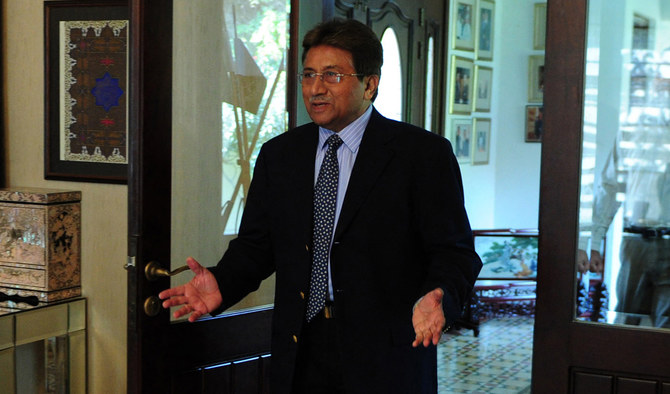
In this photograph taken November 14, 2014, Pakistan's former military ruler General Pervez Musharraf gestures as he arrives for an interview with AFP in Karachi. (AFP/File)
Short Url
Updated 16 June 2022
Follow

Senators divided over ailing Gen Musharraf’s return to Pakistan

  • Jamaat-e-Islami party’s Mushtaq Ahmad Khan says the ex-military ruler must be held accountable for his ‘crimes’
  • Senator Abdul Ghafoor Haidri calls it inappropriate to stop the general from returning while he is in a critical condition

ISLAMABAD: The Senate of Pakistan on Wednesday took up the issue of former military ruler General (r) Pervez Musharraf’s possible return to the country after media reports emerged he was in a critical condition in the United Arab Emirates where he had been living in self-imposed exile since 2016.

Musharraf toppled former prime minister Nawaz Sharif’s administration in a military coup that took place in October 1999 and later became the president of the country.

The ailing general’s family announced on Friday he had been in hospital for the last three weeks, adding that he was going through a “difficult stage where recovery is not possible and organs are malfunctioning.”

Pakistan’s top civil and military leaders have said since then that Musharraf should be allowed to return to the country, though some senators raised concern over his political record while demanding his accountability.

“[Musharraf] broke the constitution [of Pakistan] twice,” said Senator Mushtaq Ahmad Khan of the Jamaat-e-Islami party. “He attacked the judiciary and dragged around a serving chief justice by his hair on roads.”

Khan said the former military ruler should be brought back and held accountable for his “crimes.”

The senator recalled that a Pakistani judge had announced capital punishment for him in a treason trial for violating the constitution.

He maintained that if Musharraf had to be pardoned and allowed to return, the country should release all prisoners from jails and shut down courts.

Pakistan’s former prime minister Yousaf Raza Gillani, however, described the debate on the issue as a “futile exercise.”

“Such decisions are taken elsewhere,” he claimed. “Did you manage to stop him when he had to go? Will you be able to stop him when he returns?”

Senator Abdul Ghafoor Haideri of Jamiat-e-Ulama-e-Islam (JUI-F) party said, however, it was not right to oppose Musharraf’s return to the country under the current circumstances.

“Musharraf is caught between life and death,” he noted. “If we say at this stage that he should not return to Pakistan, it will not be appropriate.”


Pakistan traders seek waiver of port charges on Afghan cargo after re-export approval

Updated 8 sec ago
Follow

Pakistan traders seek waiver of port charges on Afghan cargo after re-export approval

  • Afghan transit trade stalled after border closure following last year’s skirmishes between the two countries
  • Government’s re-export approval allows stranded Afghan cargo to be shipped out without entering Pakistan

KARACHI: Pakistani traders and logistics operators are calling for waivers and rationalization of detention and demurrage charges incurred on Afghan transit cargo that remained stuck at ports after cross-border trade with Afghanistan came to a halt, according to a trade body statement issued on Saturday.

The appeal follows a government decision earlier this month allowing the re-export of stranded Afghan transit goods, after prolonged border closures prevented cargo from moving onward to Afghanistan, leaving containers immobilized at Pakistani seaports and border crossing points.

Afghan transit trade through Pakistan was disrupted following the closure of the Pakistan-Afghanistan border due to skirmishes between the two countries in October last year, causing congestion at ports and triggering escalating detention and demurrage charges. Industry representatives say the situation imposed a substantial financial burden on importers, clearing agents and transporters, even though the goods were never intended for Pakistan’s domestic market.

“[We have] been actively engaging with the Directorate General of Transit Trade (DGTT), South Asia Pakistan Terminals (SAPT), and other port and terminal operators, including through formal representations, to seek waivers and rationalization of detention and demurrage charges,” the Pakistan-Afghanistan Joint Chamber of Commerce and Industry (PAJCCI) said.

The chamber said it had taken up the matter of stranded Afghan transit trade goods with the Ministry of Commerce following a high-level meeting held on Jan. 10, after which the ministry issued a notification on Jan. 12 permitting the re-export of stranded cargo from the ports of Karachi and Gwadar and designated border crossing points.

PAJCCI said its coordinated engagement with government departments and terminal operators aims to ensure the re-export decision results in “practical relief on ground,” enabling the smooth clearance and movement of cargo while preventing further financial losses for the trade community.

Pakistan’s commerce ministry has not publicly commented on whether waivers on detention and demurrage charges will be granted.