

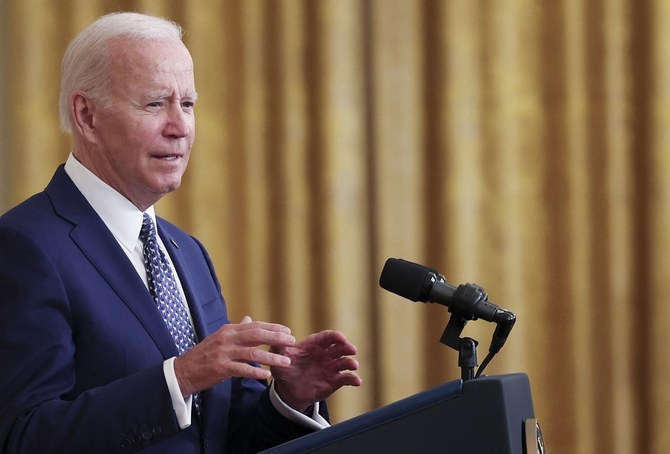

RIYADH: The White House and Saudi officials ended weeks of speculation on Tuesday by confirming that US President Joe Biden will visit Saudi Arabia on July 15 and 16 at the invitation of King Salman.
Biden will meet the king and Crown Prince Mohammed bin Salman, and attend a summit of the six GCC states plus Egypt, Iraq and Jordan.
The Saudi Embassy in Washington welcomed the presidential visit, which it said would “enhance the historic and strategic partnership” between Saudi Arabia and the US. “At a time of global challenges related to the global economy, health, climate and international conflict, the partnership between our two countries is as critical as ever to the promotion of peace, prosperity and stability around the world,” the embassy said.
Issues on the agenda for talks in the Kingdom include support for the UN-brokered truce in Yemen, which has led to the most peaceful period there since war began seven years ago. “He will also discuss means for expanding regional economic and security cooperation, including new and promising infrastructure and climate initiatives, as well as deterring threats from Iran, advancing human rights, and ensuring global energy and food security,” the White House said.
A senior US official said the crown prince’s role in helping secure an extension of the truce in Yemen was an example of what he said was a need for the US to engage with Saudi Arabia as way to help bring peace and security to the region.
The US leader will begin his regional tour on July 13 in Israel at a fraught time for Naftali Bennett’s fragile coalition. The Israeli prime minister is trying to avert another election and the potential return to power of Benjamin Netanyahu, while Israel shares Saudi concerns over advances in Iran’s nuclear program.
In Israel, Biden will take part in a virtual meeting of the I2-U2, an economic forum established last year that comprises Israel, India, the UAE and the US.
He will also visit the occupied West Bank “to consult with the Palestinian Authority and to reiterate his strong support for a two-state solution, with equal measures of security, freedom, and opportunity for the Palestinian people,” the White House said.
The Saudi political analyst Dr Hamadan Al-Shehri told Arab News: “Biden will face some difficulties during his talks in Saudi Arabia as a result of his lax policies toward many issues, foremost of which is his commitment to the security of his allies, the reluctance to meet their needs for weapons, his sudden withdrawal from Afghanistan, his ‘softness’ in dealing with the Iranian nuclear file, and other stances.
“Observers here believe that the shift in the US administration’s policy began after months of meetings in Riyadh between Biden’s top advisers Brett McGurk and Amos Hochstein on the one hand, and Saudi officials on the other hand, including the Saudi crown prince.
“The Biden administration is facing increasing criticism for its handling of the current oil crisis and its inability to stop the rise in gasoline prices, which have exceeded $5 a gallon for the first time in the history of the US.”
Dan Shapiro, who was US ambassador to Israel when Biden was vice president, said the president’s visit to Saudi Arabia came as China increasingly looked to Gulf Arab nations that mostly rebuffed US efforts to isolate Russia over its invasion of Ukraine.
“President Biden has concluded correctly that the US has more strategic interests that would be served by stabilizing the US-Saudi relationship,” said Shapiro, who is now at the Atlantic Council.


