

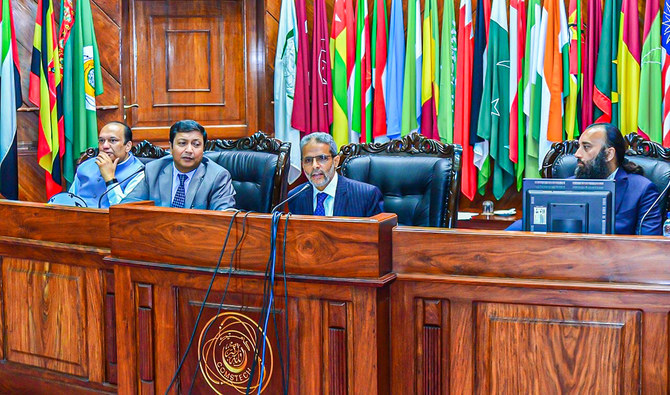

ISLAMABAD: The Organization of Islamic Cooperation’s (OIC) Standing Committee on Scientific and Technological Cooperation (COMSTECH), in collaboration with the Yemeni embassy and Pakistani universities, on Monday launched the COMSTECH Consortium of Excellence (CCoE) Yemen Programme for the capacity-building of Yemeni healthcare professionals on fully-funded scholarships in Pakistan.
The capacity-building program for Yemeni healthcare professionals was launched in Islamabad in the presence of the COMSTECH coordinator-general, the ambassador of Yemen, and officials of Pakistani universities and the ministry of foreign affairs. These Yemeni professionals will be trained at Islamabad’s Health Services Academy (HSA), the University of Lahore (UoL), and the International Center for Chemical and Biological Sciences (ICCBS) at the University of Karachi.
Headquartered in Pakistan, COMSTECH was launched in 1981 during the Islamic Summit in Makkah to enhance cooperation in the field of science and technology, including healthcare, among OIC member states.
“Under this program, 50 fellowships will be given to Yemeni health professionals and scientists to obtain training in public health and medical technologies,” Professor Dr. Muhammad Iqbal Choudhary, the COMSTECH coordinator-general, told Arab News.
He said there was so much willingness by excellent institutions in Pakistan to help brothers and sisters in the Muslim world. “Yemen is in need of several things, but we have identified to work with them in the healthcare sector.”
Professor Choudhary there were many gaps in Yemen’s healthcare sector but the most important one was in its capacity.
“We are building capacity in three areas,” he said. "Public health interventions at the policy level, training technicians so that they can be able to use complex medical devices and the third is focused on research to know the reasons of spread of diseases like cholera and others in Yemen."
Professor Choudhary said the stay of Yemeni professionals would depend on the type of training, ranging from a few weeks to two years.
“On behalf of the people of Yemen, we appreciate this initiative by COMSTECH and Pakistani universities,” Yemen's Ambassador Mohammed Motahar Alashabi told Arab News.
These fellowships, which were divided into healthcare services, technical side and research, would provide a much-needed boost to Yemen’s health sector by enhancing professional skills of its healthcare practitioners, the envoy said.
Ambassador Alashabi said this fully-funded opportunity was for all Yemeni nationals. “The embassy is working for all Yemeni people irrespective of their affiliation or territory.”
HSA Vice-Chancellor Professor Dr. Shahzad Ali Khan said Yemeni professionals would be provided state-of-the-art training at the academy and its affiliated hospitals.
He said the project was under consideration for quite some time and the academy would offer multiple courses to Yemeni professionals.
“In order to help the people of Yemen as their health system was disrupted due to internal war-like situation, we have decided to train their people,” Professor Khan told Arab News.
Awais Raoof, chairman UoL board of governors, said his university was committed to not only training biomedical engineers, but nurses and operation theater technicians as well.
“We are anticipating 20 biomedical engineers for training in the first phase and then subsequently in other areas as well,” Raoof told Arab News.


