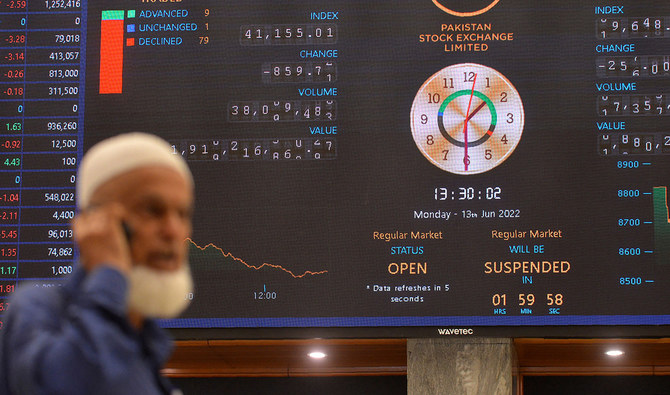
KARACHI: Pakistan’s national currency on Monday took a dip in the interbank market as the US dollar reached Rs203.86, while the equity market fell by 2.7 percent in the post-budget session as the measures announced by the government failed to restore investor confidence, dealers and analysts said.
The Pakistani currency declined by 0.74 percent, or Rs1.51, against the greenback in the interbank market as exhausted investors continued to wait for fresh inflow of major foreign funds, particularly from the International Monetary Fund.
“The rupee is under pressure due to reports that the IMF is not satisfied with certain budgetary measures like salary increments,” Abdul Azeem, the head of research at Spectrum Securities, told Arab News. “The absence of any inflows and delay in the IMF tranche will continue to exert pressure on the rupee in the coming days as well.”
Pakistan has held several rounds of negotiations with the IMF to ensure the resumption of a $6 billion loan program availed in 2019. The country has so far received $3 billion from the global lender and is desperate to get the next instalment of around $1 billion.
“The major issue is that the government is unable to arrange for the IMF tranche and due to no outcome in engagement with the Fund, other countries, including China and Saudi Arabia, are also not coming up to support Pakistan,” Zafar Paracha, a senior currency analyst, told Arab News.
“In the budget they (government) have not taken any practical step to the country’s benefit. Apart from ‘window dressing,’ they did not cut expenditures neither did they impose tax on agriculture sector. No steps have been taken to curtail unnecessary perks and privileges of bureaucracy,” he said, adding “we don’t see seriousness and sincerity.”
Pakistan on Friday unveiled its federal budget with an outlay of Rs9.52 trillion ($47 billion), setting a growth target of 5 percent that was lower than the outgoing fiscal year’s 5.97 percent.
Currency dealers say the continuous fall in forex reserves and rising demand for dollar to pay for oil and other commodities is exerting pressure on the local currency.
"Our forex reserves have declined by close to $500 million in the last week alone and there are no inflows in sight in the immediate run," Malik Bostan, president of Exchange Companies Association of Pakistan (ECAP) told Arab News.
“Daily around $120 million are required for import of oil and gas. Banks in the past would have three months to pay, but now they are insisting to deposit 100 percent payment for oil purchases.”
The country's foreign exchange reserves stand at $9.2 billion at the moment — barely enough for 45 days of imports.
Analysts say the government needs to come up with a viable solution to the erratic movement in the currency exchange rate, otherwise the rupee will continue to depreciate against dollar.
“Other friendly countries and donor institutions will only release funds, if the country gets approval from the IMF. Until then, the capital markets will remain uncertain,” Bostan said.
Pakistan's stock market also fell by 2.7 percent on Monday due to higher taxes on corporations and banks in the budget. The KSE100 index fell by 1,134 points to close at 40,879-level.
“Stocks closed sharply lower amid post-budget consolidation after higher taxes slapped on high-earning, bluechip corporates, windfall taxes on the banking sector and removal of tax credits on insurance, mutual and pensions funds,” Ahsan Mehanti, chief executive officer of Arif Habib Corporation, told Arab News.
“Institutional selling on global equity selloff and slump in global crude oil prices played a catalyst role in the bearish close.”
Pakistan raised tax rate on banks from 39 percent to 42 percent in the federal budget.
Despite record inflation in the country, the government has tried to implement strict economic reforms suggested by IMF officials by raising fuel and power prices.
According to Finance Minister Miftah Ismail, the resumption of IMF program will also unlock funding from other external sources.
The program was stalled earlier this year after former prime minister Imran Khan’s administration violated its agreement with the international lending agency by offering subsidies on energy and petroleum products, ahead of a no-confidence vote against him.
The new government is not only looking for the revival of the IMF program, but also seeking an increase in its volume to $8 billion until June 2023.


![]()

Pakistani currency hits new all-time low, equities fall nearly 3% on higher corporate taxes
Short Url
https://arab.news/vgaac
Pakistani currency hits new all-time low, equities fall nearly 3% on higher corporate taxes
- High demand for dollar for import payments continues to keep national currency under pressure
- Analysts say pressure on rupee will continue until government ensures IMF program’s revival
Latest updates


© 2026 SAUDI RESEARCH & PUBLISHING COMPANY, All Rights Reserved And subject to Terms of Use Agreement.