US gasoline average pump price tops $5 a gallon in historic first

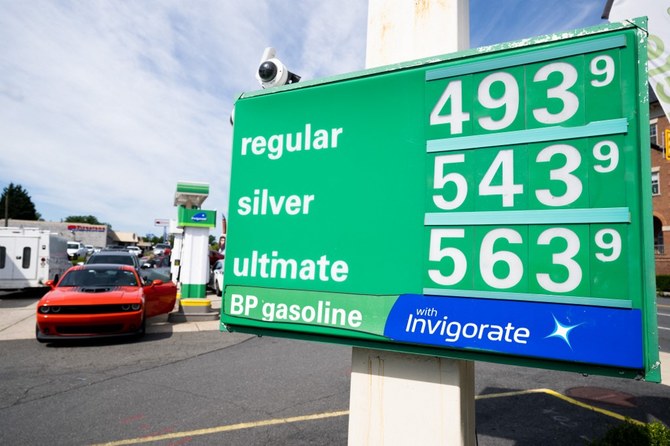
The national average price for regular unleaded gas rose to $5.004 a gallon on June 11. (AFP)
Short Url
Updated 12 June 2022
Follow

US gasoline average pump price tops $5 a gallon in historic first

WASHINGTON: The price of US gasoline averaged more than $5 a gallon for the first time on Saturday, data from the AAA showed, extending a surge in fuel costs that is driving rising inflation.

The national average price for regular unleaded gas rose to $5.004 a gallon on June 11 from $4.986 a day earlier, AAA data showed.

High gasoline prices are a headache for President Joe Biden and congressional Democrats as they struggle to maintain their slim control of Congress with midterm elections coming up in November.

Biden has pulled on numerous levers to try to lower prices, including a record release of barrels from US strategic reserves, waivers on rules for producing summer gasoline, and leaning on major OPEC countries to boost output.

Yet fuel prices have been surging around the world due to a combination of rebounding demand, sanctions on oil producer Russia after its invasion of Ukraine and a squeeze on refining capacity.

Road travel, however, has remained relatively strong, just a couple of percentage points below pre-pandemic levels, even as prices have risen.

Still, economists expect demand may start to decline if prices remain above $5 a barrel for a sustained period.

“The $5 level is where we could see very heavy amounts of gasoline demand destruction,” said Reid L’Anson, senior economist at Kpler.

Adjusting for inflation, the US gasoline average is still approximately 8 percent below June 2008 highs around $5.41 a gallon, according to US Energy Department figures.

Consumer spending has so far remained resilient even with inflation running at its highest level in more than four decades, with household balance sheets shored up by pandemic relief programs and a tight job market that has fueled strong wage gains, especially for lower-income workers.

Gasoline product supplied, a proxy for demand, was 9.2 million barrels per day last week, according to the US Energy Information Administration, broadly in line with five-year seasonal averages.

The high prices for drivers come as major oil-and-gas companies post bumper profits. Shell reported a record quarter in May and Chevron Corp. and BP have posted their best numbers in a decade. 

Other majors, including Exxon Mobil and TotalEnergies, as well as US independent shale operators, reported strong figures that have spurred share repurchases and dividend investments. 

Numerous companies have said they will avoid excessive investment to boost output due to investors’ desires to hold the line on spending, rather than respond to $100-plus barrel prices that have persisted for months. Read full story

Refiners have been struggling to rebuild inventories that have dwindled, especially on the US East Coast, reflecting exports to Europe where buyers are weaning themselves off of Russian oil.

Currently, refiners are utilizing about 94 percent of their capacity, but overall US refining capacity has fallen, with at least five oil-processing plants shutting during the pandemic.

That has left the United States structurally short of refining capacity for the first time in decades, analysts said.


Saudi Cabinet approves regulatory frameworks for 4 SEZs 

Updated 6 sec ago
Follow

Saudi Cabinet approves regulatory frameworks for 4 SEZs 

RIYADH: Saudi Arabia has formalized the regulatory frameworks for four Special Economic Zones located in Jazan, Cloud Computing Zone, King Abdullah Economic City, and Ras Al-Khair.   

These zones are designed to stimulate investment by offering tailored incentives and governance, enhancing the Kingdom’s competitive edge in sectors such as advanced manufacturing, maritime logistics, cloud technology, and energy-related industries, the Saudi Press Agency reported.  

The SEZ initiative is part of Saudi Arabia’s broader economic transformation plan under Vision 2030, which aims to diversify the economy beyond oil revenues and develop new engines of growth through foreign direct investment and infrastructure development.  

Saudi Minister of Investment Khalid Al-Falih expressed his appreciation for the Cabinet’s approval of the SEZ regulations, stating in a tweet: “I extend my sincere thanks and gratitude to the leadership, may God support it, for its continued support of efforts to enhance the business environment, attract investments, and diversify and raise the competitiveness of the national economy, through the essential step embodied in the Cabinet’s approval of the regulatory frameworks for the Special Economic Zones.”  

The session, presided over by King Salman bin Abdulaziz Al Saud, included the approval of a wide range of cooperation agreements and memoranda of understanding.   

These included an MoU on energy cooperation with Pakistan, healthcare collaboration with Iraq, and a digital communication pact with Palestine.   

Additional approvals involved cooperation with the Hungarian judiciary, as well as agreements with UNESCO and the World Economic Forum.  

Notably, the Cabinet approved the establishment of a commercial and economic office for the Hong Kong Special Administrative Region in Riyadh, underlining growing bilateral trade and investment ties between Saudi Arabia and Asian financial hubs.  

On infrastructure, the Council noted the launch of phase three of the major road development program in Riyadh, which aims to enhance connectivity and transform the city into a regional center for sustainable transport and logistics services.  

Other approvals included Saudi Arabia’s accession to the Beijing 2010 Convention on the suppression of unlawful acts relating to international civil aviation, and revisions to the governance of the General Authority for Defense Development.  

The Cabinet also endorsed the closure of the national and regional tourism development councils and approved the final accounts of several government agencies.  

It directed further review on annual performance reports submitted by regulatory bodies and strategic institutes, including those focusing on food security, export development, and communications.  

Several high-level appointments and promotions in the foreign ministry and other government bodies were confirmed during the session, reflecting the Kingdom’s ongoing administrative reforms and leadership renewal across key sectors.