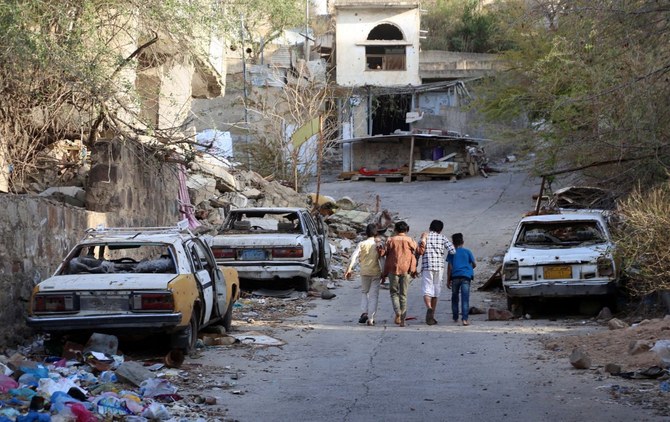

CHICAGO: The UN-brokered truce in Yemen still faces serious challenges but its continuation offers the best hope for a permanent end to the seven-year war in the country, Tim Lenderking, the US special envoy for Yemen, said on Tuesday.
The truce began on April 2 and was renewed on June 2 for another two months. Last week, US President Joe Biden said he was encouraged by the extension. He also thanked the leaders of Yemen, Saudi Arabia, Oman, Jordan and Egypt for their efforts to help restore normal daily life in the country, including the resumption of daily international flights to and from Sanaa, and encourage investment.
But Lenderking said that all parties, including the Houthis and their Iranian backers, must fulfill their commitments under the truce. The Houthis continue to hold hostage a number of Yemenis; 14 people were detained in December, including one who died in custody.
“I was very pleased that Iran welcomed the truce. That was a very good sign,” Lenderking said. “The United States would like to see Iran play a positive role in Yemen. Hitherto, they have not done so. On the contrary, they have fueled the conflict.
“They (Iran) have armed and trained and encouraged the Houthis to fire at civilians targets in their own country and in Saudi Arabia and neighboring countries. They have helped smuggle lethal material into Yemen.
“This is not the direction that Yemen needs to go. Yemen is trying to turn a corner away from a devastating conflict and move toward peace. So let Iran support that effort and that is something we would welcome.”
Lenderking said that the support of the Biden administration “has been indispensable” and, although mostly taking place behind the scenes, it has played a “pivotal role” in building an international consensus to help prevent those who “want to destabilize this conflict” from doing so.
“I think that the president taking the risk of prioritizing the Yemen conflict among others has born fruit and I think the international community has responded very well to United States leadership and diplomatic engagement on this file,” he added.
“I think our engagement with the Saudis, with the government of Oman and with the UAE in particular have been very strong and very impactful.”
He also praised Jordan for the support it has provided and said he remains optimistic about the prospects for lasting peace because of the overall progress made over the past few months, including the continuing truce.
“At the start of the year we saw over 400 attacks from Yemen into Saudi Arabia,” Lenderking said. “We had the January attacks on civilian targets in the UAE. Indeed, things looked very, very dire.
“But a number of factors came into play: I think strong diplomatic engagement, I think the fact that the Houthis were not able to take Marib over the course of a year and a half, despite the tremendous resources that they threw at that particular conflict.
“We have by no means achieved peace. We have not ended this war. We have to use the current momentum to push forward to reach into these other areas: a durable truce, political talks. These are the ways and the channels through which we get an ultimate end of the conflict.”
Lenderking said an important goal is to help Yemen’s government restore and improve basic services and economic stability for the people of the country. He highlighted the humanitarian contribution made by the US, which he said totals “about $4.5 billion over the term of the conflict.”
Another challenge that remains, he added, is the fate of the oil tanker FSO Safer. It has been moored in the Red Sea off the west coast of Yemen since the start of the conflict without maintenance and its condition has deteriorated, raising growing fears of a devastating oil spill. International donors have pledged more than $33 million to fund emergency work by a team of experts to make the vessel safe but officials said much more is needed to avert an environmental crisis that could undermine the peace efforts.
“Let’s use this period of relative calm and confidence-building to get the ticking time bomb which is the Safer tanker, with its 1.1 million barrels of oil, offloaded onto a safer vessel so we can avert an economic and humanitarian and economic disaster in the Red Sea,” Lenderking said, adding that there is concern about the possibility of an explosion.