UAE In-Focus: Nasdaq Dubai welcomes two Sukuk issuances; Airlink and Emirates announce codeshare; First free-zone market

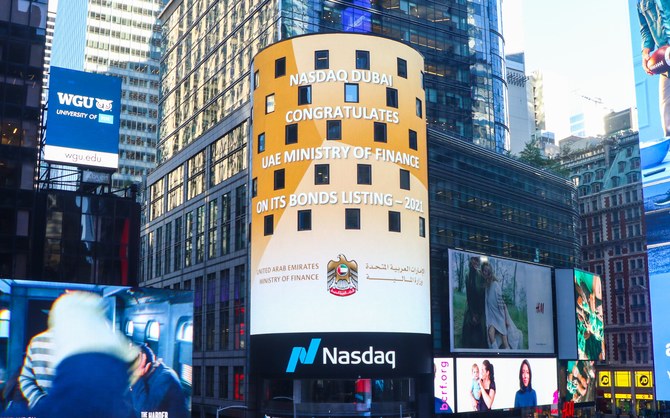
Nasdaq Dubai announced on Monday the listing of two Sukuk issuances by the Government of Indonesia valued at 11.9 billion dirhams ($3.25 billion). (Supplied/File)
Short Url
Updated 07 June 2022
Follow

UAE In-Focus: Nasdaq Dubai welcomes two Sukuk issuances; Airlink and Emirates announce codeshare; First free-zone market

DUBAI: Nasdaq Dubai announced on Monday the listing of two Sukuk issuances by the Government of Indonesia valued at 11.9 billion dirhams ($3.25 billion), according to Emirates News Agency WAM. 

Two tranches consist of 6.4 billion dirhams in five-year Trust Certificates with a 4.40 percent yield and 5.5 billion dirhams in 10-year Trust Certificates with a 4.70 percent yield.

Indonesia’s government has been one of the largest issuers of Sukuk on Nasdaq Dubai, and the new listings increased the total amount of Sukuk listed on Nasdaq Dubai to 80.8 billion dirhams, the statement added. 

Dubai has emerged as one of the largest Sukuk listing centers in the world, with a total listed value of 297 billion dirhams, the statement concluded.

Airlink and Emirates activate codeshare partnership

Emirates and Airlink have officially activated a codeshare agreement, which will provide customers with a single booking reference across eight domestic South African cities. This will be provided via the airline’s gateways in Johannesburg, Cape Town, and Durban. 

Emirates customers can now book additional destinations from Johannesburg, Cape Town and Durban, including eight places from Johannesburg, five other from Cape Town and one point from Durban, according to a press release issued by Dubai Media Office. 

Travelers can book their itineraries on Emirates' website, with travel agents as well as online travel agents, it added. 

Dubai’s first free-zone market to open soon

A free market that will see customs fees waived on goods is set to open in Dubai.

Yiwu, located in Jebel Ali Free Zone, will be the Middle East's first smart free-zone market serving retail and wholesale industries.

The market has been established in partnership with China Commodity City Group and DP World with an investment of 600 million dirhams ($163 million).

As part of the project, goods can be moved directly from the airfield or quayside into storage areas without incurring additional customs fees, according to a press release.

Yiwu Market offers 100 percent foreign ownership, 100 percent foreign repatriation of capital and profits, and no re-export tariffs, it added.

Chief Operating Officer of Parks and Zones at DP World UAE Ahmad Al Haddad said: “Jafza has helped traders maximize opportunities by giving them access to 60 percent of the world’s GDP (gross domestic product) through air, sea, and road transport.”

The services offered are secure payment portals for electronic transactions, inventory management, custom declarations, and hassle-free cargo gate clearance.


Egypt rules out new energy costs as IMF reviews advance 

Updated 10 sec ago
Follow

Egypt rules out new energy costs as IMF reviews advance 

RIYADH: Egypt’s government said it will impose no new burdens on citizens in the energy sector, including petroleum and natural gas, as it moves toward the final year of its economic reform program with the International Monetary Fund. 

Prime Minister Mostafa Madbouly said the targets agreed with the IMF through the end of the program “do not relate to anything that affects the Egyptian citizen,” seeking to counter speculation about additional austerity measures. 

Speaking at the weekly press conference following a cabinet meeting in the New Administrative Capital, Madbouly said the IMF has completed the fifth and sixth reviews of Egypt’s reform program.    

A Facebook post on the official Egyptian Cabinet Presidency page stated: “The Prime Minister explained that the IMF program will end within a year from now, noting that what has been done during the current stage is to follow up on the targets of the fifth and sixth reviews, in addition to agreeing on the targets of the two remaining reviews in the program, the seventh and eighth, which required more effort on the part of the Egyptian government to reach an understanding with the fund on the targets of these two reviews.” 

Madbouly said IMF assessments praised Egypt’s stabilization efforts, citing improved balance-of-payments indicators and a narrowing current-account deficit despite external shocks.  

He pointed to stronger non-oil exports and fiscal performance, including a primary surplus of 3.5 percent of gross domestic product in fiscal year 2024-25, alongside higher tax revenues and monetary policies aimed at easing inflation. 

Such evaluations matter for capital flows, Madbouly said, as foreign investors closely track IMF reporting when making investment decisions. 

He also cited a Moody’s report, saying the rating agency pointed to a sharp decline in inflation to 12.5 percent year on year in October, exchange-rate flexibility, and a clearer reduction in the current account deficit, alongside expectations for stronger growth ahead.  

On external inflows and trade, Madbouly said remittances reached about $34 billion in the first 10 months of the year, compared with $23.7 billion in the same period a year earlier.    

He added that non-oil merchandise exports in 2025 are expected to rise by more than 20 percent versus 2024.    

Tourism remains a core pillar of the government’s growth plan. Madbouly said Egypt received around 18.8 million tourists in 2025, up from about 15 million in 2024, and reiterated a target of 30 million tourists by 2030.    

He said the government aims to expand aviation capacity, including doubling the fleet of EgyptAir and other state-owned carriers within “two or three” years, to align with projected tourism growth.    

Madbouly also pointed to investment activity in the Suez Canal Economic Zone, saying the area recently signed new agreements with investors across multiple sectors with investments exceeding $1.15 billion, with inaugurations of major projects planned for January, including factories linked to solar energy supply chains.    

Finance Minister Ahmed Kouchouk said IMF negotiations were “very positive” and reflect “good financial results and the underlying potential of the Egyptian economy.”   

He said efforts to broaden the tax base lifted revenues by 35 percent “without any additional burdens on the business community,” while the government prioritizes reducing public debt and expanding targeted social spending, including higher allocations for health, education and cash support.