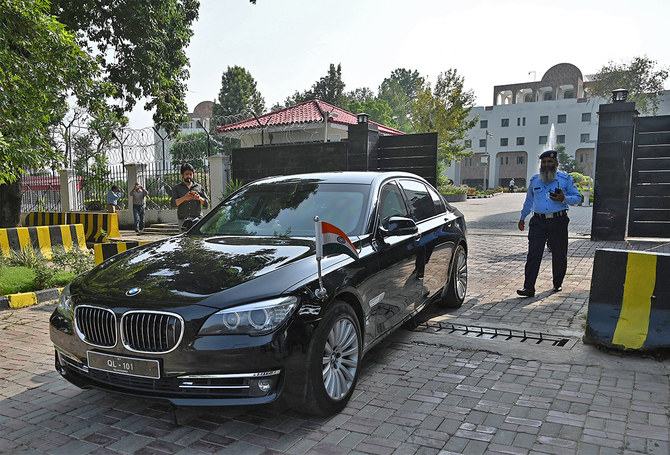

ISLAMABAD: Pakistan on Monday issued a demarche to the Indian charge d’affaires over “derogatory remarks” against Prophet Muhammad (Peace Be Upon Him) by two officials of Prime Minister Narendra Modi’s party, the Pakistani foreign office said, amid uproar in the Muslim world over the issue.
Nupur Sharma, a spokeswoman for the Bharatiya Janata Party (BJP) party, made the remarks during a TV debate about Prophet Muhammad (PBUH). Another BJP spokesman, Naveen Jindal, made similar comments on social media.
After a backlash from Muslim nations on Sunday, the BJP said it had suspended Sharma and expelled Jindal from the party, denouncing “insult of any religious personalities of any religion.”
“The Indian Charge d’ Affaires was summoned to the Ministry of Foreign Affairs and conveyed the Government of Pakistan’s categorical rejection and strong condemnation of the highly derogatory remarks made by two senior officials of India’s ruling party BJP about the Holy Prophet Muhammad (PBUH),” the Pakistani foreign office said in a statement.
“He was told that these remarks are totally unacceptable and have not only deeply hurt the sentiments of the people of Pakistan but of Muslims across the world.”
The Indian diplomat was that told the “belated” and “perfunctory” disciplinary actions taken by the BJP government could not assuage the pain caused to the Muslims, the foreign office said.
“Pakistan strongly urges the BJP leadership and the government of India to unequivocally condemn the sacrilegious comments of the BJP officials and ensure that they are held accountable through decisive and demonstrable action against them for attacking the dignity of the Holy Prophet (PBUH),” it said.
Pakistan’s President Arif Alvi and Prime Minister Shehbaz Sharif also condemned the “hurtful” comments by BJP officials.
“The derogatory and controversial remarks have hurt the feelings of all Muslims around the world,” President Alvi said on Twitter.
PM Sharif said India, under Modi’s leadership, was “trampling religious freedoms and persecuting Muslims.” He asked the world to take note of it reprimand New Delhi.
The Pakistani military also condemned the insulting remarks by Indian officials. “The outrageous act is deeply hurtful and clearly indicates extreme level of hate against Muslims and other religions in India,” it said in a statement.
At least five Gulf nations have lodged official protests against India over the comments.
Saudi Arabia and Iran lodged complaints with India, and the Jeddah-based Organization of Islamic Cooperation (OIC) said the remarks came in a “context of intensifying hatred and abuse toward Islam in India and systematic practices against Muslims.”
Riyadh said the comments were “insulting” and called for “respect for beliefs and religions.”
Qatar’s Foreign Ministry said it expected a “public apology” from the Indian government and Kuwait warned that if the comments go unpunished, India would see “an increase of extremism and hatred.”
The Grand Mufti of the Sultanate of Oman described the “obscene rudeness” of Modi’s party toward Islam as a form of “war.”
New Delhi has made no comment so far over protests lodged by Muslim nations.
Anti-Muslim sentiments and attacks have risen across India under Modi. Last week, US Secretary of State Antony Blinken said India was seeing “rising attacks on people and places of worship,” eliciting a response from New Delhi which called the comments “ill-informed.”
Anger has poured out on social media, and calls for a boycott of Indian goods have surfaced in some Arab nations too.
The controversial remarks follow increasing violence targeting India’s Muslim minority carried out by Hindu nationalists who have been emboldened by Modi’s regular silence about such attacks since he was first elected in 2014.
Over the years, Indian Muslims have often been targeted for everything from their food and clothing style to inter-religious marriages. Watchdog groups such as Human Rights Watch and Amnesty International have warned that attacks could escalate.
Rights groups have also accused Modi’s ruling party of looking the other way and sometimes enabling hate speech against Muslims, who are 14 percent of India’s 1.4 billion people but still numerous enough to be the second-largest Muslim population of any nation.
Modi’s party denies the accusations, but India’s Muslims say attacks against them and their faith have become relentless.