

Pakistan’s defense budget expected to increase by six percent amid rising inflation — media

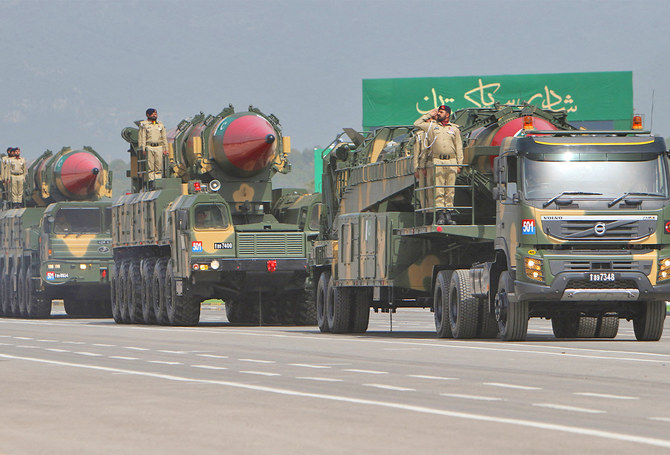
Pakistan's military vehicles carry long-range ballistic missiles Shaheen during the Pakistan Day parade in Islamabad on March 23, 2022. (AFP)
Short Url
Updated 05 June 2022
Follow

Pakistan’s defense budget expected to increase by six percent amid rising inflation — media

  • Despite a likely increase of Rs1.37 trillion, armed forces are expected to get Rs53 billion less in real terms
  • Pakistan’s per soldier spending of about Rs2.65 million is not even one-third of India’s usual allocation

ISLAMABAD: Pakistan is likely to allocate Rs1.453 trillion to its armed forces in the next federal budget, reported the local media on Sunday, indicating about six percent increase which still does not completely account for the average inflationary pressure of 11.3 percent in the national economy.

The government is scheduled to present the next annual budget on Friday, June 10, as its forex reserves have sharply declined to $9.7 billion amid a widening current account deficit and double-digit inflation.

Pakistan is striving for a staff-level agreement with the International Monetary Fund (IMF) for the resumption of a loan program amounting to $6 billion since it desperately needs external finances.

As the government finalizes details of the next federal budget, the country’s defense spending has also come under scrutiny under the prevailing economic context.

“The armed forces are likely to be allocated Rs1.453 trillion in the budget for the next fiscal year, which would be about Rs83 billion higher than the outgoing year’s allocation of Rs 1.37tr, an increase of almost six percent,” reported Dawn newspaper after talking to defense sources.

“This year a Rs136bn raise was expected after taking into account an average of 11.3pc inflation for the outgoing year,” it added. “Therefore, in number terms, the armed forces would be getting about Rs53bn less than what they say was needed for coping with inflation.”

Much like the outgoing year, the newspaper informed, the defense budget was likely to be about 16 percent of the total outlay, though the share was expected to go down in GDP terms from 2.54 to 2.2 percent in the next fiscal year.
Dawn said that Pakistan’s per soldier spending stood at about Rs2.65 million per annum which was “not even one-third of what India spends.”

The report also noted that the armed forces and their welfare entities paid Rs935 billion in taxes in the outgoing fiscal year, adding that the army saved and returned Rs500 million to the government from COVID-19 allocation and $16.9 million against procurements.


Pakistan says defense pact with Saudi Arabia elevated brotherly ties to ‘new heights’

Updated 25 February 2026
Follow

Pakistan says defense pact with Saudi Arabia elevated brotherly ties to ‘new heights’

  • Pakistan, Saudi Arabia signed strategic defense pact last year pledging aggression against one will be treated as attack on both
  • Deputy PM Ishaq Dar says enduring bonds with Islamic and Arab nations form vital pillar of Pakistan’s foreign policy 

ISLAMABAD: Deputy Prime Minister Ishaq Dar said on Wednesday that Pakistan’s defense pact with Saudi Arabia elevated its brotherly ties with the Kingdom to “new heights,” stressing that close ties with Arab and Islamic nations form a key pillar of Islamabad’s foreign policy. 

Pakistan and Saudi Arabia signed a Strategic Mutual Defense Agreement on Sept. 17 last year, pledging that aggression against one country would be treated as an attack on both, enhancing joint deterrence and formalizing decades of military and security cooperation.

Both nations agreed in October 2025 to launch an economic cooperation framework to strengthen trade and investment ties. 

“In the Middle East, our landmark Strategic Mutual Defense Agreement with Saudi Arabia has elevated our brotherly ties to new heights,” Dar said while speaking at the Pakistan Governance Forum 2026 event in Islamabad. 

The Pakistani deputy prime minister was speaking on the topic “Navigating International Relations Amidst Changing Geo-Politics.”

Dar noted that Pakistan has reinforced partnerships with other Middle Eastern nations such as the UAE, Qatar, Jordan, Oman, Egypt and Bahrain. He said these partnerships have yielded “concrete agreements” in investment, agriculture, infrastructure, and energy sectors. 

“Our enduring bonds with Islamic and Arab nations form a vital pillar of our foreign policy, and we will continue to expand our partnerships across Asia, Latin America, and Africa,” he said. 

Dar pointed out that the presidents of Kazakhstan, Uzbekistan and Kyrgyzstan have undertaken visits to Pakistan in recent months, reflecting Central Asian nations’ desire to boost cooperation with Islamabad.

On South Asia, the Pakistani deputy PM said Pakistan has successfully transformed its fraternal ties with Bangladesh into “a substantive partnership.”

“Similarly, the trilateral mechanism involving China, Pakistan, and Bangladesh has been launched with a view to expanding and deepening regional cooperation and synergy,” the Pakistani minister said. 

He said Islamabad has strengthened its “all-weather” partnership with China via the second phase of the multi-billion-dollar China-Pakistan Economic Corridor agreement and “unwavering support” from both sides for each other’s core interests. 

Dar said Pakistan had also reinvigorated its partnership with the US, advancing cooperation in trade, technology, investment, and regional stability. 

“This calibrated approach has enhanced our ability to navigate complexity with skill and confidence, ensuring that our national interests are served without compromising our core foreign policy principles,” he said.